


Pull open the drawer of a $600 dresser at a big-box store. Look at the corner joint.
Staples. Maybe a dab of glue. The “wood grain” is a photograph laminated onto compressed sawdust.
Now pull the drawer on a $60 dresser at your local thrift store. Interlocking trapezoid dovetails, cut into solid oak, still tight after eighty years.
That gap — between what old furniture was and what new furniture pretends to be — is the entire reason this list exists. Some categories have collapsed so badly that buying new is throwing money into a landfill on a five-year delay.
Here are 32 pieces of furniture that are almost always better bought used, and what to look for on each one.
1. Solid-Wood Chest of Drawers

This is the one that converts people.
American case goods built before roughly 1970 were made from solid oak, maple, walnut, or mahogany. Drawers ran on wooden runners, sat in dovetailed boxes, and had thin dust panels separating each level so dirt from the drawer above didn’t sift onto your sweaters.
Compare that to a new dresser at the same price point. Particleboard carcass, stapled butt joints, drawer bottoms of 1/8-inch hardboard that bow under folded jeans.
The three-second test: pull one drawer out and look at the front corner. If you see interlocking wedge shapes, the piece was built by someone who expected it to outlive them. Hand-cut dovetails are slightly uneven in spacing; machine-cut ones from after about 1870 are perfectly uniform. Either is good news. Standpipe Antiques has a useful breakdown of how the joint styles date a piece.
Now the part nobody wants to hear. Vintage dressers predate modern stability requirements entirely.
In 2023 the Consumer Product Safety Commission adopted the STURDY final rule, which requires new clothing storage units to stay upright under simulated real-world conditions — a child climbing, carpet underfoot, drawers loaded and open. Your 1948 walnut highboy was never tested against anything.
So anchor it. Not with the flimsy nylon strap that came in a drawer pull kit — use a steel anti-tip bracket kit with lag screws driven into a stud, not drywall anchors. Two brackets, one at each top corner of the case back. Ten minutes, about $15.
One more caution. If the dresser is painted and predates 1978, treat that paint as suspect. The EPA flags old painted furniture as a household lead source, and sanding it dry is the worst thing you can do. Test first, strip chemically or leave it sealed under a fresh topcoat.
Anchored and checked, a solid dresser is the best furniture value in America.
2. Extension Dining Table With Leaves

An $800 new dining table is usually a paper-thin veneer over MDF. Spill a glass of water, forget about it for an hour, and the edge swells like a sponge — permanently.
Solid hardwood tables from the 1920s through the 1970s came with their leaves, and the mechanisms were steel. A scratched top isn’t damage. It’s a Saturday with a sander.
Look under the apron for solid lumber edges rather than a taped veneer seam. Then check that the leaves are actually there — a table missing its leaves loses half its value and all of its usefulness.
3. Leather Wingback or Club Chair

“Genuine leather” on an affordable new chair usually means bonded leather: ground leather scrap mixed with polyurethane and glued to a fabric backing.
It peels. Not cracks — peels, in sheets, off the seat and arms, typically inside five years.
Top-grain leather from the 1930s through the 1980s does the opposite. It darkens, softens, and develops exactly the patina that design showrooms charge a premium to fake.
Press your thumbnail into an inconspicuous spot. Real leather dents and recovers. Bonded leather feels like a mousepad.
4. China Cabinet or Dining Hutch

Nothing on this list has crashed harder in price.
Formal dining rooms went out of fashion, and with them went demand for glass-front mahogany and cherry cabinets that cost $2,000–$4,000 new. They now go for $50 to $150 constantly. Plenty get listed free by families cleaning out an estate on a deadline.
Everybody’s grandmother had one. The good ones have adjustable wooden shelves, real plate glass, and interior lighting that still works.
Strip the top hutch off, put it on the floor, and you’ve got a bookcase.
5. Brass-and-Glass Bar Cart

New bar carts are hollow tube steel with a brass-tone coating that rubs through at the handle within a year. The casters wobble under two bottles of bourbon.
Mid-century carts were solid brass or heavy chrome with real glass shelves and casters rated for a full tea service.
Tarnished brass looks hopeless and isn’t. Bar Keeper’s Friend and a rag brings it back in twenty minutes.
6. A Matched Set of Wooden Dining Chairs

Pre-1980 chairs were built with mortise-and-tenon joints and glued corner blocks under the seat.
Budget chairs today use dowels and glue. Dowels have almost no glue surface and no mechanical lock, which is why new chairs start racking and creaking after two Thanksgivings.
Here’s the part that matters: a wobbly vintage chair is a repair, not a loss. Knock the joints apart, scrape the old hide glue, re-glue, clamp overnight. A failed dowel chair is kindling.
| Pre-1980 Vintage | Budget New | |
|---|---|---|
| Joinery | Mortise and tenon | Dowels and glue |
| Seat support | Glued corner blocks | Staples or nothing |
| Wood | Oak, maple, walnut | Rubberwood, veneer |
| When loose | Re-glue and clamp | Replace entirely |
Buy the set of six even if two need work. You’ll still be under the cost of one new chair.
7. Cedar Hope Chest

Aromatic red cedar chests are one of the most abundant items in the entire secondhand market. Lane alone produced them from 1912 until 1987, and they turn up at every estate sale in the country.
But this entry comes with a genuine safety obligation, and it needs stating plainly.
Lane and Virginia Maid chests built between 1912 and 1987 used a lid latch that locks automatically when the lid closes — and can’t be opened from inside. The CPSC has connected 14 child suffocation deaths to these chests between 1977 and 2015. Roughly 12 million were recalled.
The remedy is free. Lane’s successor company has supplied replacement latches at no cost for decades, a program TODAY has covered repeatedly as the chests keep circulating through thrift stores.
Before any cedar chest comes into a house with children, do this: open the lid and look at the latch. If closing it engages a lock that requires a key or an outside button to release, remove the lock hardware entirely. Unscrew it, fill the holes, done. The chest works fine as a blanket box with no latch at all.
Inside, the cedar should smell strongly when you scratch it with sandpaper. Never finish the interior — the raw aromatic oils are the entire point.
8. Steel Tanker Desk

Steelcase, All-Steel, and Shaw-Walker built these for government and insurance offices that expected forty years of daily use.
They weigh 250 to 350 pounds. Drawers run on full-suspension ball-bearing slides that still glide. Nothing manufactured today at any price point compares.
The old linoleum tops are often scarred. Pull it off and drop a maple butcher block slab on the steel frame — the single best-looking desk-per-dollar move there is.
Bring help. Seriously.
9. Solid-Wood or Barrister Bookcase

Laminate bookcases visibly bow under one shelf of hardbacks. Not eventually — within a year.
Quartersawn oak and walnut cases don’t, because solid wood has real stiffness across a 36-inch span and particleboard has almost none.
Stacking barrister sections with the hinged glass fronts are the collector’s favorite, and they still show up for less than a flat-pack unit from a big-box store. Each section is independent, so you buy three now and two more next year.
10. Mid-Century Credenza or Sideboard

This is the category where thrifting crosses over into investing.
Danish teak and American walnut credenzas from the 1950s through the 1970s have climbed steadily in value for two decades. The “mid-century inspired” version at a chain store is veneer over MDF with hairpin legs bolted into compressed sawdust.
Open a drawer and look at the sides. Solid oak or birch drawer boxes mean the real thing. Stapled particleboard means someone slapped a tapered leg on a modern cabinet and raised the price.
Check the veneer edges for lifting before you commit. That’s the one repair that gets fussy.
11. Rocking Chair

A rocker takes more racking stress than any other seat in a house. Every rock cycles the joints.
Which is why the Windsor, Boston, and pressed-back rockers from the 1880s through the 1950s are still going — steam-bent parts, wedged through-tenons, no reliance on glue alone.
New rockers are commonly rubberwood held together with dowels. Put an adult in one for a few hundred hours of evening rocking and the joints open up.
Test it by sitting and twisting. A sound old rocker feels like one solid object.
12. An Upholstered Sofa Worth Reupholstering

The frame is the part you cannot fake or fix later.
Sofas built before roughly 1990 commonly used kiln-dried hardwood frames with doweled and corner-blocked joints, riding on eight-way hand-tied coil suspension. Cheap new sofas use engineered-wood frames, stapled, over a drop-in coil unit that starts dipping in the middle inside two years. Houzz has a good rundown of what separates the two if you want the construction details before you shop.
Buy the bones. Budget $600 to $1,500 for new foam, webbing, and fabric on a good frame — and you end up with a better sofa than a $3,000 new one.
Now the inspection, because upholstery is the one category where a bad buy brings a real problem into your house.
Bring a flashlight and a credit card. Work the card along the welted seams and under the piping — you’re looking for anything that reads as rust-colored specks, pepper-like dark flecks, or pale shed skins. Pull the cushions completely out and check the deck corners and the seam where the arm meets the back. Then tip the sofa and inspect the underside of the dust cover and the frame corners, which is where bed bugs actually prefer to sit.
Oklahoma State University Extension publishes a short, practical guide to reducing risk while thrift shopping that’s worth reading before you go looking for upholstery.
Also trust your nose. Musty means the piece sat in a damp basement, and mildew in foam and webbing is not something a cleaning fixes. Walk away from mildew, cat urine, and smoke — all three live in the frame itself.
Everything gets reupholstered anyway, so torn fabric is irrelevant. Bugs and mold are not.
13. A Pair of Nightstands

Nightstands are the orphans of broken-up bedroom suites. Someone sells the dresser, someone else buys the bed, and the little tables sit unwanted.
That means solid wood pairs with dovetailed drawers routinely cost less than a new particleboard pair from a flat-pack retailer.
Two mismatched vintage stands painted the same color read as deliberate, not thrifty. Nobody can tell, and the drawers actually work.
14. Maple Butcher Block Table or Kitchen Cart

End-grain maple block is one of the most expensive items in any kitchen catalog. A commercial block from the early 1900s or a 1970s home-revival cart costs a fraction of that used.
The surface will look wrecked. It isn’t.
Belt sander with 80 grit, then a card scraper, then 120, then mineral oil until it stops absorbing. The knife scars that remain are the reason to want it.
15. Rattan, Wicker, or Bentwood Chair
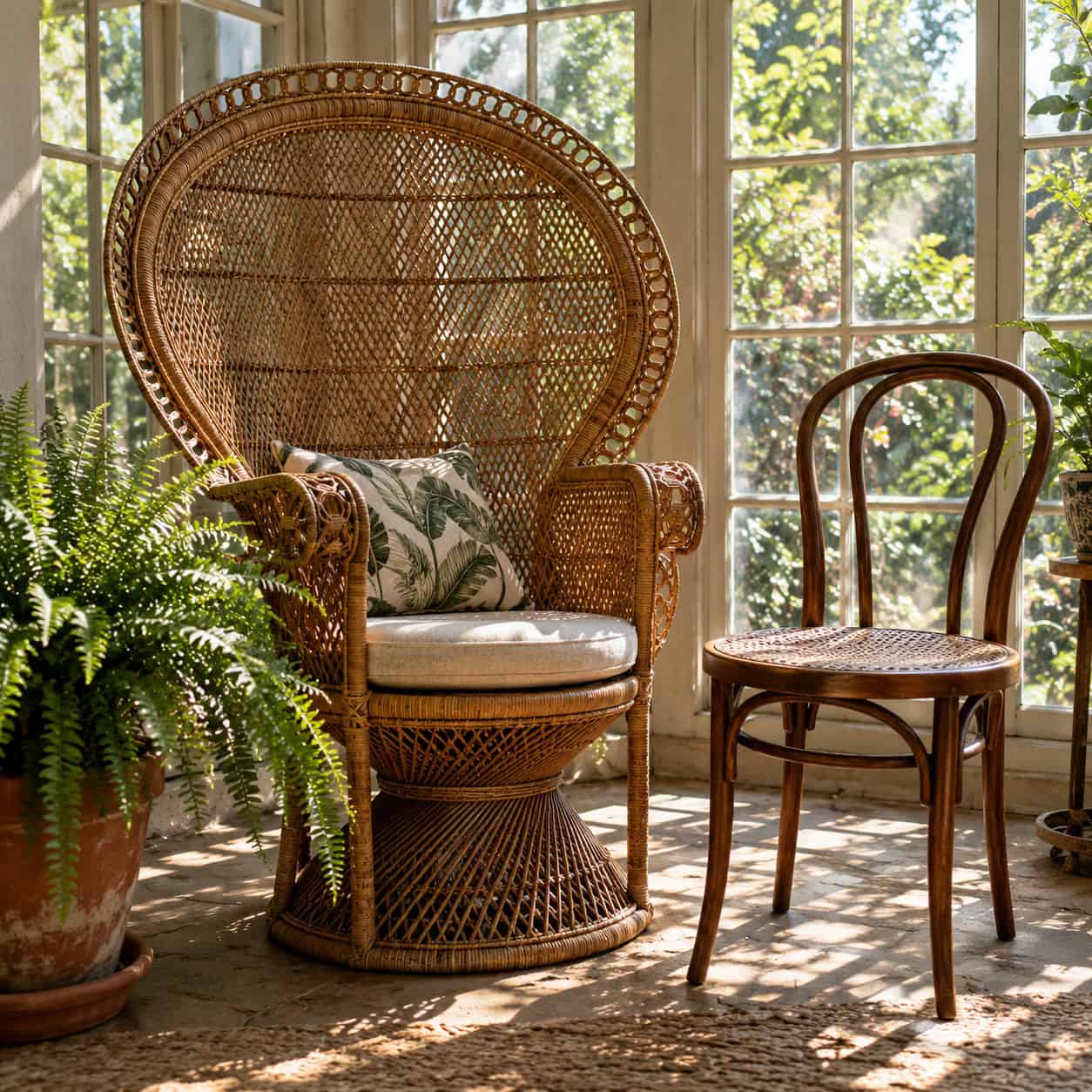
Real rattan and cane is hand-wrapped over a solid frame, and a blown-out cane seat can be re-caned by any number of restorers for less than the chair is worth.
Modern outdoor “wicker” is extruded resin. UV makes it brittle, then it cracks, then the strands unravel and there’s nothing to repair.
Peacock chairs, Ficks Reed loungers, and bentwood bistro chairs turn up constantly. Keep any of it out of direct weather and it’ll last decades.
16. Coffee Table

The most abundant piece of furniture in every thrift store in America.
It’s also the safest first refinishing project you can pick, because the whole top gets sanded regardless. Scratches, water rings, cigarette burns — all irrelevant. If you’re unsure how far to take the sanding before staining, this rundown on what grit to use on furniture will keep you from going too fine too fast.
Expect to pay $10 to $30. Expect to spend a weekend. Expect people to ask where you bought it.
17. Secretary or Drop-Front Desk

Small cubbies, tiny drawers, a fold-down writing surface, and a footprint that tucks into a hallway.
Nobody builds these properly anymore. When a manufacturer tries, it’s veneer over MDF and it costs four figures.
The Colonial Revival versions from roughly 1900 to 1960 show up at $100–$250 and solve small-space living better than any modern desk. Close the front and the mess disappears.
18. Solid-Wood Bed Frame and Headboard

New platform beds are laminated particleboard held together with cam-lock hardware. Those cams strip out of engineered wood after two moves and there’s no fixing them.
Vintage hardwood frames use bolt-on rails with hook plates or through-bolts. You can tighten those forever.
One hard exception on this entry: buy the mattress new. Never used, no matter the price. That’s the bed bug vector, and unlike a wood frame, a mattress can’t be inspected properly.
Watch the sizing too. Antique three-quarter beds measure 48 inches wide, and no modern mattress fits them without a custom order.
19. Teak Outdoor Furniture

Teak’s natural oils make it rot-resistant without any finish at all. A weathered-gray Danish or Indonesian set from the 1960s through the 1990s is almost always structurally fine under the color.
Scrub it with a stiff brush and a teak cleaner, sand lightly, and it comes back to honey.
Compare that to a new big-box patio set: powder-coated tube steel that rusts through at the welds by the third season, because that’s exactly where the coating is thinnest.
20. Large Beveled or Mantel Mirror

Victorian through 1940s mirrors used real beveled plate glass — the bevel is ground, not printed — set into carved or gilded wood frames.
A new statement mirror at the same size is an MDF frame with flat glass and a price in the hundreds.
Even the desilvered ones with the cloudy speckling sell as a deliberate look now. That antique foxing is being reproduced on purpose.
21. Steel or Oak Filing Cabinet

Vintage steel file cabinets used thick-gauge steel with counterweighted anti-tip interlocks that prevent more than one drawer opening at a time. New budget cabinets are thin sheet metal that dents if you lean on them.
The 1900s oak card-file cabinets are the prize. Quartersawn oak, brass pulls, and they work as nightstands, printer stands, or bedside towers with zero explanation needed.
Run every drawer before you buy. Bent slides are the one fault worth walking from.
22. Hoosier Cabinet or Enamel-Top Kitchen Table

The original kitchen island, and better designed than most built today.
A proper Hoosier from 1900 to 1930 has a tin-lined flour bin with a built-in sifter, a sugar bin, a pull-out porcelain-enamel work surface that slides away when you’re done, and spice racks in the doors.
Nothing new replicates any of it.
The matching enamel-top tables — white with red or green trim and a drawer at the end — are one of the strongest memory triggers in this entire category. They’re also nearly indestructible. Same family as the rest of the forgotten kitchen features worth bringing back.
23. Ergonomic Office Task Chair

The cleanest dollars-and-cents case on this list.
Office liquidators and used-furniture dealers sell refurbished Herman Miller Aerons and Steelcase Leaps for a third to half of new — often $300 to $500 against $1,200 to $1,800 retail.
Better yet, both were designed for parts replacement. Cylinders, arm pads, casters, and mesh are all available, so a repair is a $40 decision rather than a new chair.
A $200 new task chair is foam over a nylon shell. It bottoms out in 18 months and there’s no part to order.
24. Stereo Console or Record Cabinet

Long, low, walnut-veneered, and built like furniture — because Magnavox, Zenith, and Fisher were selling it as furniture first and electronics second.
Working units with functioning tube amplifiers command real money now. Dead ones get hauled away for free.
Gut the guts, add a shelf, and you have a media console or a bar at the cost of the gas to go get it. The cabinet was always the expensive part.
25. Armoire or Wardrobe

Two separate gold mines sit in this category.
The first is true antique wardrobes — Victorian knockdown models that disassemble into flat panels with pin hinges, specifically so two people could move them up a staircase. Try that with a modern wardrobe.
The second is 1990s TV armoires. Televisions hang on walls now, so these are frequently free on the curb, and many of them are solid cherry or oak.
Pull the TV shelf, add pull-out trays, and you’ve got a pantry, a craft station, or a home office that closes behind two doors at 5 p.m.
26. Library Card Catalog or Apothecary Chest

Dozens of small dovetailed drawers with brass label holders and finger pulls.
No modern manufacturer builds these, and the reason is simple arithmetic: 60 dovetailed drawers is more joinery labor than an entire bedroom set.
Library deaccession sales and closing pharmacies are the real hunting grounds — not thrift stores. Watch for university surplus auctions too, where a card catalog occasionally goes for under $200 because nobody in the room has a truck.
27. Waterfall Vanity or Dressing Table

Art Deco waterfall bedroom sets from the 1930s and 1940s are gorgeous and cheap, and they’re cheap for one reason: the veneer scares people off.
Those rounded “waterfall” edges are book-matched veneer bent over a curved core. Cleaned and waxed, with the original bakelite pulls and trifold mirror intact, a waterfall vanity is a showpiece.
But this entry needs a real warning, because waterfall pieces are exactly the vintage furniture most likely to have been painted at some point.
Assume any painted finish from before 1978 contains lead. The Minnesota Department of Health lists old painted furniture among the common vintage lead sources in a home, and old furniture paint often tested far higher than wall paint did.
Never dry-sand it. Sanding lead paint creates fine dust that settles into carpet and floor cracks and stays there for years.
Test first with a $10 swab kit from the hardware store. If it’s positive, your options are a chemical stripper used outdoors with the debris bagged, or simply sealing the existing paint under a fresh coat and leaving it alone. If the piece will live in a child’s room, seal it or skip it.
Unpainted, original-finish waterfall pieces sidestep all of this. Look for those first.
28. Hall Tree or Entry Bench

Hooks, a mirror, an umbrella stand, and a lift-lid storage seat — all cut from one slab of quartersawn oak with visible ray fleck.
The 1890s through 1930s oak and Mission versions were built for houses where every person owned a heavy wool coat and one wet hat.
New entryway benches are laminate boxes with plastic hooks screwed into a thin back panel. Hang one soaked winter coat and watch the hook come out with the screw still in it.
29. Machinist’s Tool Chest or Shop Workbench

Gerstner-style oak machinist chests have felt-lined drawers, a piano-hinged lid, and a fit-and-finish that new tool storage can’t touch at the same price.
Maple-top benches with tail vises are the same story. A bench with 80 years of dents is already flattened, already seasoned, already yours.
Check the top for a real laminated maple slab rather than a plywood facing, and put a straightedge across it. Some cupping is normal and plane-able. A twist is a bigger job — worth knowing about the right working height before you commit to cutting the legs down.
30. Church Pew or Meetinghouse Bench

Quartersawn oak, worn smooth by a century of hands on the same spot at the end of the armrest.
Congregations are consolidating and renovating, and pews are coming out by the truckload. A ten-foot section often sells for $100 to $300, sometimes less if you can haul it the day of the sale.
Cut down to six feet, it fits a mudroom. At full length, it seats four along one side of a dining table.
It’s one of the very few pieces of furniture you can buy that arrives already carrying somebody else’s history.
31. Drafting Table or Drafting Stool

Hamilton and Mayline built these with cast-iron bases and thick maple tops, tilting and height-adjustable through crank mechanisms that still turn.
Flatten the top, set it level, and it’s a desk nobody else has.
The catch is size — most are 37 by 60 inches or larger, which rules out small rooms. Measure the doorway before you buy.
32. Wooden Bar Stools

Solid maple and oak stools from the 1940s through the 1970s used the same mortise-and-tenon joinery as good dining chairs, plus a stretcher ring low on the legs that triangulates the whole structure.
New stools in the $60 range are rubberwood with dowels and a single bolt through the seat. They loosen fast, and a loose bar stool at counter height is a genuine hazard.
Buy vintage, retighten once a year, hand them down.
The pattern across all 32 is the same: labor got expensive, materials got engineered, and the furniture industry solved both problems by making things that look right for about five years.
Meanwhile the stuff that was built when labor was cheap and plywood was new is sitting in a thrift store at a fraction of its replacement cost. You’re not buying secondhand. You’re buying a quality grade that isn’t manufactured anymore at any price.
Take a flashlight, pull a drawer, and look at the corner. The furniture will tell you everything in three seconds.