

In 1945, the war ended and the country came home to nowhere to live.
Twelve million servicemen mustered out in a span of months. They wanted wives, jobs, and a front door of their own. What they found was a housing shortage so severe that families doubled up in attics, parked trailers in relatives’ driveways, and rented converted chicken coops at city prices.
So America built. Fast, cheap, and small. The 1945 house wasn’t the long, low ranch you picture when you think of the suburbs. That came later. The 1945 house was a holdover and an experiment at the same time — a Depression-era cottage trying to stretch into a new decade, or a wartime invention pressed into peacetime use.
It was tiny. Often under 800 square feet. One bath if you were lucky. Built from whatever materials weren’t still rationed, on a slab or a shallow footing, with a coal stove or an oil burner in the basement.
Drive an old streetcar suburb today and the bones are still there, hiding under vinyl siding and a 1990s addition. But the originals — the smallness, the make-do materials, the wartime weirdness — got renovated away or bulldozed.
Here are 23 house styles that were everywhere in 1945. And the reasons you almost never see new ones going up today.
1. The Minimal Traditional

This was the house of the 1940s. Plain, gabled, boxy, with narrow eaves and a front door shoved off to one side.
It looked like a cottage that had been stripped for parts. All the porches, brackets, and gingerbread of the 1920s bungalow were gone, shaved off because nobody had money for ornament during the Depression and nobody had materials during the war.
It kept the comforting shape and dropped everything else.
By the early 1950s the ranch buried it. Buyers wanted long and low and modern, not small and upright and old-fashioned. Nobody builds a new one because the whole point of the style was doing without — and doing without went out of style the moment the country could afford to stop.
2. The Quonset Hut Home

A half-cylinder of corrugated steel, sitting on a concrete pad like a giant tin can cut lengthwise.
The Navy churned out roughly 170,000 of them during the war for barracks and storage. When peace came, surplus huts got sold off cheap to veterans who had nowhere else to live. A family could buy one for a few hundred dollars and bolt it together in a weekend.
Inside, it was one curved room you divided with curtains. Hot in summer, cold in winter, loud in the rain.
Colleges used them as married-student housing. Some are still standing as garages and feed stores. Nobody builds a home out of one now — but for a few desperate years, a corrugated tube beat sleeping in the car.
3. The Cape Cod

A small, steep-roofed box with a centered door, a window on each side, and maybe a pair of dormers poking out of the roof.
The style was 200 years old by 1945, but it was perfect for the moment. Cheap to frame, easy to heat, expandable into the attic when the third kid arrived.
The Levitts would soon mass-produce it by the thousands.
A typical postwar Cape ran 24 by 32 feet. Two bedrooms down, two stuffed under the roof, one bath, one kitchen you couldn’t fit a table in. The shape still gets built in New England as a nostalgia piece, but the 800-square-foot price-point version is gone for good.
4. The Bungalow

Low, wide, and friendly, with a deep front porch under the main roofline and tapered columns sitting on brick piers.
The bungalow had ruled American building from 1900 to 1930, and in 1945 those neighborhoods were still the heart of every city. Built-in bookcases, a brick fireplace, leaded-glass cabinets, and craftsmanship that came standard.
By 1945 almost nobody was building new ones.
The deep porch and the hand-fitted interior woodwork cost real money and real labor, and the postwar builder had neither to spare. The originals are some of the most beloved old homes in America. New construction skipped the porch and never looked back.
5. The Sears Kit House (Last of Them)

For decades you could order an entire house from the Sears catalog. It arrived by boxcar — 30,000 numbered pieces, a stack of lumber, a barrel of nails, and a leather-bound instruction book.
Sears sold its last kit home in 1940, so by 1945 the catalog house was already a memory. But hundreds of thousands of them stood in neighborhoods coast to coast, and families were still moving into them.
They were shockingly well built. Old-growth lumber, real plaster, oak floors.
You can still find them, and owners hunt for the stamped lumber and the shipping labels in the attic to prove what they have. Nobody mails you a house anymore. The closest modern echo is a flat-pack that fits in a moving truck, not a boxcar.
6. The Foursquare

A big, plain, boxy two-story with a low hipped roof, a central dormer, and a full-width front porch. Four rooms down, four rooms up. That’s the whole idea, and it’s where the name comes from.
The Foursquare maximized space on a narrow city lot, which made it the workhorse of the streetcar suburb from 1900 to 1930.
By 1945 it read as old-fashioned and heavy.
The boxy two-story shape needed two full floors of framing and a real porch, and the postwar buyer wanted a cheaper single story sprawled across a wider lot. The Foursquare aged into a beloved classic. The new builder went horizontal.
7. The Tudor Revival Cottage

Steep gables, decorative half-timbering, a round-arched front door, and a tall narrow chimney made to look like an English country cottage.
Tudors were the prestige house of the 1920s and 1930s, and the smaller “storybook” versions dressed up modest cottages with the same romantic trim. In 1945 they still lined the nicer prewar streets.
The half-timbering was the problem.
It’s decorative woodwork applied to the face of the house, fussy to build and a nightmare to maintain through decades of weather. Production builders dropped it instantly. The originals survive in older neighborhoods, charming and high-maintenance in equal measure.
8. The Lustron and Other All-Steel Houses

Right after the war, a few companies bet the future of housing on steel. The Lustron was a one-story home made of porcelain-enameled steel panels — the same finish as a bathtub — bolted together from thousands of factory parts.
You cleaned the exterior with a garden hose. The walls came in surf blue, dove gray, and maize yellow. A built-in combination washer-dishwasher and radiant ceiling heat came standard.
Production didn’t ramp up until 1948, but the idea was born in the 1945 housing panic.
The company went bankrupt by 1950. The houses are nearly indestructible, and the few thousand that exist are protected and collected. Nobody builds a steel house you hose down anymore — but for a moment it looked like the answer.
9. The Trailer Coach Home

Not a vacation camper. A place to actually live, parked on a lot because there was no house to be had.
Wartime defense plants drew workers faster than housing could be built, so the government and private makers cranked out small towable coaches by the tens of thousands. After the war, veterans kept living in them while they saved for something permanent.
Eight feet wide, maybe twenty long. A bed, a stove, a fold-down table.
These tin boxes were the seed of the entire mobile-home industry. The postwar trailer court was a step on the ladder, not a punchline. Plenty of families bought their first real house with money saved while living in one.
10. The Prefab Panelized House

Walls, floors, and roof sections built flat in a factory, trucked to the lot, and craned into place in a day or two.
The housing shortage made prefab a national obsession in 1945. Companies like Gunnison and National Homes promised a finished house in a fraction of the time of stick-building, and magazines breathlessly covered every new system.
Most of the early systems flopped.
Banks wouldn’t lend on them, unions fought them, and buyers distrusted a house that came off a truck. The idea never died — modular building still exists — but the dream of a fully factory-made American home stalled out before it ever replaced the framing crew.
11. The Shotgun House

One room wide, three or four rooms deep, with every door lined up so you could fire a shotgun through the front and out the back without hitting a wall. That’s the story behind the name, anyway.
Shotguns packed Southern cities and mill towns, cheap to build on a skinny lot and easy to ventilate before air conditioning. In 1945 whole blocks of them stood near every factory and rail yard.
No hallways. You walked through every room to reach the last one.
Urban renewal flattened thousands of them in the 1960s. The survivors get restored and adored now, but the narrow no-hallway layout fights everything a modern buyer wants.
12. The Colonial Revival

A symmetrical two-story with a centered door, evenly spaced windows, shutters, and a little classical detailing around the entry. The dignified house. The banker’s house.
Colonial Revival had been the respectable American style since the 1880s, and it never fully went away. In 1945 it was what you built if you had money and wanted to look established.
It survived where the fancier styles died because the symmetry is cheap.
A plain box with balanced windows costs little to frame, and the colonial look could be dressed up or down to any budget. It’s the one prewar style that production builders kept building — which is exactly why a 1945 colonial is hard to spot. The shape outlived the decade.
13. The Dutch Colonial With the Gambrel Roof
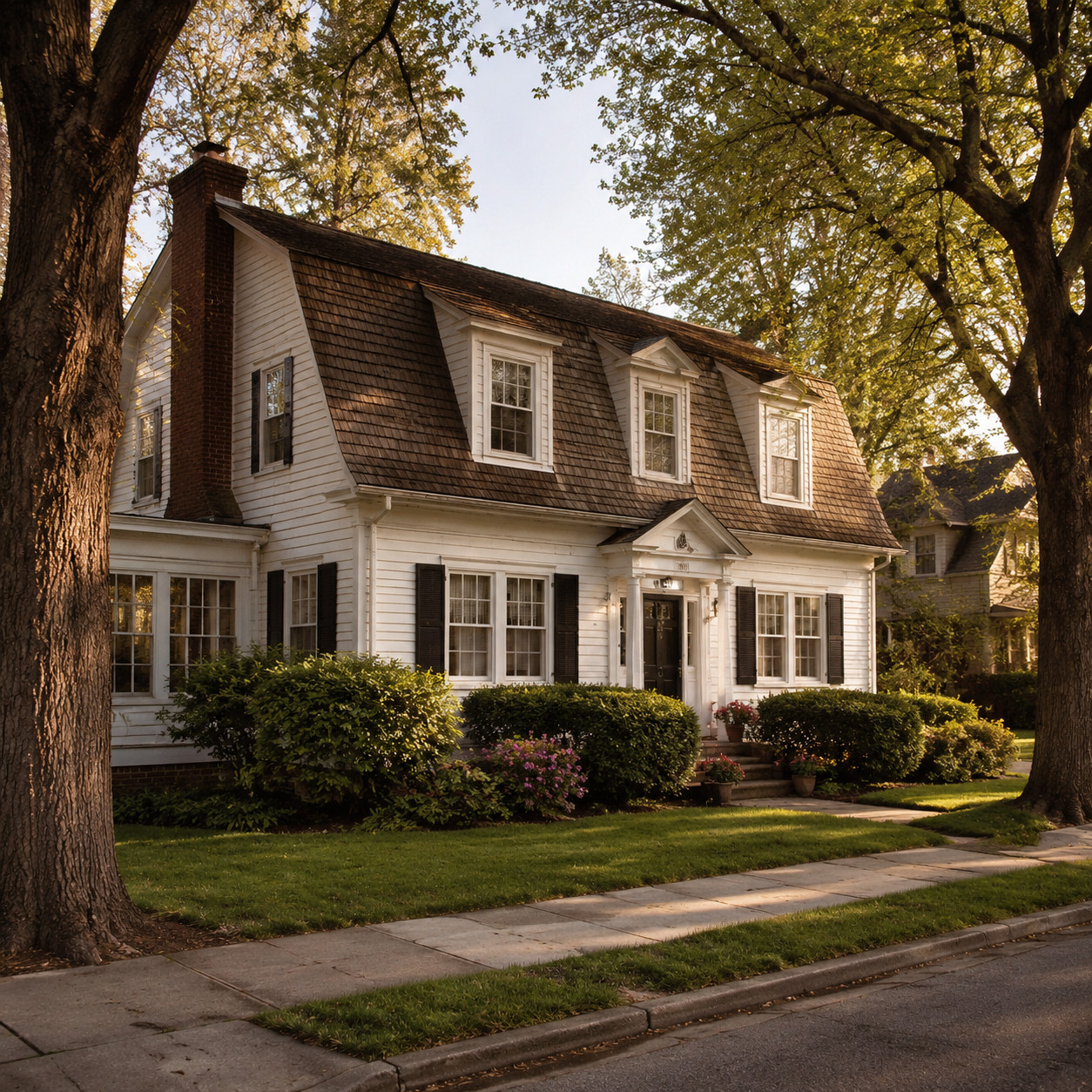
The gambrel roof is the giveaway — that barn-shaped roof with two slopes on each side, the lower one steep, the upper one shallow.
The point was attic space. The gambrel let a one-and-a-half-story house feel like a full two-story upstairs without the cost of a second full floor of walls.
It was clever, and in 1945 it still looked handsome on a tree-lined street.
But that distinctive roof is more complicated to frame than a simple gable, and it screams a specific era the moment you see it. Builders quietly dropped it. The barn-roofed house became a thing you inherit, not a thing you order.
14. The Spanish Eclectic / Mission Cottage

Stucco walls, a low-pitched red clay tile roof, arched windows, and maybe a little wrought iron — the look of old Spain in a small American package.
The style swept the Sunbelt in the 1920s and 1930s and was still being lived in across California, Florida, and the Southwest in 1945. White stucco stayed cool. Tile lasted forever.
The clay tile roof is what killed it for the budget builder.
Real tile is heavy, expensive, and needs reinforced framing to carry the weight. Postwar tract builders swapped it for cheap composition shingle and the whole look fell apart. The originals are protected. The new stucco box wears asphalt now.
15. The Garrison Colonial

A two-story where the upper floor juts out a few inches past the first, often with little decorative drops hanging from the overhang.
The overhang was a nod to genuine 1600s New England houses, where the second story really did project for defense and structure. By 1945 it was pure decoration — a way to make a plain colonial look older and more substantial.
Buyers loved the look for a while.
But the overhang is a framing complication that adds nothing but style, and the detailed drops were extra millwork nobody wanted to pay for. The garrison got absorbed into the plain colonial and the jut quietly disappeared.
16. The Stone-Front Cottage
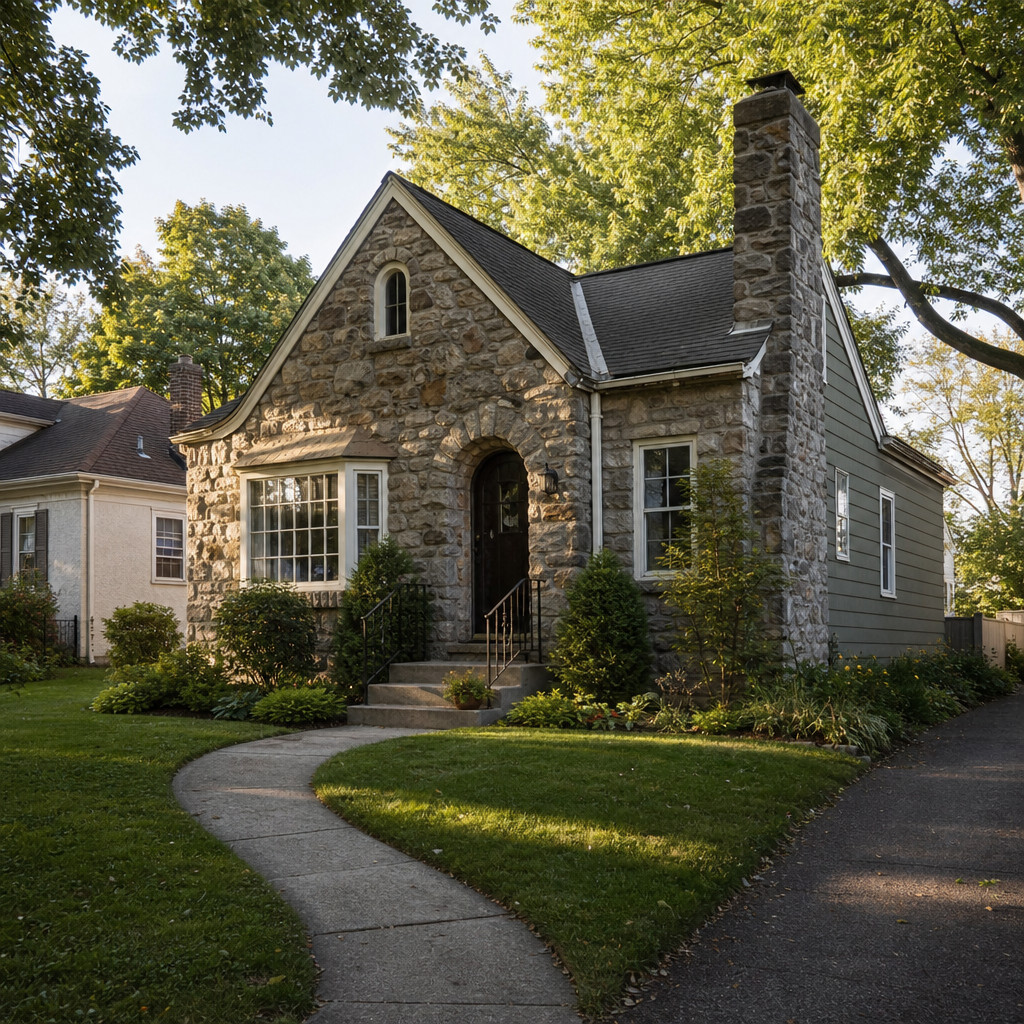
A small house with a face of local fieldstone or cut stone — often just the front wall and chimney, with cheaper siding wrapping the rest.
Stone was the mark of permanence and a little money, and in 1945 a stone-front cottage in a good neighborhood signaled that you’d arrived. Regional builders used whatever stone the area gave them, so these houses look different in Pennsylvania than they do in Texas.
Laying stone is slow, skilled, backbreaking work.
The postwar builder had no time and no masons to spare, so the stone front gave way to brick veneer and then to thin cultured-stone panels glued on. The real thing got rare. The fake thing got everywhere.
17. The Defense Worker Cottage

Tiny, identical houses thrown up in rows near shipyards and aircraft plants to house the war-production army.
The federal government built whole towns of them under wartime programs — places like Vanport, Oregon and Linda Vista, California appeared almost overnight. Two bedrooms, flimsy framing, a coal stove, and a shared wall in many cases.
They were meant to be temporary.
Most were demolished after the war, but plenty survived as cheap starter housing and never left. They’re the unglamorous ancestor of the tract house — the first time America mass-produced a neighborhood and proved it could be done in a hurry.
18. The Streetcar Suburb Cottage

A modest one or one-and-a-half story house on a narrow deep lot, built within walking distance of a trolley line.
Before everyone owned a car, the streetcar decided where the suburbs went. Houses clustered tight along the line, close to the sidewalk, with detached garages or no garage at all out back.
In 1945 these were the established middle-class neighborhoods.
The car killed the formula. Once families drove everywhere, builders spread houses across wide lots far from any trolley, and the close-set walkable cottage stopped being built. The neighborhoods that have them are some of the most walkable left in America — by accident, not design.
19. The Honeymoon Cottage / Starter House

The smallest house a builder could legally sell. One bedroom, a kitchenette, a sitting room, maybe a sleeping porch. Often well under 600 square feet.
These were built for young couples and widows and anyone who needed a door of their own without a family’s worth of space. In the housing-starved 1940s, even a one-bedroom cottage was a prize.
Nobody builds them now.
Minimum lot sizes, zoning rules, and the math of construction make a sub-600-foot house impossible to put up at a profit. The tiny-house movement is trying to reinvent exactly this — and running headfirst into the codes that outlawed it.
20. The Log Cabin Revival
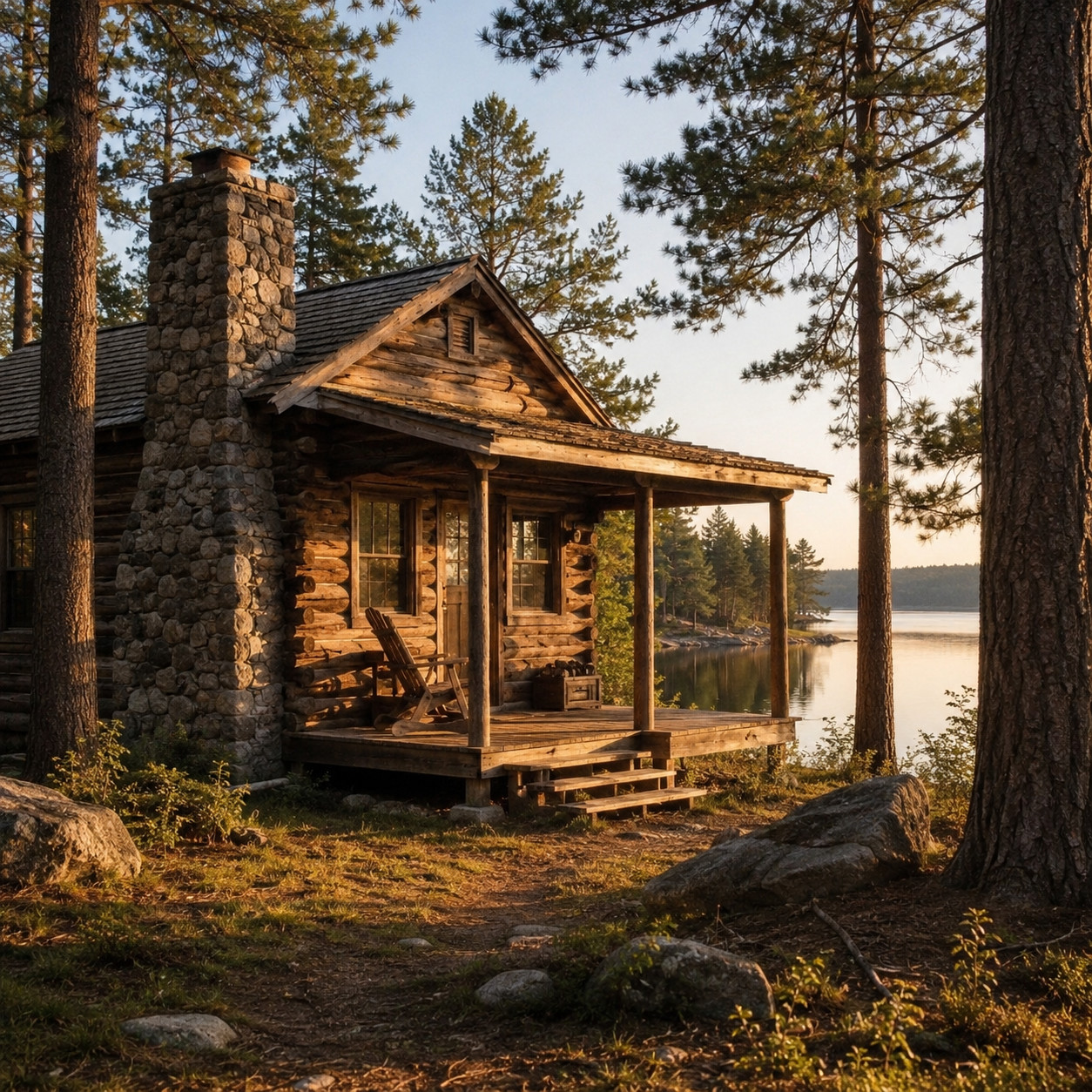
Real logs, notched at the corners, sold as a romantic escape rather than a frontier necessity.
Companies were selling log-cabin kits by mail in the 1930s and 1940s for hunting camps, lake places, and back-to-the-land dreamers. By 1945 the cabin was nostalgia you could buy — a fantasy of the pioneer past, not a hard fact of survival.
Logs are heavy, they settle, and they need constant sealing against rot and bugs.
As a primary home it never made budget sense for the average buyer. The log house stayed a vacation thing, a weekend thing, a someday thing. The everyday family bought a Cape and dreamed about the cabin.
21. The Pyramid Cottage

A simple square house under a steep pyramid-shaped hipped roof that comes to a single point at the top.
It was about the cheapest house you could frame. A square is efficient, and a four-sided roof sheds water and uses short rafters, so the pyramid cottage filled working-class neighborhoods across the South and Midwest from the 1900s on.
One story, a few rooms, a small porch.
By 1945 the shape looked plain and old. The ranch offered the same single-story simplicity with a more modern profile, and the little pyramids stopped going up. They blend into old neighborhoods so quietly that most people walk right past them without a glance.
22. The Two-Family Flat

One house, two front doors — a full apartment up and another down, or one in front and one behind.
The flat let a family own a home and rent the other half to help pay the mortgage. In the housing crunch of 1945, that second unit also meant a place for the newly married kids or the parents who couldn’t find a place of their own.
Cities were full of them.
Suburban zoning eventually banned the type outright, walling off whole towns to single-family houses only. The duplex got pushed to the margins. Now that housing is scarce again, cities are scrambling to legalize the exact thing they spent decades forbidding.
23. The Cinderblock House
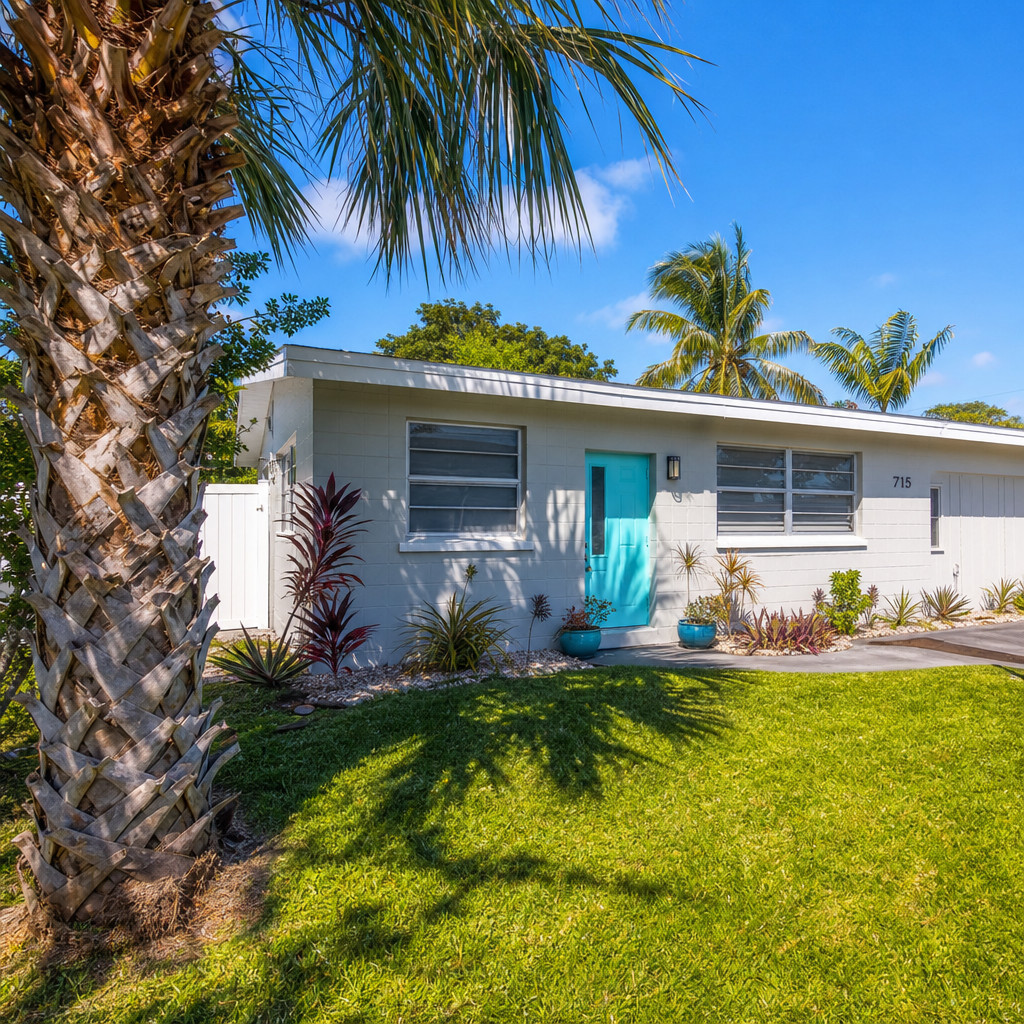
Walls of bare or painted concrete block, often left exposed, common across the South and in hot climates.
Block was cheap, fireproof, termite-proof, and it handled humidity better than wood frame. After the war it boomed in Florida and the Gulf Coast, where a man with a few hundred blocks and a strong back could lay up a house himself.
It was solid and it was honest.
But exposed block reads as cheap to a modern buyer, and the look fell out of fashion the moment people could afford brick veneer or siding to cover it. The block is still there under a lot of stucco. You just can’t see it anymore.
The Houses the Boom Left Behind
The 1945 house was a stopgap. A bridge between the Depression cottage and the ranch that hadn’t arrived yet, built in a panic by a country that needed somewhere to put twelve million homecoming soldiers.
Most of these styles were dead or dying within ten years. The ranch flattened them, the tract builder cheapened them, and the zoning code outlawed the smallest and densest among them.
But the bones survived. They’re under your neighbor’s siding and behind that 1990s addition, in the oldest streets of every town, quietly holding up houses that have outlived the decade that built them by 80 years.
Walk those streets and look past the vinyl. The 1945 house is still there, waiting for someone to notice what it used to be.