


Clearing out a parent’s or grandparent’s house usually happens on a deadline. The house is listed, the dumpster arrives Friday, and every piece of furniture gets sorted into keep, donate or toss in a matter of seconds.
Professional appraisers work the opposite way. They pull drawers, tip chairs, run a hand under a tabletop and read the construction before they ever judge the style. Most of what drives price is structural and hidden from view.
The 30 checks below follow that same habit. Each one takes a few minutes and a decent flashlight. Some point to age, some point to a maker, and some flag the repairs and refinishing jobs that cut value in half.
Do the checks before anyone sands, paints or hauls a single piece.
1. Hand-Cut Dovetails at the Drawer Corners

Pull a drawer out and study the front corner where the side meets the face. Hand-cut dovetails usually show a few broad tails separated by narrow pins, spaced a little unevenly, with a faint knife line scored across the wood where the maker marked his depth.
Machine-cut dovetails arrived in the 1880s and look like a tidy row of equal-sized fingers. Between roughly 1870 and 1900, some factories used the Knapp joint instead, a pin-and-half-moon pattern that dates a piece to that window.
Hand work is not automatically valuable, but it puts a piece in the right era to keep investigating.
2. A Round Tabletop That Is No Longer Round
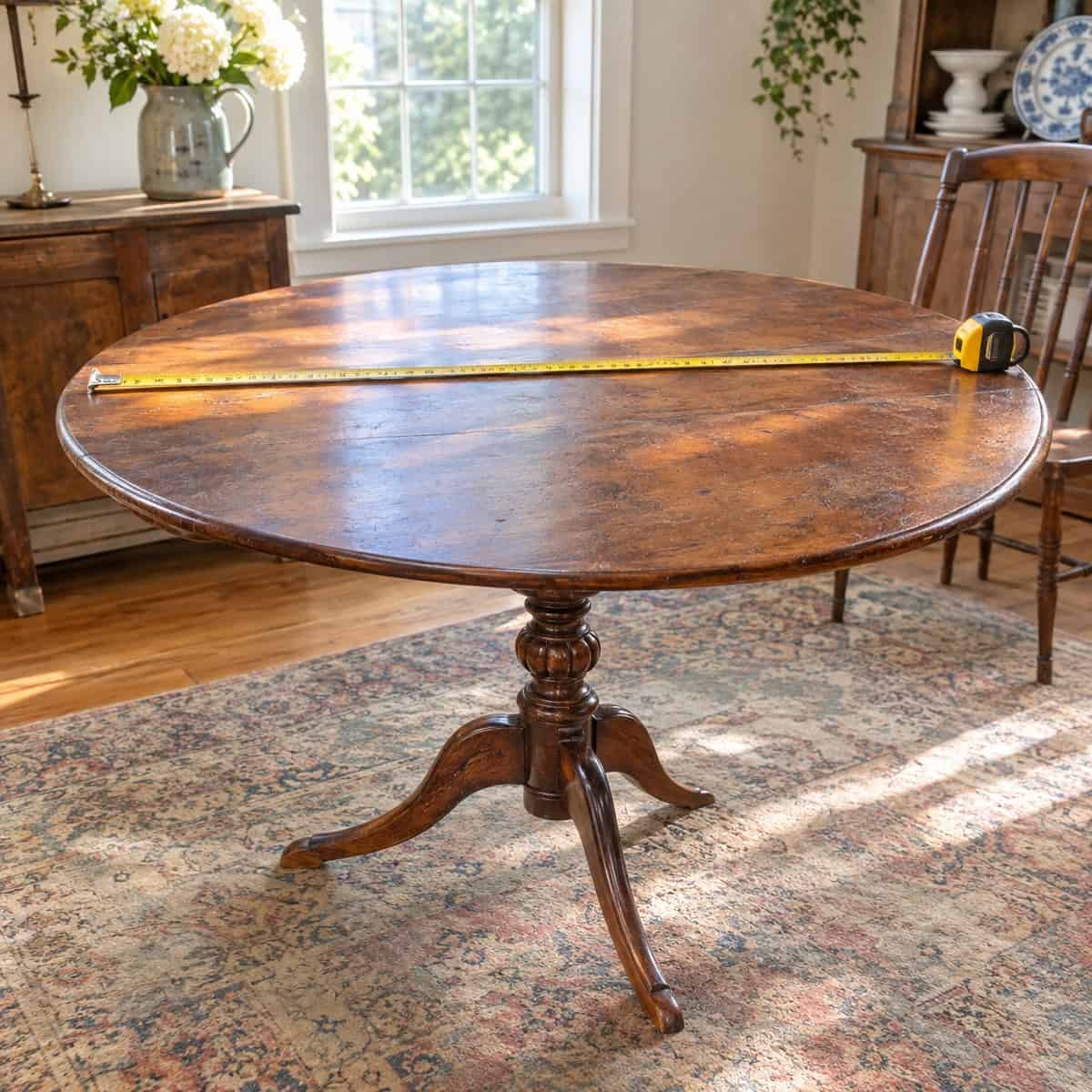
Solid wood shrinks across the grain as it dries over the decades, but barely changes along its length. A round top made from solid boards in 1840 is usually measurably oval today.
Run a tape measure across the top in both directions. On a 42-inch pedestal or tilt-top table, a difference of 1/8 to 3/8 inch across the grain is typical of real age. A reproduction built from plywood or freshly milled lumber will measure almost perfectly round.
Expect slight cupping on old boards too. A dead-flat, perfectly circular top on a supposedly early table deserves a second look.
3. Finish That Has Never Been Stripped

Most American furniture made before the 1920s was finished in shellac, which mellows to a warm amber and wears thin where hands rest. Factory pieces from the 1920s onward shifted to nitrocellulose lacquer, which tends to check in fine lines.
Either surface, left alone, is worth more than a fresh refinish. Stripping a period piece commonly cuts its value by half or more, and the loss cannot be reversed.
To identify the finish, dab denatured alcohol on a hidden spot such as the back of a leg. Shellac turns tacky within a minute. For cleaning, mild soap on a damp cloth and a coat of paste wax are usually all an old finish needs.
4. Shaker Chairs With a Gold Mount Lebanon Decal

The Shaker community at Mount Lebanon, New York, ran a chair business from the 1860s into the 1930s and sold thousands of ladderback rockers and side chairs to the public. Many carry a gold transfer decal reading Shakers Trade Mark, Mt. Lebanon, N.Y. on a rocker or back post.
Look for a size number from 0 to 7 stamped into the top back slat, woven seats of cotton tape in checkerboard colors, and thin, light frames of maple or birch. Some side chairs have small wooden ball tilters set into the back feet so the chair could lean back without scuffing the floor.
Decaled rockers in original condition often sell from several hundred dollars to well over a thousand.
5. Nail Heads That Tell the Date

Find a spot where a nail is exposed, often along a backboard, a drawer bottom or the molding under a top. The shape of the head and shank works as a reliable date stamp.
Hand-forged rose-head nails have a lumpy, faceted head and mostly predate 1800. Machine-cut nails, common from the 1790s through the 1890s, have a rectangular head and a shank that tapers on two sides only. Wire nails, round and uniform from head to point, took over around 1890.
A 1790s chest held together with wire nails is not necessarily fake. It may simply have a replaced backboard or drawer bottom, which lowers value and should be disclosed in any sale.
6. Ray Fleck in Quartersawn Oak

Quartersawn white oak shows bright, irregular ribbons and flecks that seem to float on the surface when light hits them. Those marks are the tree’s medullary rays, exposed only when boards are cut radially from the log.
The method wasted lumber and cost more, so it signals a better grade of furniture. It was the signature of the Mission and Golden Oak era, roughly 1895 to 1925, on everything from library tables to sideboards and hall trees.
Check the legs. Better makers arranged or veneered posts so the fleck shows on every face. Flat, repetitive cathedral grain with no fleck at all usually points to later plainsawn oak or a printed veneer.
7. Stickley Decals, Brands, and Paper Labels

Square, heavy oak furniture with exposed joinery is easy to overlook, and plenty of it came from small factories copying the style. The name that changes the price is Stickley.
Gustav Stickley’s Craftsman Workshops, near Syracuse, marked pieces between about 1901 and 1916 with a red decal of a joiner’s compass and the Dutch motto Als ik kan, later switching to burned brands and paper labels. L. & J.G. Stickley of Fayetteville, New York, used its own decals and labels reading The Work of L. & J.G. Stickley.
Stickley still operates today and has reissued Mission designs since the late 1980s. Those newer pieces are clearly marked and dated, so read the full label before assuming an early original.
8. Wormholes: Old Damage or Active Beetles

Small round holes in old wood are usually the exit points of powderpost beetles, and on their own they say little about value. What matters is whether they are old, genuine and finished over.
Old holes are dark inside and often have wax or finish worked into them. Holes that look freshly drilled, sit in a neat pattern, or appear only on show surfaces suggest faked distressing. Real beetles prefer sapwood and unfinished surfaces like backboards.
Fresh holes with fine, pale powder piling beneath them mean an active infestation. Move the piece away from other wood furniture and call a conservator or pest professional. Treatment usually involves borate solutions, or controlled freezing for smaller pieces.
9. Thick Hand-Sawn Veneer at the Edges

Veneer has a bad reputation it mostly earned in the particleboard era. On furniture made before about 1850, it was sawn by hand to roughly 1/16 to 1/8 inch thick and glued to solid mahogany, pine or poplar.
Look at a chipped corner, the edge of a drawer front or a lifted section on a case side. Old veneer is thick enough to see as a distinct layer. Knife-cut veneer from the late 1800s onward is much thinner, and modern veneer over particleboard is paper-thin.
Loose old veneer should be reglued with hot hide glue, which a restorer can reverse later. Yellow wood glue makes future repairs much harder.
10. Secondary Woods in Hidden Places

Period cabinetmakers saved expensive mahogany, walnut and cherry for the surfaces buyers saw. Drawer sides, backboards, dust panels and glue blocks were built from whatever cheaper wood grew nearby.
White pine points toward New England. Tulip poplar and yellow pine suggest Pennsylvania, the Mid-Atlantic or the South. Late Victorian factory furniture from Grand Rapids often used ash, elm or gum on the inside.
Plywood in the back or drawer bottoms generally places a piece after 1900, and particleboard after the 1950s. A case built entirely of one species, inside and out, more often signals 20th-century production than an early handmade piece.
11. Original Casters Still on the Legs

Casters are small, but they often stay with a piece for its whole life and are rarely reproduced well. Federal and Regency tables, sofas and chairs from about 1800 to 1840 often roll on brass cup casters with brass or leather-rimmed wheels.
Victorian furniture from the 1850s through 1900 commonly sits on white or mottled brown ceramic wheels mounted in iron. Plastic wheels or bright, unworn brass are later replacements.
Original casters confirm the legs have not been cut down, a common alteration that lowers value. If a set is worn or loose, have it serviced rather than replaced, and keep any loose originals in a labeled bag with the piece.
12. Pencil and Chalk Writing Inside Drawers

Turn drawers over and shine a flashlight across the underside at a low angle. Cabinetmakers often numbered drawers in pencil or chalk so they went back into the right openings, and some signed or dated their work there.
Later owners left notes too. A repair date, a family name, a mover’s inventory number or an estate auction lot number written in grease pencil all help trace a piece’s history.
Do not wipe these surfaces with water or cleaner, since faint graphite and chalk disappear easily. Photograph every mark in raking light with a ruler beside it for scale, and record which drawer it came from.
13. Herman Miller, Knoll, and Eames Labels

Mid-century chairs from Herman Miller and Knoll are among the most copied furniture of the last 70 years, so the label is everything. Turn the piece over and look for a foil label, an embossed medallion or stamped production codes.
Eames molded plywood chairs, the DCW and LCW, date to 1946, with Herman Miller labels appearing from 1949. Knoll pieces such as Bertoia wire chairs and Saarinen Tulip tables usually carry a Knoll Associates or Knoll International label underneath.
On early Eames fiberglass shells, a wire-wrapped rope edge points to the first years of production, about 1950 to 1953. Original pieces with worn labels still bring strong prices, often several hundred dollars per chair.
14. A Marble Top That Belongs to the Base

Victorian and Eastlake washstands, dressers and parlor tables from about 1860 to 1900 often wore white or gray-veined marble tops. Replacement stone is common, and an original top adds real value.
Old marble is usually 3/4 to 1 inch thick, with a hand-shaped ogee or molded edge and a rough, unpolished underside. It should sit snugly in its frame, with matching wear and stains on stone and wood.
Lift marble with two people and carry it on edge, never flat, since it can crack under its own weight. Never trim an original slab to fit, and save broken pieces. A stone restorer can often rejoin them.
15. Hand-Plane Marks You Can Feel

Before power planers, boards were flattened by hand. The rough work was done with a scrub or jack plane, which left shallow, scooped tracks running across or along the board.
Run fingertips slowly over a backboard or drawer bottom. Gentle ridges and hollows, uneven in width, point to hand work, generally before the 1860s. Machine planers leave tiny, evenly spaced ripples that are easier to see than to feel.
Look also at the edges of drawer bottoms. On early work, they were thinned with a plane into a wide bevel so they could slide into grooves. That bevel is another hand detail factories rarely bothered with.
16. Original Paint on Country Furniture

On a pine cupboard, blanket chest or dry sink from the 1800s, the paint is often worth more than the wood. Early colors include Prussian blue, dry red, mustard and green, frequently mixed as milk paint with a flat, chalky look.
Look for even aging: wear at knobs and edges, color settled into every crack and joint, and no fresh brush strokes. Many pieces were repainted later, sometimes several times.
A trained conservator can sometimes remove later layers to reveal the first coat, an expensive job that can raise value considerably. A heat gun or chemical stripper used at home almost always destroys it. When unsure, leave every layer alone.
17. Figured Maple, Birch, and Mahogany

Some boards carry figure that cabinetmakers paid extra for: the rippling stripes of curly or tiger maple, the tiny swirls of bird’s-eye maple, flame birch, crotch mahogany, and burl walnut panels on Victorian Renaissance Revival pieces.
Real figure shimmers and shifts while walking past it, a quality woodworkers call chatoyance. Painted graining, popular on cheaper 19th-century pine, looks the same from every angle and often shows brush or comb marks.
On early American chests, tables and Federal case pieces, strong figure can multiply the price compared with a plain example of the same form and age.
18. Kittinger, Baker, and Henkel-Harris Labels

Not every valuable piece is old. Several American firms built high-quality traditional reproductions in solid mahogany, cherry and walnut that sell well on the secondary market today.
Kittinger of Buffalo made licensed Colonial Williamsburg reproductions starting in 1937, usually with a branded mark inside a drawer. Baker Furniture of Grand Rapids, Kindel, known for its Winterthur reproductions, and Henkel-Harris of Winchester, Virginia, which closed in 2012, all marked their work clearly.
These names often bring hundreds to several thousand dollars per piece, far more than generic department-store Colonial. Look for hand-rubbed finishes, dovetailed drawers, solid brass hardware and a label on a drawer side or back panel.
19. Eight-Way Hand-Tied Springs in Upholstery
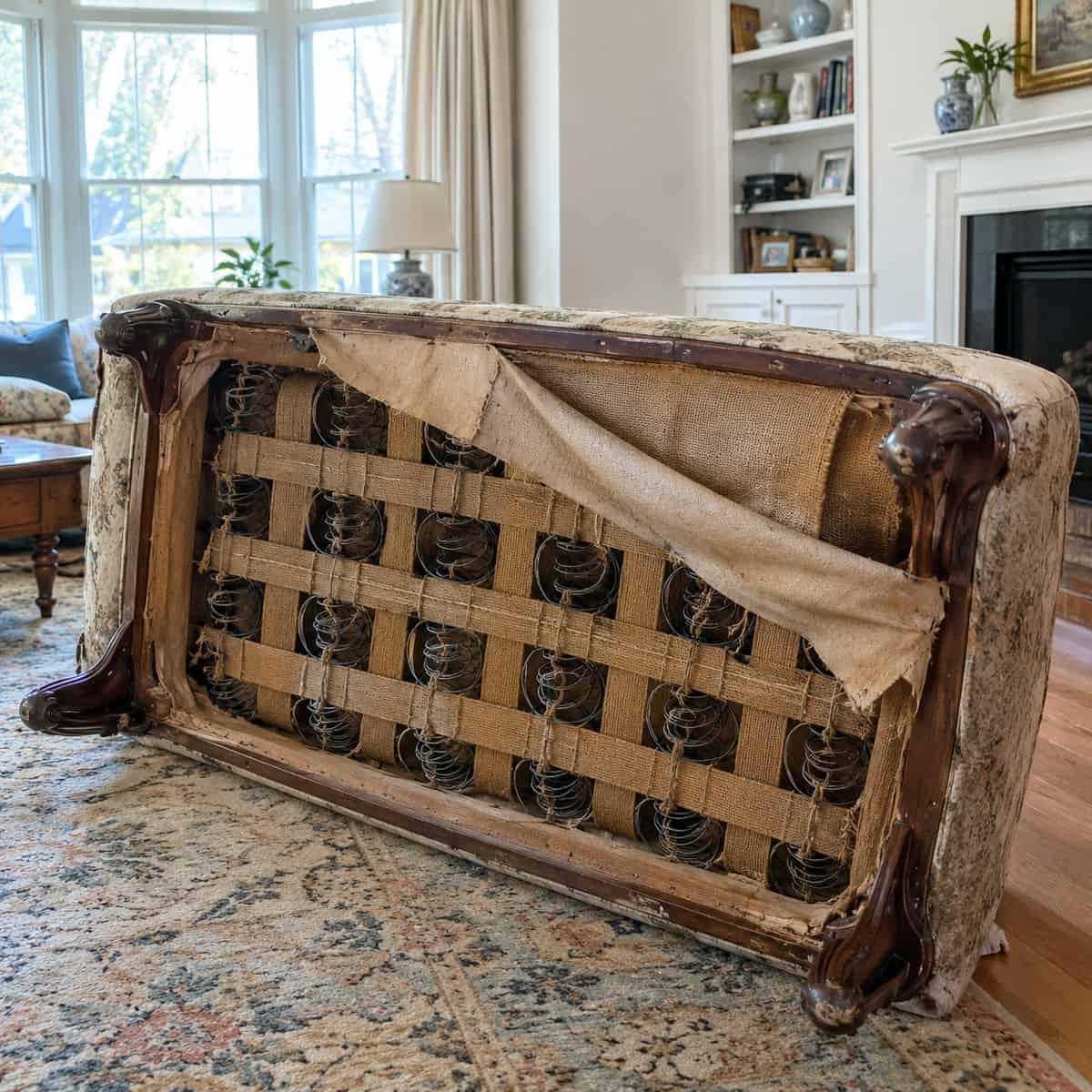
Tip a sofa or armchair onto its back and look under the dust cloth. Quality older upholstery rests on interwoven jute webbing, with steel coil springs knotted to each other and to the frame with twine in eight directions.
Natural stuffing such as horsehair, coconut fiber or moss confirms age. Look at the frame too: kiln-dried hardwood with glued and screwed corner blocks outlasts any fabric.
Reupholstering a sofa properly commonly runs $1,500 to $4,000 including labor. That is money well spent on a frame and spring system of this quality, and a better investment than a new sofa built on foam and zigzag wire.
20. Even Darkening on Unfinished Wood

Raw wood left exposed to air and light darkens slowly over decades. On a genuine old piece, the unfinished back, drawer sides and underside of a top usually share a dull gray-brown tone.
Look for bright spots. A drawer bottom or backboard that looks fresh and pale beside darker neighbors was likely replaced. Unusually crisp, light wood around a hinge or pull may mean hardware was moved.
Fakers sometimes stain new wood to imitate age. The giveaway is uniform color even in places air never reached, such as deep inside a joint or under a glue block. Real oxidation is uneven and heaviest on surfaces that faced the room.
21. Wavy Glass and Old Silvered Mirrors

Look through the glass on a china cabinet, bookcase or secretary at an angle. Glass made before about 1900 usually has slight waves, tiny bubbles called seeds and a faint distortion of anything behind it. Modern float glass is perfectly flat.
Older mirrors age in their own way. Mercury-backed plates, common before about 1840, and later silvered glass both develop gray clouding and spotting near the edges.
Check the back too. Original mirrors are often held by thin wooden boards and small nails or glazing points, not cardboard and staples. Resist resilvering or replacing old glass, since collectors want the flaws intact.
22. Danish Teak With a Control Stamp

Danish modern furniture from roughly 1950 to 1975 commands strong prices, especially dining chairs, sideboards and lounge chairs in solid teak or rosewood.
Look underneath for a burned or stamped mark reading Danish Furniture Makers Control or Made in Denmark, plus a maker’s label. Names worth knowing include Hans Wegner, Finn Juhl, Arne Vodder, Kai Kristiansen and J.L. Moller. A Wegner Wishbone chair from Carl Hansen is often stamped on the seat rail.
Sets of four stamped dining chairs can sell for $1,500 to well over $5,000. Care is simple: a light coat of teak oil once or twice a year, and no silicone polish, which complicates any future refinishing.
23. Wooden Pegs Through the Joints

Look at the corners where a table apron meets a leg, or where a door frame’s rails meet the stiles. Small wooden plugs passing through the joint often mean mortise-and-tenon construction locked with pegs, standard before the mid-1800s.
Hand-made pegs are slightly irregular, often a little square or faceted, and many now sit just above the surface after a century of wood movement. Factory dowels are perfectly round and flush.
Arts and Crafts makers added decorative pegs for looks between about 1900 and 1915. Those are usually larger, rounder and spaced in tidy patterns, so read them alongside the other clues rather than as proof of early age.
24. Wear in All the Right Places

A century of use leaves predictable wear. Chair stretchers get rubbed flat on top where feet rested. Drawer runners wear grooves, and the bottoms of drawer sides round over. Tabletop edges soften where arms and hands rested.
Feet should be worn and slightly rounded underneath, with dirt and old finish ground into the end grain.
Be suspicious when wear shows up in odd spots, like the center of a tabletop, the back of a leg nobody touched, or evenly on every edge at once. Uniform, decorative distressing is a factory finish or a faker’s shortcut, not a history of use.
25. Original Brass Hardware and Its Holes

Hardware is one of the most frequently swapped parts on old furniture, and buyers check it closely. Pull a drawer and look at the inside of the front.
One set of holes per pull is a good sign. Extra holes, wood filler or plugs mean the hardware has changed at least once. On the outside, an original pull often sits over a faint outline worn into the finish that matches its exact shape.
Early brass from before about 1850 is sand-cast, rough on the back and attached with hand-cut nuts and slightly irregular threads. Avoid polishing old brass to a mirror shine. Most collectors prefer the soft, oxidized tone it has earned.
26. Saw Marks on Raw Surfaces

The underside of a tabletop, a backboard or a drawer bottom often still shows how the board was cut at the mill. Hold a light low across the surface.
Straight, slightly uneven lines running across the board come from a pit saw or water-powered up-and-down saw, the norm before the 1830s and later in rural areas. Large curved arcs come from a circular saw, which spread from the 1830s on. Fine, evenly spaced straight lines usually mean a band saw, common after the 1870s.
These marks are hard to fake convincingly and rarely faked at all, which makes them a dependable check.
27. Old Photos, Receipts, and Store Labels

Paper and photos can prove where a piece came from. Search drawers, the underside of tops and the backs of mirrors for store tags, delivery tickets, warranty cards and catalog clippings.
Family records help too. An insurance appraisal from the 1970s, a letter mentioning a purchase, or an old snapshot that shows the sideboard in a 1940s dining room all support a piece’s age and ownership.
Scan or photograph everything, then keep the originals in acid-free folders, never in PVC plastic sleeves. Pass copies along with the furniture if it sells. Documented history routinely helps a piece sell faster and closer to its full value.
28. Paul McCobb Planner Group Pieces

Clean-lined maple or birch dressers and cabinets with simple brass pulls often turn out to be Paul McCobb’s Planner Group, made by Winchendon Furniture in Massachusetts from 1949 into the 1960s.
The line was affordable when new, built in modular sizes so buyers could add pieces over time. Look inside a drawer or on the back for a stamped or branded Planner Group mark, along with solid wood construction and slender tapered legs on some designs.
Authentic dressers and bookcases regularly sell from several hundred to a few thousand dollars, depending on size and condition. Lookalikes are everywhere, so the mark matters.
29. Mid-Century Walnut From Drexel, Lane, and Broyhill

Dark walnut bedroom and dining furniture from the late 1950s and 1960s spent decades in basements and spare rooms. It now ranks among the most searched categories in vintage furniture.
Drexel’s Declaration line, introduced in 1958 and designed by Kipp Stewart and Stewart MacDougall, pairs walnut cases with minimal pulls and a Drexel stamp inside a drawer. Broyhill’s Brasilia line from 1962 is known for arched, architectural shapes. Lane stamped numeric production codes inside drawers that collectors use for dating.
A dresser, chest and pair of nightstands in matching original finish sells far better than scattered survivors. Keep sets together and sell them as one lot.
30. Maker’s Marks Hidden in Plain Sight

Labels and stamps turn a nice piece into an attributed one, and attribution moves prices. Marks take several forms: paper labels, burned brands, ink stamps, stencils, metal tags and impressed numbers.
Check the back panel, the inside of drawers, the underside of seats and tops, the inner face of a case side and the back of any mirror frame. Hold a flashlight low and to one side, since faint ink and shallow brands show best in raking light.
Never peel, wet or tape over a fragile label. Photograph it as found, then search the name in maker databases or auction archives before setting a price.
One Weekend, One Flashlight, No Sandpaper
Go through the house one room at a time, and give every case piece and chair the same quick routine: drawer out, piece tipped, light across the hidden surfaces. Photograph every mark, label and joint along the way.
Hold off on cleaning beyond a dry dusting, and skip anything involving sandpaper, stripper or paint until someone knowledgeable has seen the piece. A local appraiser, an auction house specialist or an accredited member of the American Society of Appraisers can confirm what the clues suggest.
Furniture that turns out to be ordinary can still be donated next week. A refinished antique cannot be put back.