

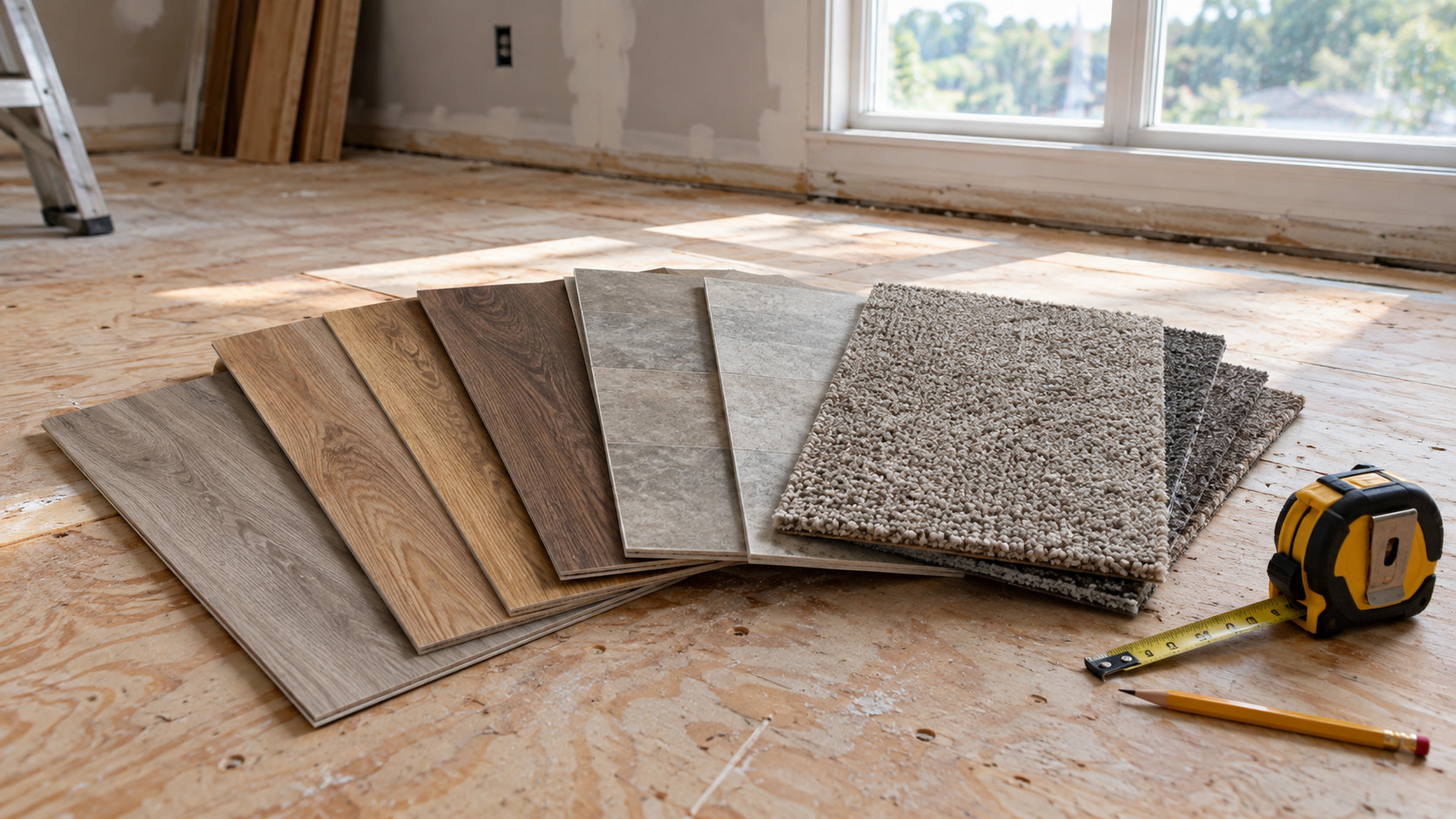
Walk into a house that’s five years old and look down.
The kitchen island has a gray halo worn around it. There’s a dull path from the garage door to the fridge. The hallway carpet has a stripe in it like a deer trail.
None of that was visible on install day. Floors don’t fail the way a roof fails — they fail slowly, in the spots you walk most, until one morning you notice the floor looks tired and you can’t un-notice it.
Most of these regrets weren’t bad taste. They were a spec sheet nobody read, a subfloor nobody checked, or a trend that peaked eighteen months after the check cleared.
Here are 32 flooring choices that look great on day one and turn on you by year five.
1. Bargain-Bin Luxury Vinyl Plank With a 6-Mil Wear Layer

Vinyl plank isn’t the villain here. The wear layer is.
That top film is measured in mils, and promo-grade planks ship with 6 mil or less. It’s enough for a guest bedroom. It is not enough for the four-foot strip in front of your kitchen sink, where the finish dulls and then scuffs through while the rest of the room still looks brand new.
Once you’re through it, you’re into printed film. There’s no wood under there to sand, no color running through the plank. The pattern is gone in that spot permanently.
Shop mils, not marketing words. For a house with kids, a dog, or a back door people actually use, 12 to 20 mil is the range that survives. Installers who see Floor Focus-style failure reports year after year say the same thing — the cheap stuff fails in the traffic lanes first, and nobody replaces one lane.
2. Wall-to-Wall Carpet in the Bathroom

You remember it. Plush shag right up to the base of the toilet, with a matching lid cover and a little contoured rug around the base.
Every drip, splash, and overflow soaks into the pad and sits there. The pad holds it against the subfloor, and the subfloor holds it against the joists.
Shampooing pulls the surface clean and leaves the smell exactly where it lives. Five years is generous — most of these start announcing themselves in humid weather by year two.
3. Cool-Gray and ‘Greige’ Washed Wood

The fastest-dating floor of the last decade, and it isn’t close.
Gray-washed oak owned 2014 through 2020 and now reads like a laminate countertop from 1998. Designers have already swung back to warm mid-browns, natural white oak, and soft whites — Homes & Gardens puts gray floors near the top of the list of finishes aging homes fastest.
The practical problem is worse than the style problem. A gray floor carries a green or pink undertone, and that undertone fights every warm paint color, every leather chair, every oak table you bring into the room.
You end up decorating around the floor forever.
4. Solid Hardwood in a Basement

Concrete looks dry. It isn’t.
A slab sits directly on damp soil, and water vapor moves upward through it constantly — this is vapor drive, and it never stops. A basement slab can pass several pounds of moisture per 1,000 square feet per day, year round, without a single drop of visible water anywhere.
Solid wood is a hygroscopic material. It absorbs that vapor from the bottom face while the room-side face stays drier, and the board responds the only way it can: the edges swell and lift, the center dishes down, and you get cupping. Crowning comes later, after somebody sands the cupped boards flat and the moisture finally equalizes.
Under the boards is where it gets expensive. Sleepers and subfloor stay damp in the dark, and mold colonizes the underside long before you smell anything upstairs.
The fix isn’t refinishing. It’s demolition. You’re paying for tear-out, disposal, mold remediation if the growth spread into framing, and then a whole new floor — remediation alone routinely runs $2,000 to $6,000 for a moderate basement, before you’ve bought a single new plank.
Engineered plank rated for below-grade, click-together LVP over an underlayment with a vapor barrier, or tile over a proper membrane. Any of those. Not solid oak.
And test the slab first. A calcium chloride test or a relative humidity probe costs almost nothing compared to what you’re about to install on top of it.
5. Near-White Marble-Look Tile in a Bathroom

Gorgeous on a phone screen. Exhausting in person.
Modern marble-look porcelain has gotten so clean and so lightly veined that there’s no pattern left to hide anything. Every dark hair, every speck of lint, every crumb of dropped mascara sits there in high contrast.
One landlord who spec’d it across several rental bathrooms told Redesign Daily the rooms looked dirty within an hour of being cleaned.
Pick a tile with real movement in it. Veining is camouflage.
6. Engineered Wood With a 1-Millimeter Veneer

It’s sold as real hardwood. Technically that’s true — the top is a slice of actual wood.
The slice is the problem. At 1mm, a drum sander takes the entire wear layer off in a single pass and blows through to plywood.
You need roughly 3mm of veneer to survive one honest refinish, and 4mm to consider two. Under that, the floor has exactly one life. Scratch it badly, flood it once, get tired of the color — the answer is always replacement, never restoration.
That’s hardwood money for a disposable floor. Ask for the veneer thickness in millimeters before you ask about anything else.
7. Builder-Grade Plush Carpet in the Main Living Area

Low face weight, thin pad, and a hallway everyone walks forty times a day.
By year three there’s a visible lane from the front door to the kitchen, crushed flat and slightly darker than everything around it. The fibers aren’t dirty. They’re bent, and they don’t stand back up.
It’s the single thing that makes a five-year-old house feel fifteen. A better pad costs a few hundred dollars and buys years.
8. Polished Marble in a Kitchen

Marble is calcium carbonate. Lemon juice, wine, vinegar, tomato sauce, and most kitchen cleaners are acidic.
The acid eats the polish and leaves a dull spot — that’s etching, and it’s not a stain. Nothing scrubs it out, because the surface itself has been dissolved. Fixing it means honing and repolishing the stone.
Give a working kitchen two years and the floor around the stove becomes a map of everything that ever hit it.
9. Peel-and-Stick Vinyl Tile Laid Over Old Flooring

Every rental, every weekend flip, every “we’ll do it properly later.”
The adhesive is pressure-sensitive and it gives up first at the doorways and seams, where foot traffic twists the tile. Corners curl. Toes catch them. Then a whole tile shifts and you’ve got a gap.
Whatever is underneath telegraphs through, too — every trowel ridge, grout line, and nail head reads right through the vinyl within months.
And it’s stuck down just enough to make pulling it up a miserable afternoon with a heat gun and a scraper.
10. Dark Espresso-Stained Hardwood

Showroom-perfect under track lighting. Then you live on it.
Dark stain turns dust gray, pet hair white, and every bare footprint into a smudge. Worse, wood is pale inside — so every scratch shows up as a bright line against the dark surface, like chalk on a blackboard.
Own a golden retriever and you’ll sweep daily. Not weekly.
11. Polished or Glazed Porcelain on a Bathroom Floor

A glaze that gleams in the showroom behaves very differently with a film of water and shampoo on it.
Tile sold for wet areas carries a DCOF rating — dynamic coefficient of friction — and the industry benchmark for interior wet floors is 0.42 or higher. High-gloss polished porcelain often tests well below that.
Ask for the number by name. A salesperson who can’t produce it is selling you a wall tile for a floor.
Matte, textured, or small-format with more grout lines. Your grandmother’s bathroom had tiny hex tile for a reason.
12. Laminate in a Laundry Room or Mudroom

Laminate’s photographic top layer is genuinely tough. The core underneath is compressed wood fiber — essentially very dense cardboard.
Water finds the seams. A washer supply line that weeps a few ounces a day behind the machine, a dishwasher gasket gone soft, a pile of snowy boots parked in the same spot every January. The fiberboard drinks it up and swells, and the swelling pushes up at the edges into a chipped, puffy ridge.
Here’s the part that catches people: that swelling is permanent. Fiberboard expands when it absorbs water and the fibers don’t return to their original dimension when they dry. You can run a dehumidifier for a month and the plank stays fat at the edge.
Braided stainless supply lines fail too — a burst washing machine hose is one of the most common homeowner water claims there is, and it can push hundreds of gallons into a floor before anyone notices. Rubber hoses should be replaced every five years, period.
A swollen laminate floor is a full replacement, not a repair, because you can’t buy four matching planks from a discontinued run and you can’t get to the middle of a click floor without pulling it back from the wall.
Put waterproof rigid-core vinyl or tile in any room with a drain or an appliance. Save the laminate for bedrooms.
13. Bright White Grout on a Floor

Grout is cement with pigment in it. Cement is porous.
Wall grout stays white because nothing walks on it. Floor grout lives at shoe level, absorbing everything the mop pushes into it, and the traffic lanes go gray-brown within a couple of years.
Scrubbing gets you partway back. Never all the way.
This is why tile setters push mid-tone grout on floors and reserve white for backsplashes. A warm gray joint looks intentional forever.
14. Bamboo in a Kitchen, Bath, or Laundry
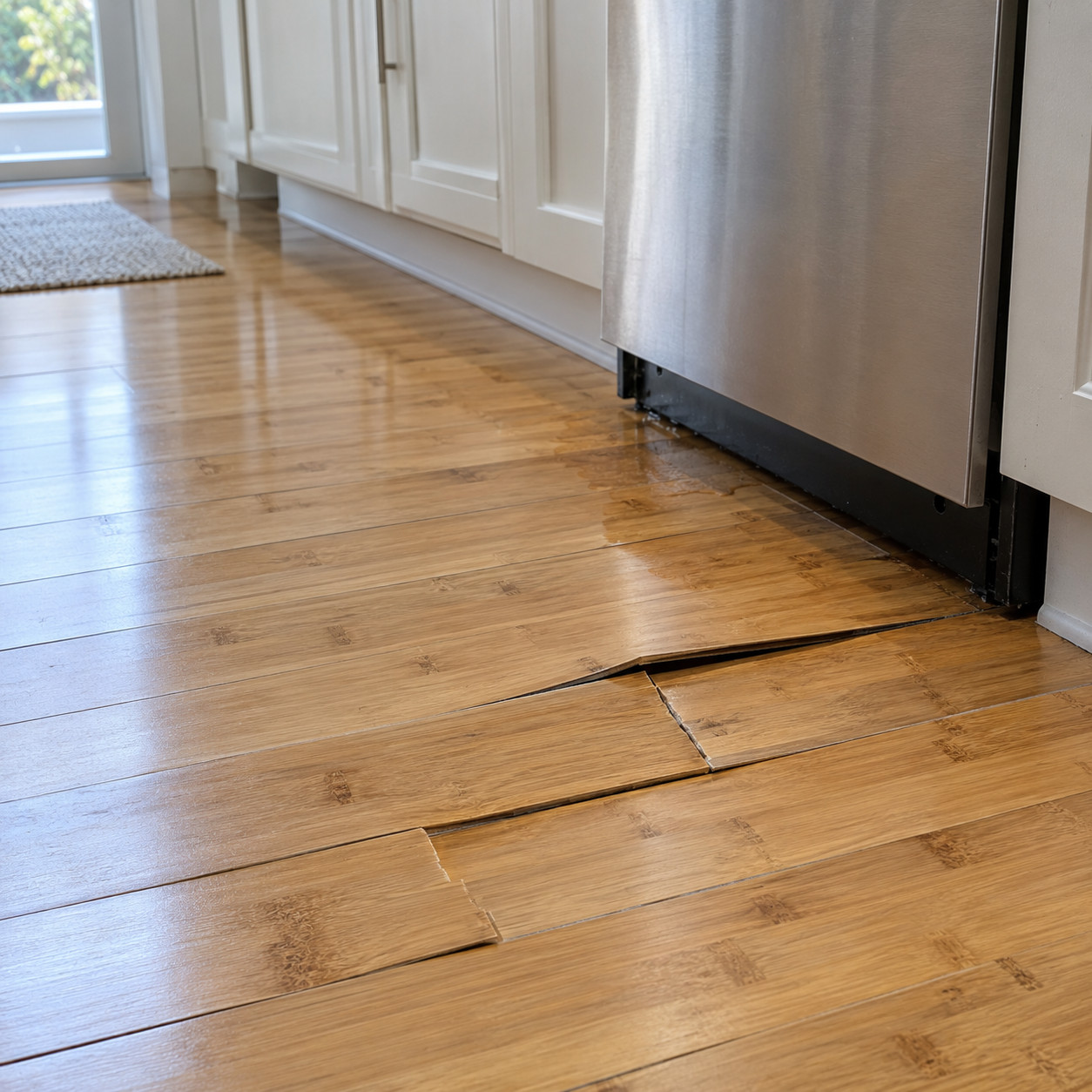
Bamboo arrived around 2006 with an unbeatable pitch: harder than oak, renewable, grows back in five years.
Hardness isn’t water resistance. Bamboo is a grass laminated together with adhesive, and it swells, delaminates, and warps with humidity swings like any other organic floor. Homeowners who installed it in kitchens and laundry rooms show up in regret threads constantly.
Quality between manufacturers is also wildly uneven — strand-woven from a good mill is a legitimately tough floor, and cheap horizontal bamboo dents if you drag a chair.
15. Large-Format Tile Over a Springy Wood Subfloor
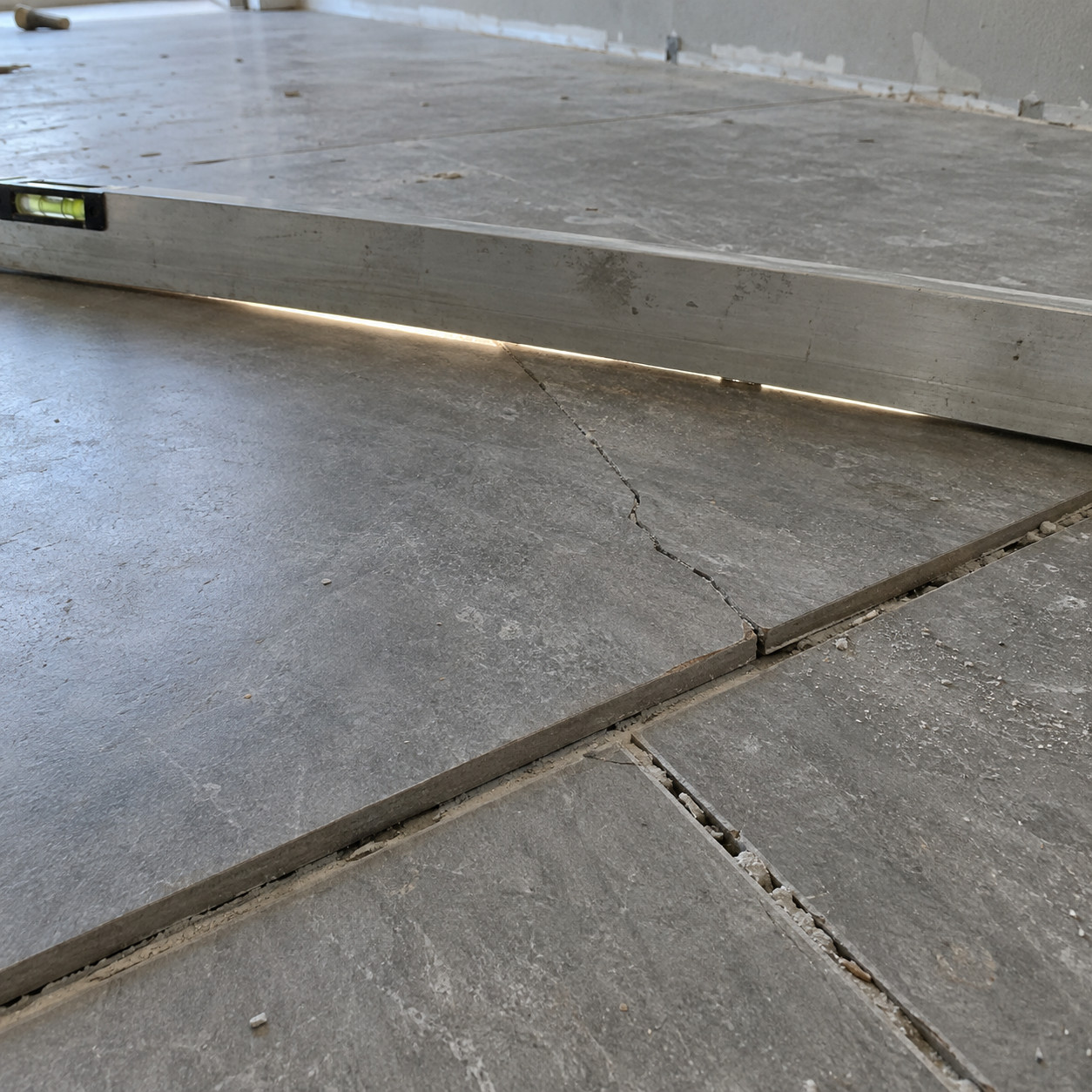
Big tile is unforgiving. A 12×24 or 24×48 plank tile cannot bend, and it cannot follow a subfloor that moves.
The industry standard for ceramic tile over wood framing is a deflection limit of L/360 — meaning a joist span can’t flex more than its length in inches divided by 360 under load. For natural stone, it tightens to L/720. Most older houses with 2×8 joists on 16-inch centers spanning 13 feet do not meet that, and nobody checks before the tile goes down.
You feel the failure before you see it. Walk barefoot and catch a tile edge standing proud of its neighbor — that’s lippage, and with long planks, even a 1/8-inch dip in the deck throws the ends out of plane.
Then the grout cracks in a line. Then the tile cracks, usually right over a joist or at a seam in the subfloor.
Every one of those repairs fails again, because the cause is under the floor. You can regrout it a dozen times and the deck will keep moving.
Doing it right means sistering joists or adding a mid-span beam if deflection is borderline, getting to a minimum 1-1/8 inch total subfloor thickness, then an uncoupling membrane or a proper mortar bed on top of that. Add a self-leveling underlayment if the deck is out of plane more than 1/8 inch in 10 feet.
That prep costs real money. It costs less than tearing out 400 square feet of cracked porcelain.
16. Wall-to-Wall Carpet Installed Over Original Hardwood
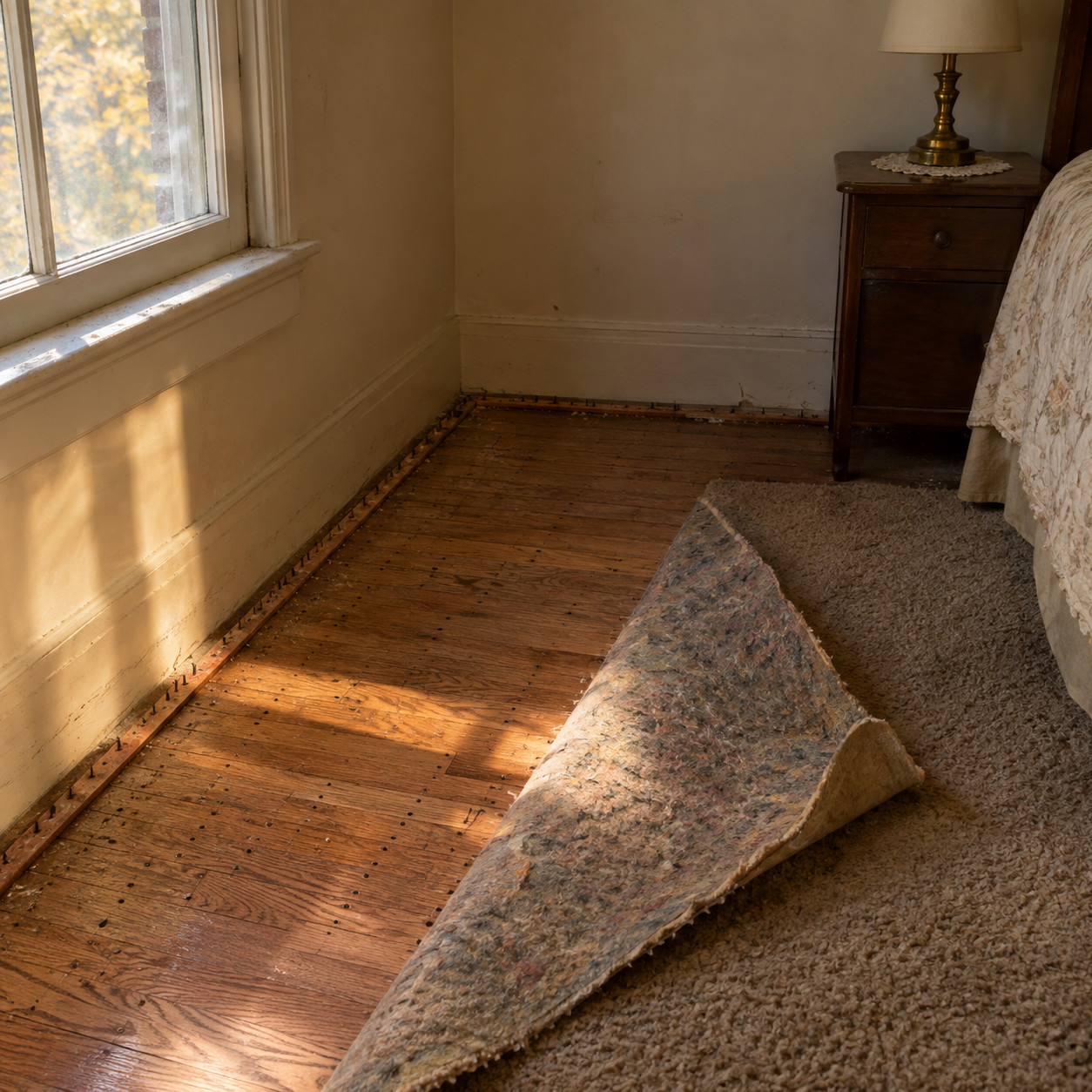
Someone in 1968 thought they were modernizing.
Tack strips get nailed every few inches around the entire perimeter, and every nail punches through the face of old-growth quartersawn oak. Staples go through the pad and into the field of the floor by the thousand.
Sanding closes some of it. The perimeter nail holes stay, and if a previous owner also glued the pad down, you’re looking at black adhesive ground into the grain.
Plenty of people are pulling this carpet up right now and finding a floor that’s 90% gorgeous and 10% scarred. Take the 90%.
17. Heavily Hand-Scraped, Distressed Plank
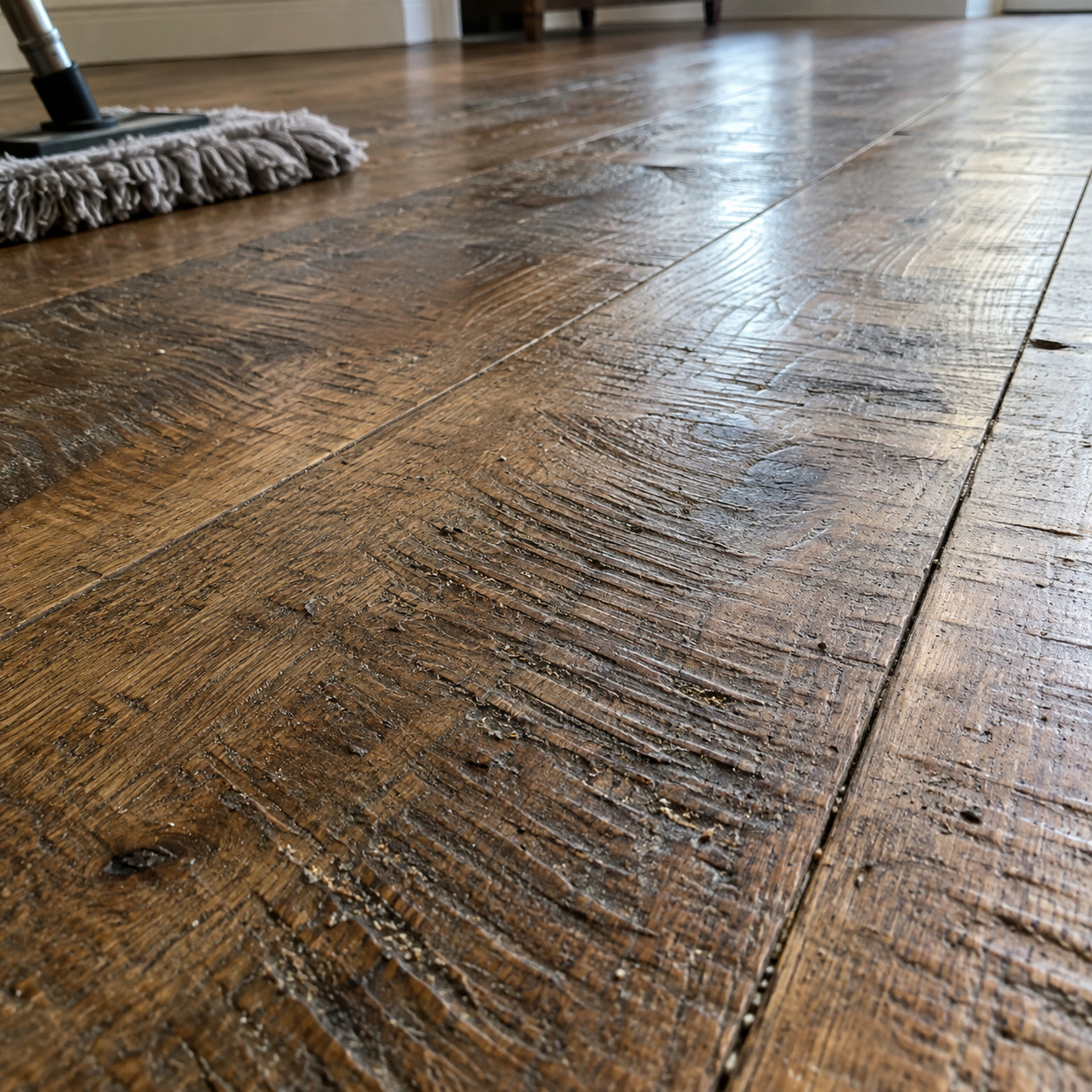
Factory distressing has a tell: the pattern repeats. Every fifth board has the same gouge in the same place because they came off the same machine head.
Real wear happens where people walk. Fake wear happens everywhere equally, which is exactly why it reads as costume. Designers now list artificial distressed finishes among the surest signs of a dated farmhouse renovation.
Living on it is the other half. Those deep grooves hold grit, mop water, and dog hair, and a vacuum can’t reach the bottom of them.
Genuine dents just disappear into the manufactured ones. You never get the satisfaction of a floor earning its patina, because it showed up pre-aged.
18. Penny-Round or Tiny Hex Mosaic on a Bathroom Floor
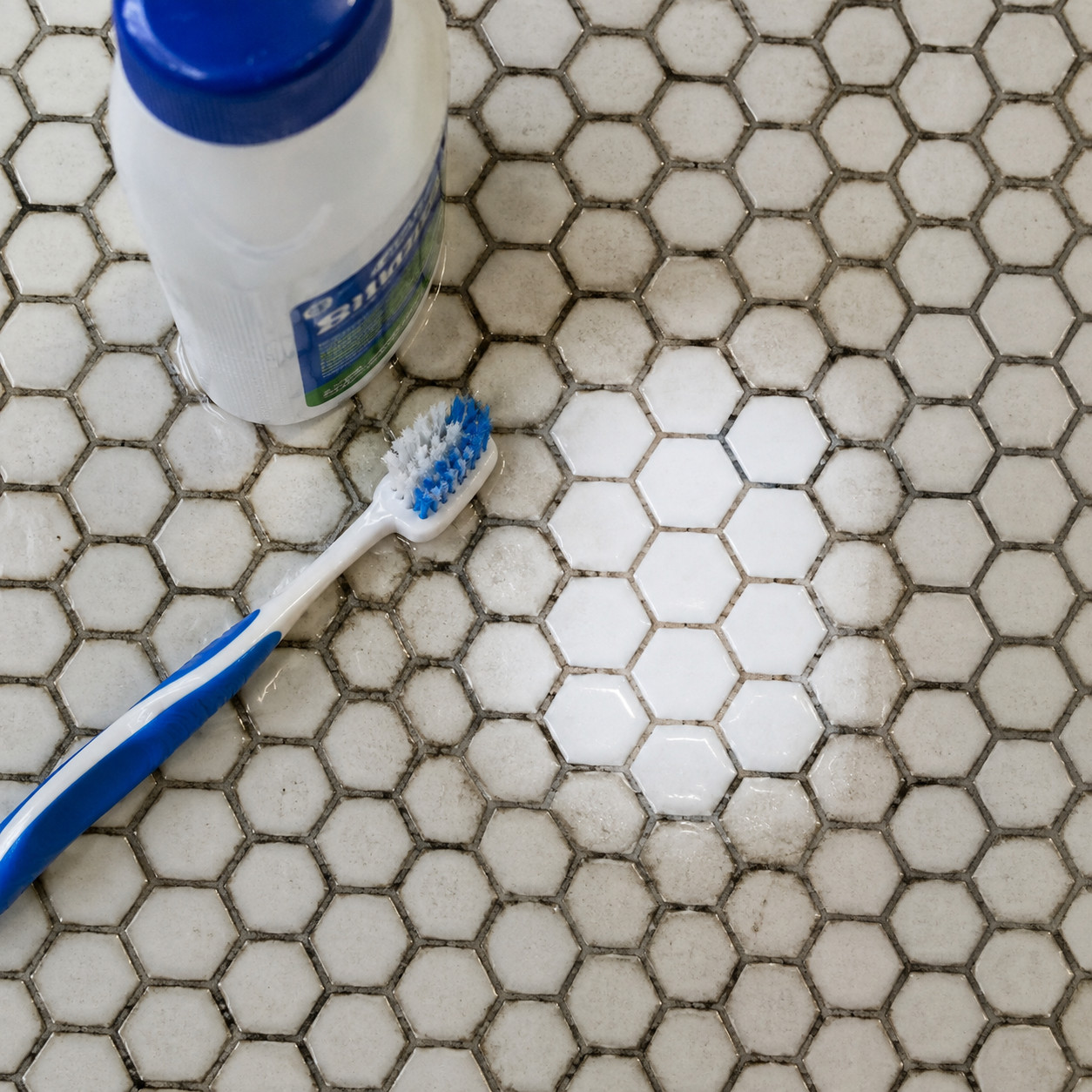
A 1920s hex floor is one of the loveliest things in an old house. Then you own one.
Smaller tile means more joints. A penny-round floor can be close to half grout by surface area, and grout is the part that stains.
Hair, soap film, and dirty mop water settle into every one of those miles of joints. A mop glides right over the top and cleans almost nothing.
Five years in, you’re on your knees with a toothbrush and a bottle of oxygen bleach. Epoxy grout helps enormously — spend the extra on it if you’re set on the look.
19. Polished Concrete in a Living Room or Bedroom
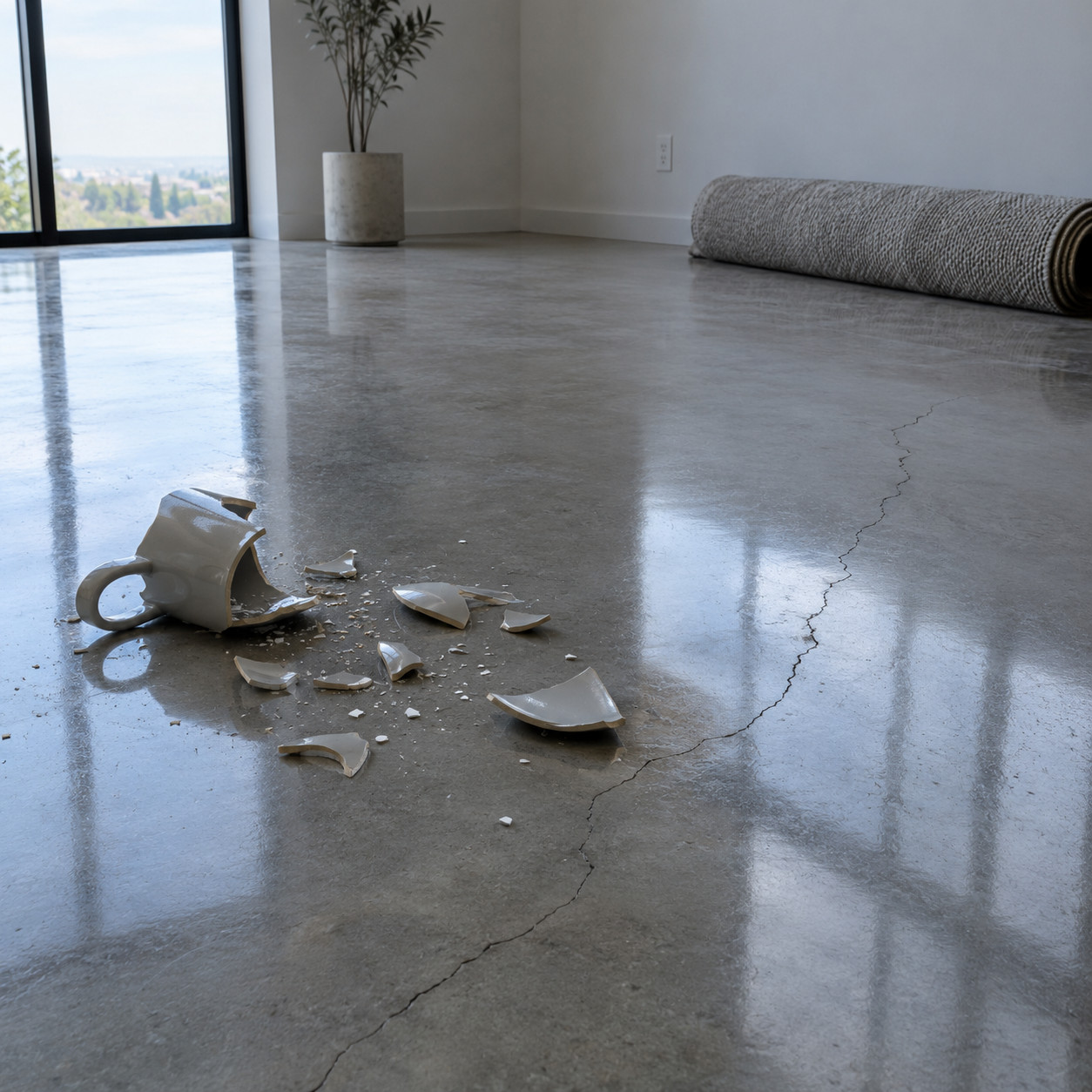
It photographs like a downtown loft. It lives like a parking garage.
Concrete is cold — it pulls heat out of your feet all winter unless you’ve got radiant tube in the pour. It’s also acoustically brutal. Every footstep, every dropped fork, every dog nail clicks and echoes because there’s nothing in the room absorbing sound.
Drop a plate and it’s gone. Drop a phone and it’s gone.
Then there’s cracking, which isn’t a defect so much as a certainty. Concrete shrinks roughly 1/16 of an inch per 10 feet as it cures, and it keeps moving with the soil underneath for the life of the house. Control joints are supposed to tell it where to crack. Sometimes it ignores them.
A hairline crack in a garage is nothing. A hairline crack wandering diagonally across your polished living room floor is a permanent feature, because you can’t patch polished concrete invisibly. Color-matched epoxy injection runs $300 to $800 for a single crack, and it will still read as a repair. Slab issues from actual settlement — where the crack has vertical displacement — start at a few thousand and go up fast.
The final irony: the only way to make it comfortable is to cover it in rugs, which is the look you were trying to avoid.
20. Cork in a Sun-Drenched Room
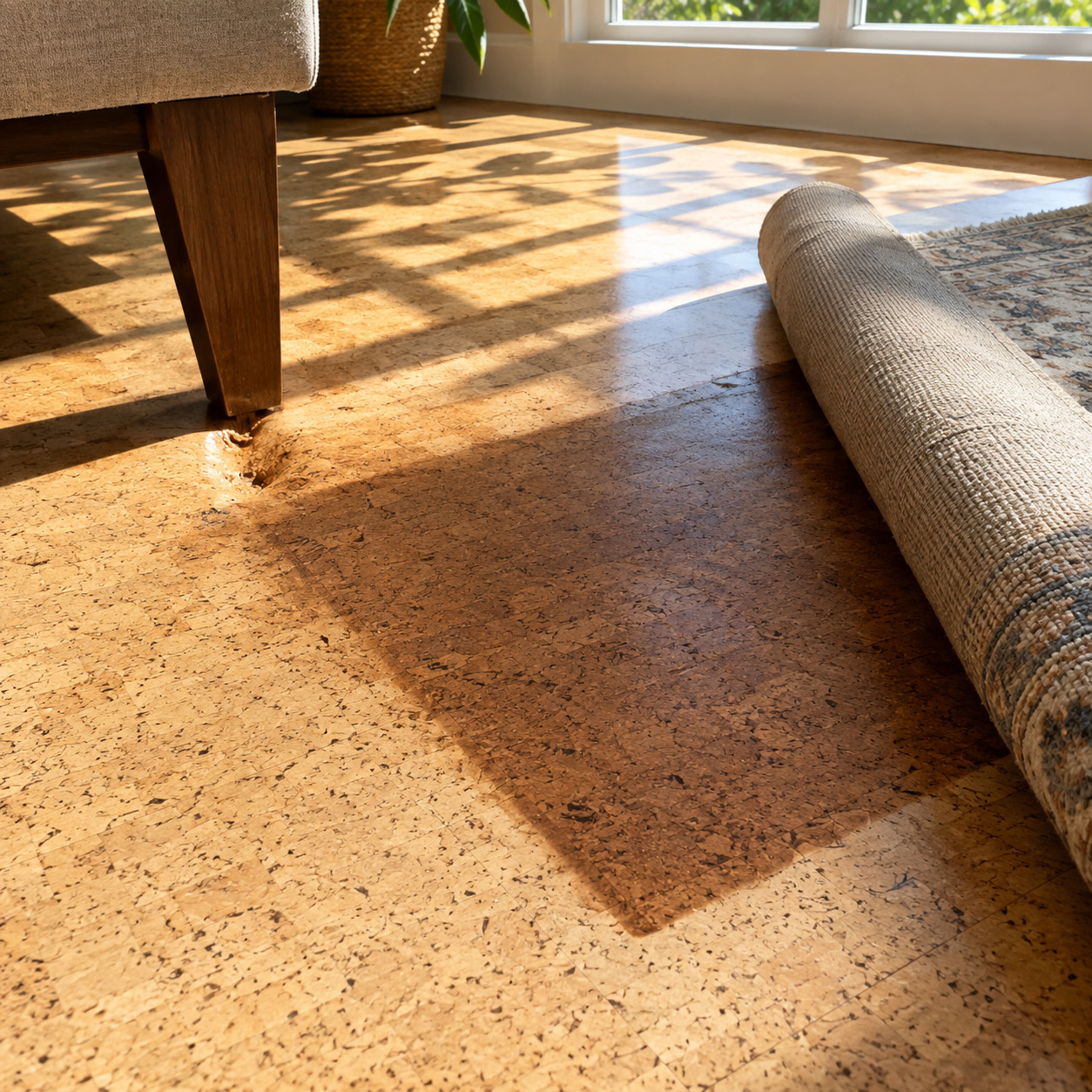
Cork deserves its reputation. It’s warm underfoot, quiet, forgiving on your knees, and made from bark that grows back.
It also fades. UV bleaches cork noticeably faster than it bleaches oak, and the reveal comes the day you move the area rug and find a perfect dark rectangle in the middle of a pale floor.
Dog claws tear it. A refrigerator leg leaves a permanent divot — cork is compressible, and compression past a point doesn’t spring back. Angi’s rundown puts dents and fading at the top of the complaint list.
Put it in a north-facing study. Not the sunroom.
21. Ultra-Wide Planks Over Radiant Heat
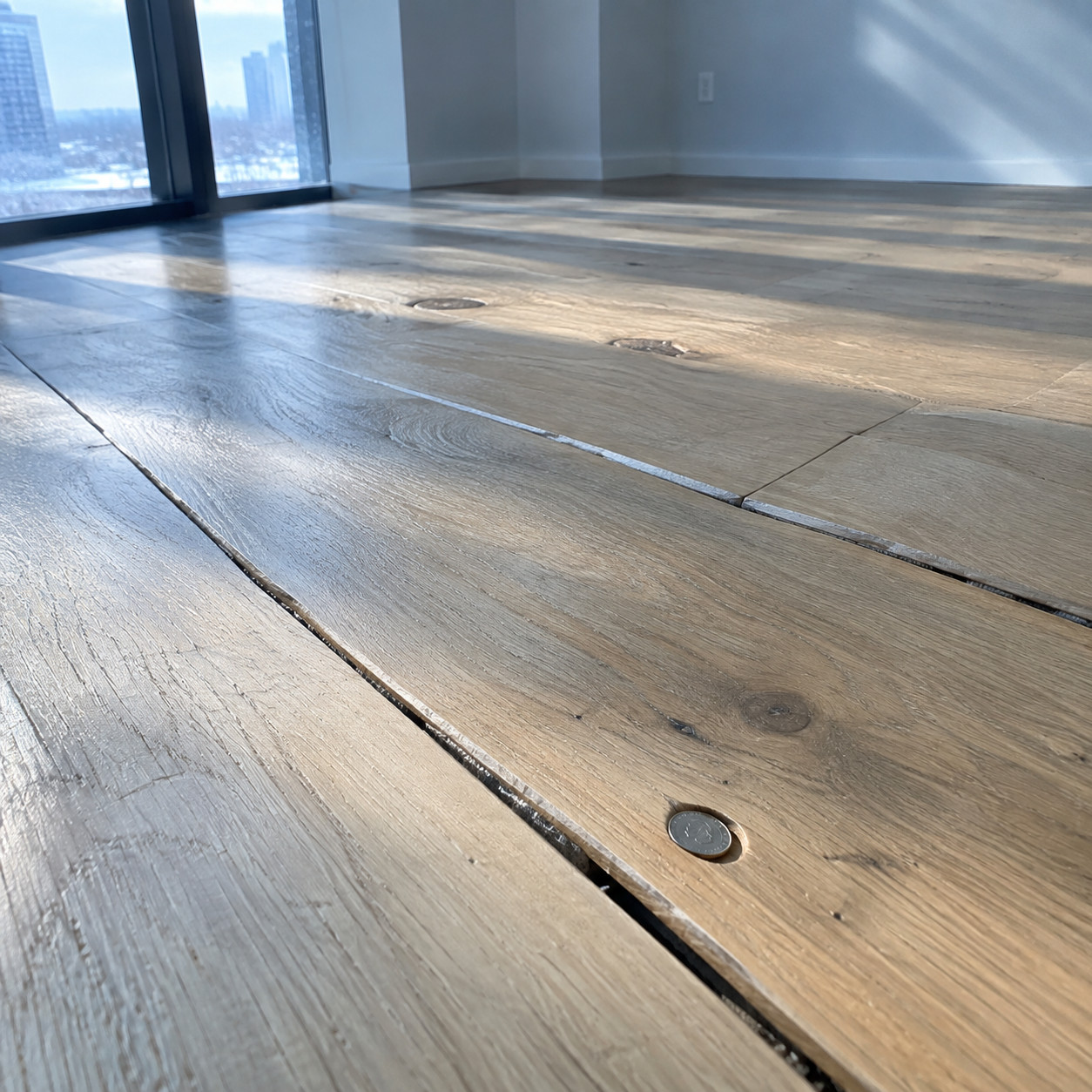
Wood moves across its width, not its length. That’s the whole issue.
A 3-inch strip floor might move 1/32 of an inch per board with a seasonal humidity swing — invisible, spread across a hundred boards. A 9-inch plank moves three times that, in the same seasonal swing, in one joint.
Now heat it from underneath all winter while the furnace drops indoor humidity to 20%. You get gaps you can drop a nickel into and cupped edges you can feel through a sock.
Engineered wide plank is the answer, with a humidifier and a slab temperature capped around 80°F. Solid 9-inch oak over radiant is a physics problem, and no warranty covers physics.
22. Patterned Encaustic Cement Tile
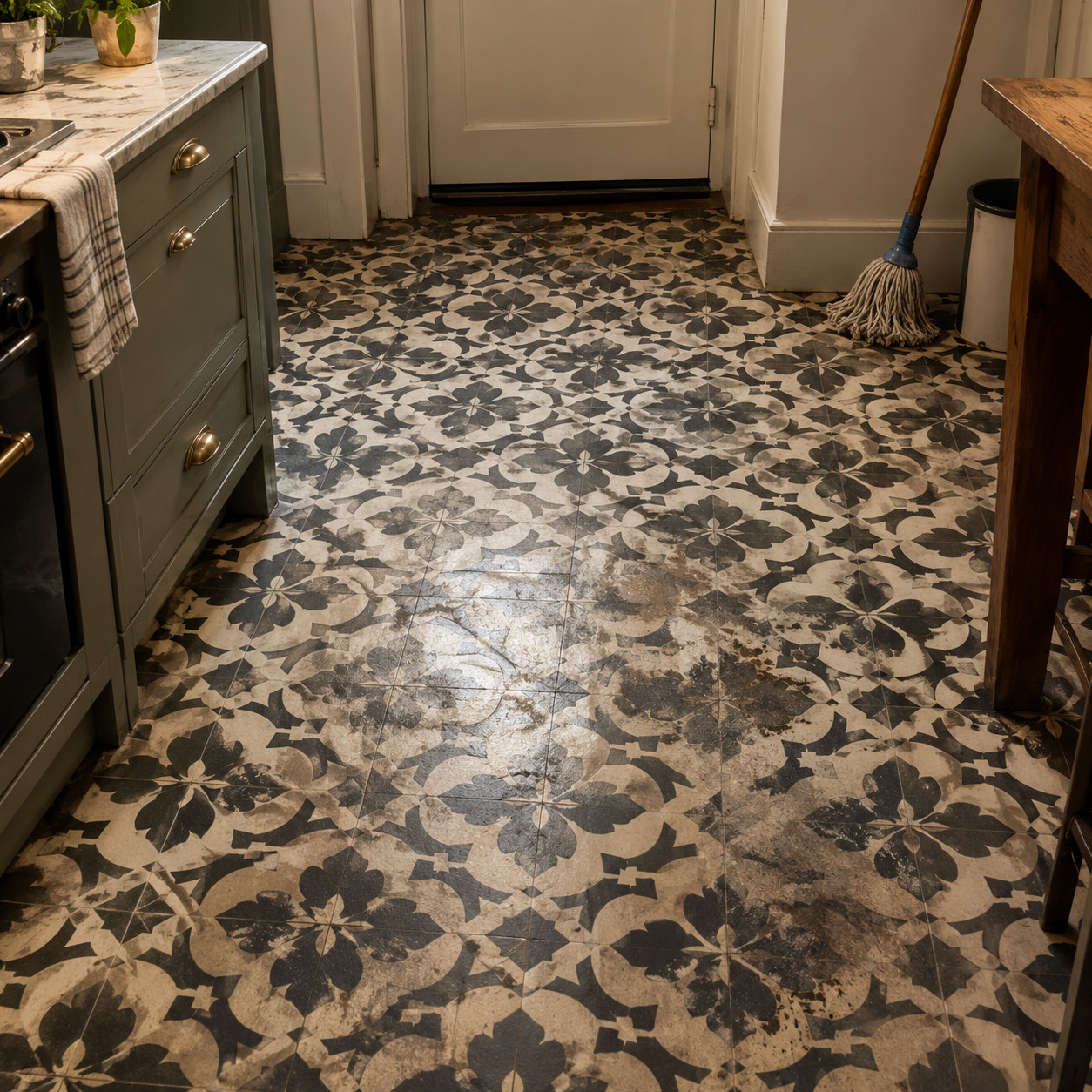
True cement tile isn’t fired. The color is pigment pressed into the top layer, and the body stays porous like a sponge.
It needs a penetrating sealer at install and resealing on a schedule — realistically every year or two in a kitchen. Almost nobody keeps that up past the first time.
Unsealed, it absorbs cooking grease, mop water, and red wine right into the pattern. Splotchy is not a look.
And separate from maintenance: a bold graphic floor is the hardest thing in a house to live with for a decade. Wallpaper you can strip in a weekend.
23. Sheet Vinyl With a Photo-Printed Stone or Brick Pattern
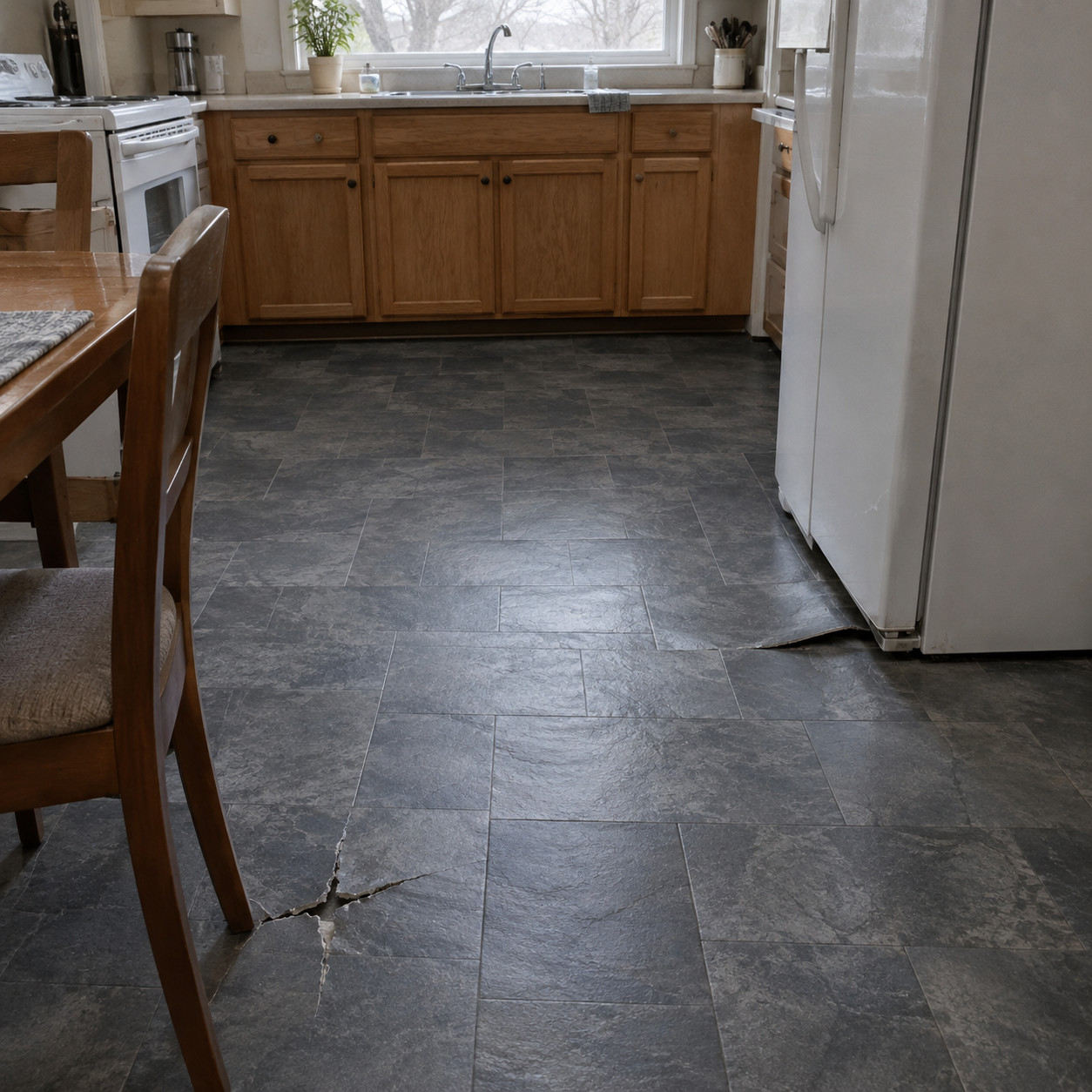
Stand at the doorway and you’ll find the repeat. The same three “stones” cycle across the whole room, and once you see it you can’t stop.
Seams lift where the adhesive thins out. A dropped chef’s knife or a dragged chair leg opens a tear, and there’s no patching sheet goods invisibly — the pattern won’t line up and the seam always shows.
Buyers price it as “needs replacing” the second they walk in. That’s the real cost.
24. Sisal or Jute Wall-to-Wall
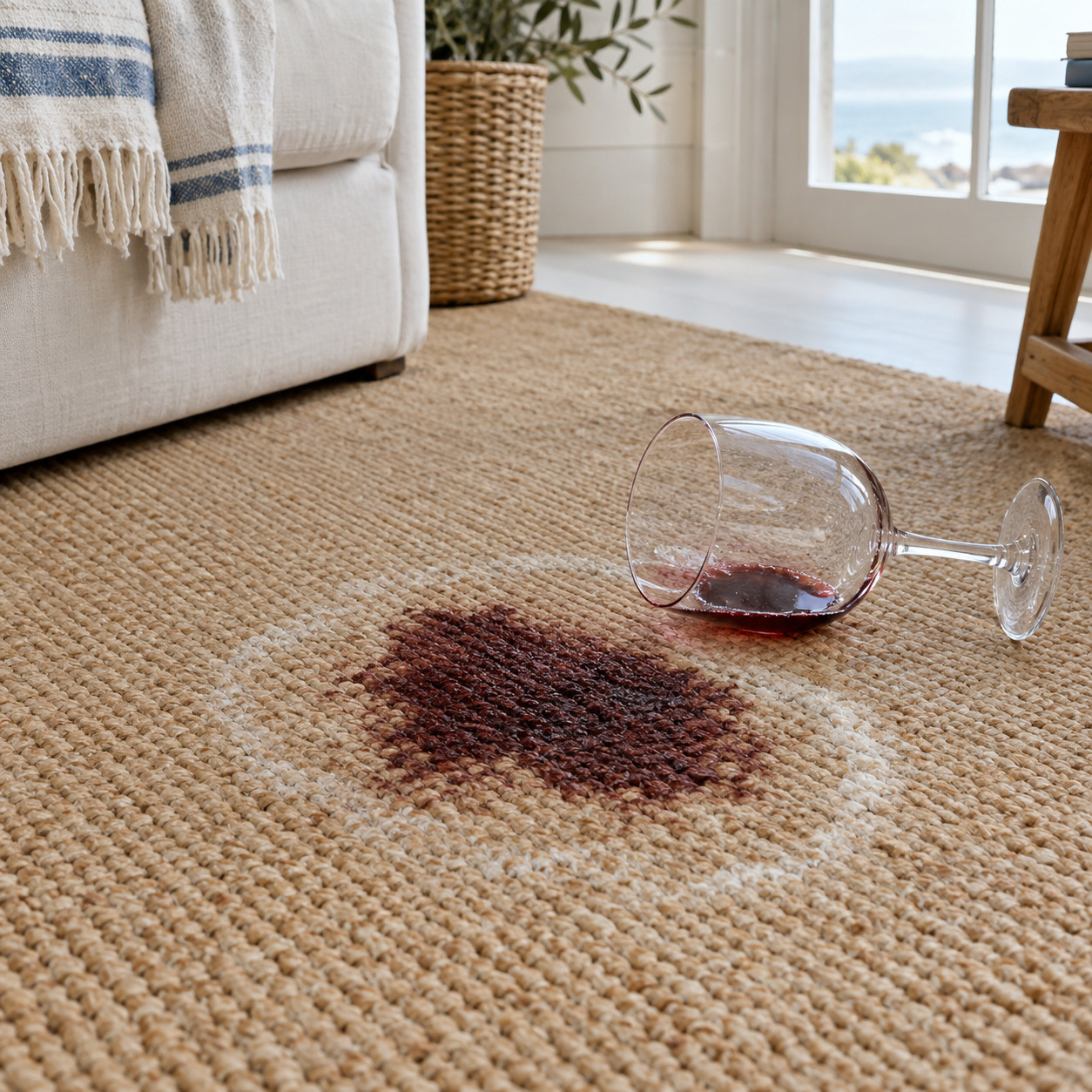
It looks beautifully restrained in a coastal house. Natural fiber wicks, which is the entire problem.
Spill something and it doesn’t bead or sit on top — it travels down the fiber and into the backing instantly. Then you try to blot it with water and you get a water ring, because jute stains when it’s cleaned.
One glass of pinot noir is permanent.
It’s also coarse enough that nobody sits on it, nobody lies on it, and kids avoid it barefoot. A soft floor that nobody wants to touch is just an expensive floor.
25. A DIY Epoxy Kit Over a Garage Slab
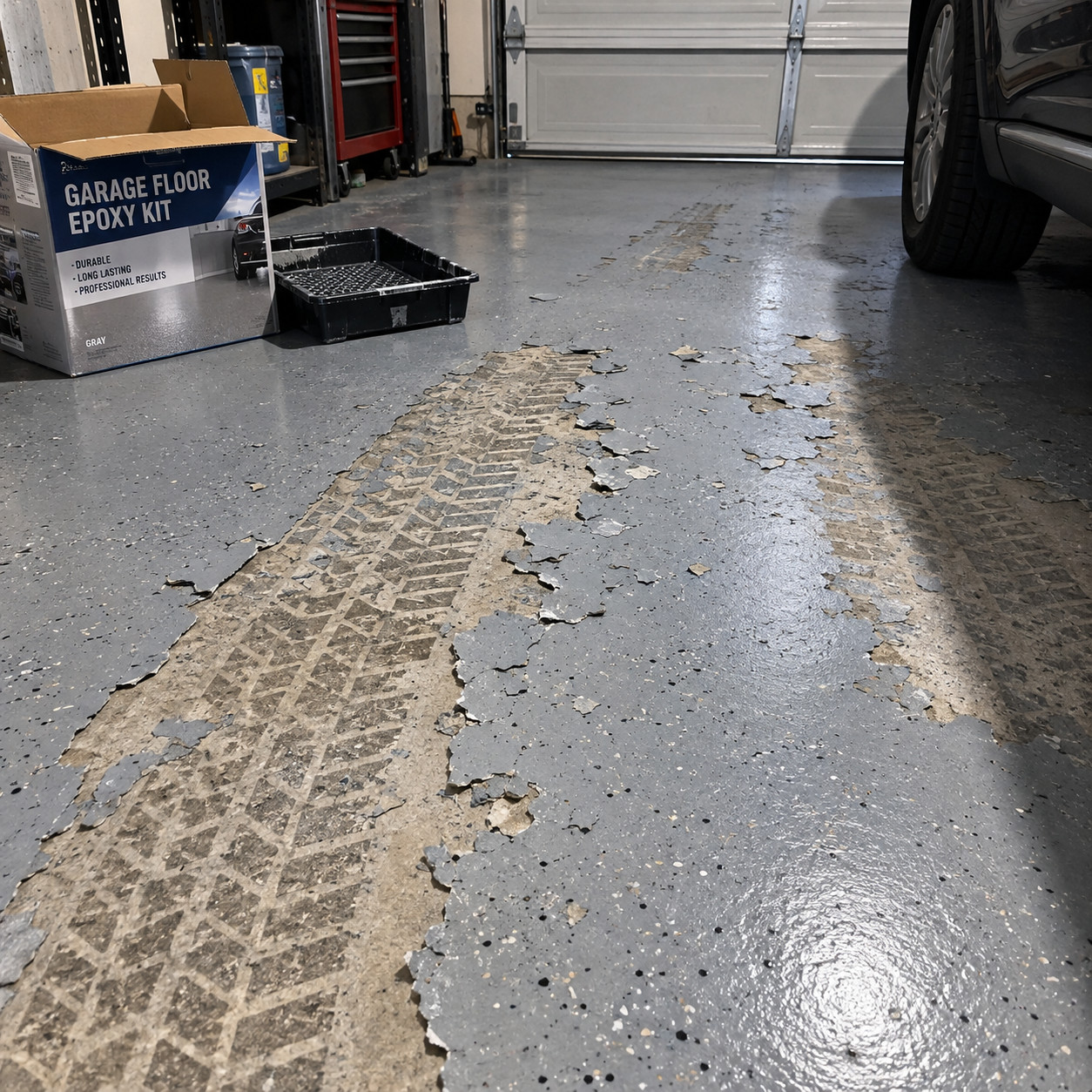
The box promises a Saturday. The failure arrives two summers later.
Two things kill garage epoxy: skipped surface prep and slab moisture. Acid etching from the kit doesn’t open the concrete the way mechanical grinding does, so the coating is sitting on a surface it never really grabbed.
Then hot tires do their work. A tire that’s been on the highway comes home at 140°F and softens the coating, then grips it as it cools — hot tire pickup, and it lifts the epoxy off in sheets shaped like your tread.
Removing failed epoxy means renting a diamond grinder and eating the dust, or paying a crew more than the original coating cost. A professional grind-and-coat runs $4 to $8 a square foot for a reason.
26. Unsealed Travertine or Slate
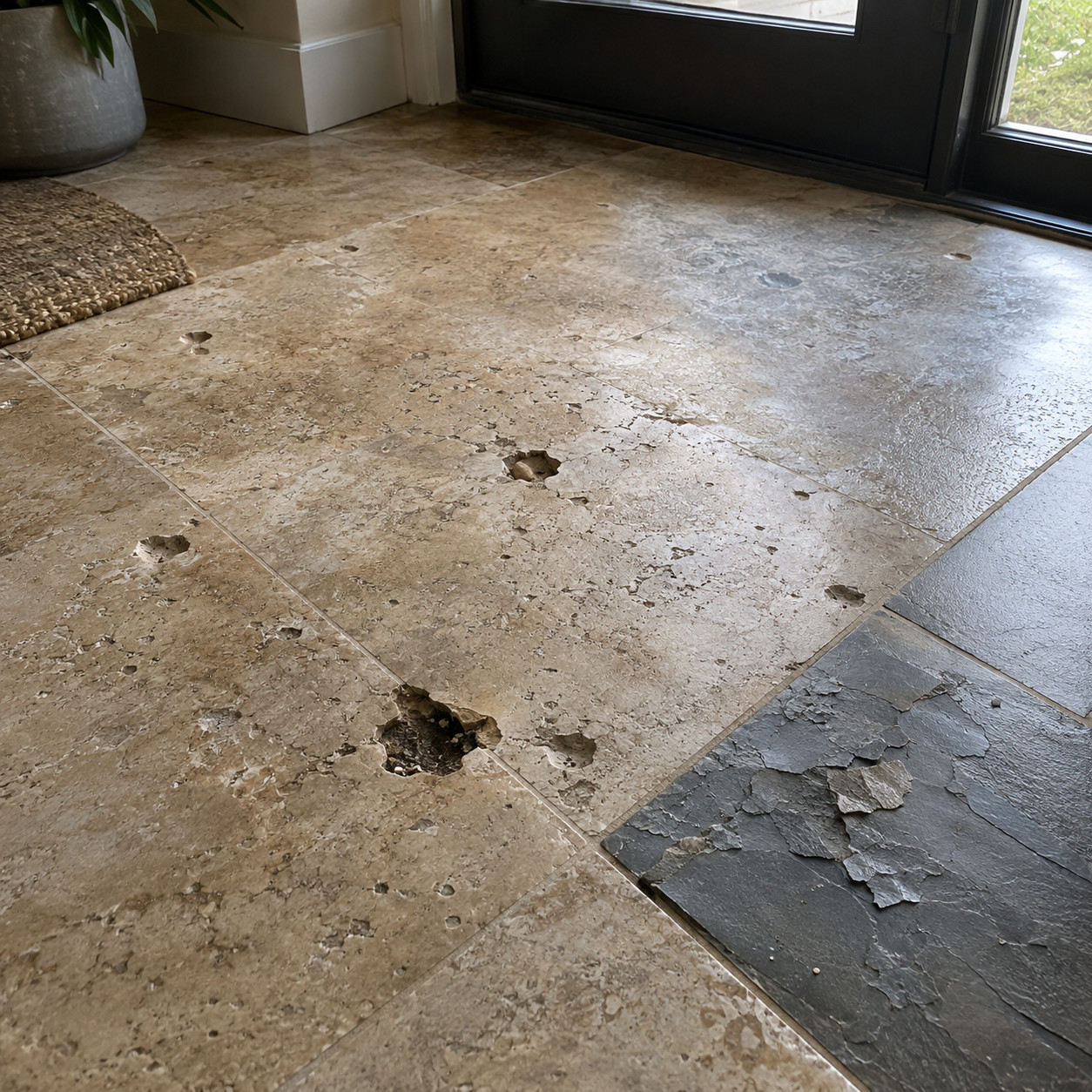
Travertine comes out of the quarry full of voids. The factory fills them with resin or cement, and those fills pop out over a few years of foot traffic, leaving pits that collect dirt and never mop clean.
Slate has a different failure: it spalls. Thin layers flake off the surface — that’s the material’s natural cleavage doing what it does — and you find gritty little chips on the floor that you swear weren’t there yesterday.
Both stones need sealing and both hate acidic cleaners. Mop travertine with vinegar for a year and you’ll etch the whole floor uniformly, which at least is consistent.
27. Painted White Plank Floors
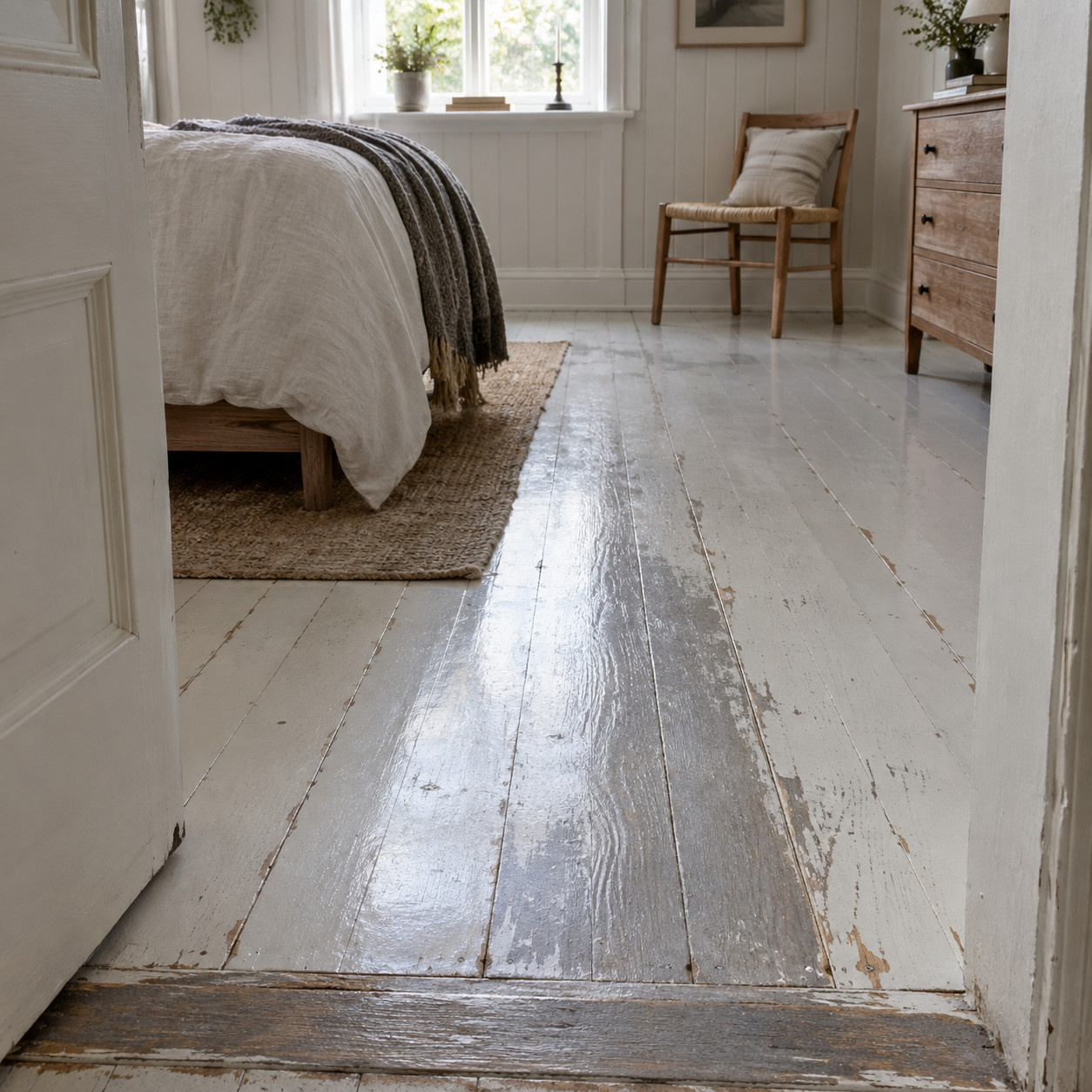
Every Scandinavian cottage photo you’ve saved. Also a floor with a one-year clock on it.
Paint forms a film on top of the wood instead of penetrating it. Stain soaks in; paint sits. So traffic abrades the film off at the doorways, the stair landing, and the spot in front of the sink, and you’re looking at bare gray grain inside twelve months.
Touching up doesn’t work, because fresh white never matches settled white. The fix is repainting the entire room, and then doing it again.
Two coats of a proper floor enamel plus a clear topcoat buys real time. A quart of wall paint buys a season.
28. Any Floating Floor Over an Unlevel Subfloor
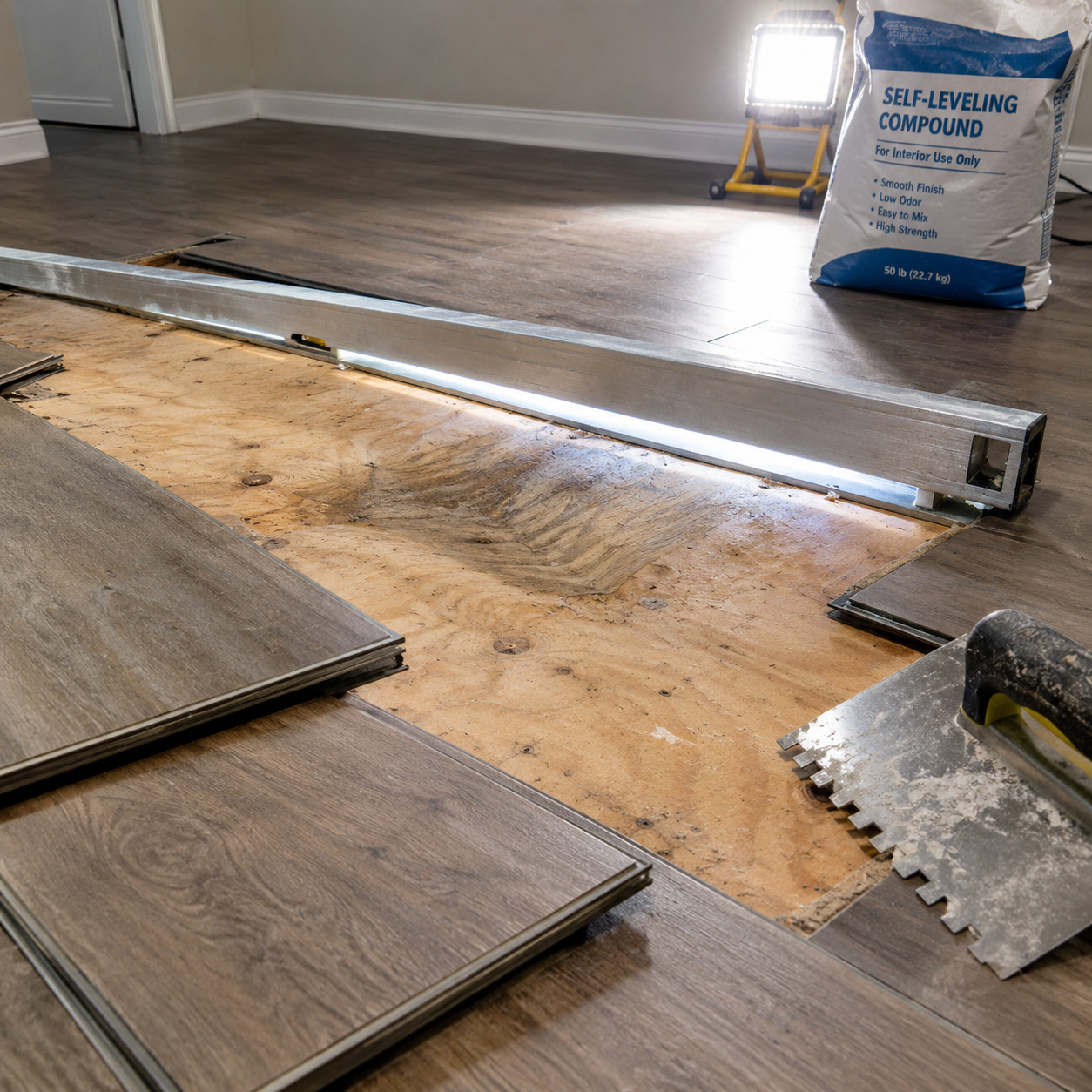
This one explains half the failures above it.
A floating floor isn’t fastened to anything. It’s a big rigid raft of locked-together planks resting on foam, and it depends entirely on the surface underneath being flat and on having room to move at the edges.
Nearly every manufacturer spells out the same tolerance: flat within 3/16 of an inch over 10 feet. Most houses aren’t. Old joists sag, new subfloors crown at the seams, and slabs have low spots you can’t see by eye.
Lay planks across a dip and the click joints span it like a bridge. Step on the span and the joint flexes. Every step works the locking mechanism a little looser, until you hear that hollow tick and the seam separates into a visible gap or a lip you can catch a sock on. RS Hardwood Floors lists uneven subfloor as the root cause behind most vinyl plank complaints they get called out for.
The other half is expansion gap. Vinyl and laminate expand with temperature and humidity, and they need roughly 1/4 inch of free space at every wall, every door jamb, every pipe. Pin the floor tight to a wall or trap it under a heavy kitchen island and it has nowhere to grow — so it goes up, and you get a ridge running across the room like a wave.
The repair is never local. You pull the floor back to the problem, grind down the high spots or pour self-leveling compound in the low ones, and reinstall — and click joints get damaged coming apart, so figure on buying material again.
Self-leveling underlayment runs $1.50 to $3 a square foot installed. A full tear-out and reinstall costs several times that. Check the deck with an 8-foot straightedge before anything goes down. It’s a twenty-minute job that saves the whole floor.
If you’re cutting the material yourself, the right blade for cutting laminate flooring matters more than people expect for clean, tight-fitting ends at the walls.
29. A Different Floor in Every Room
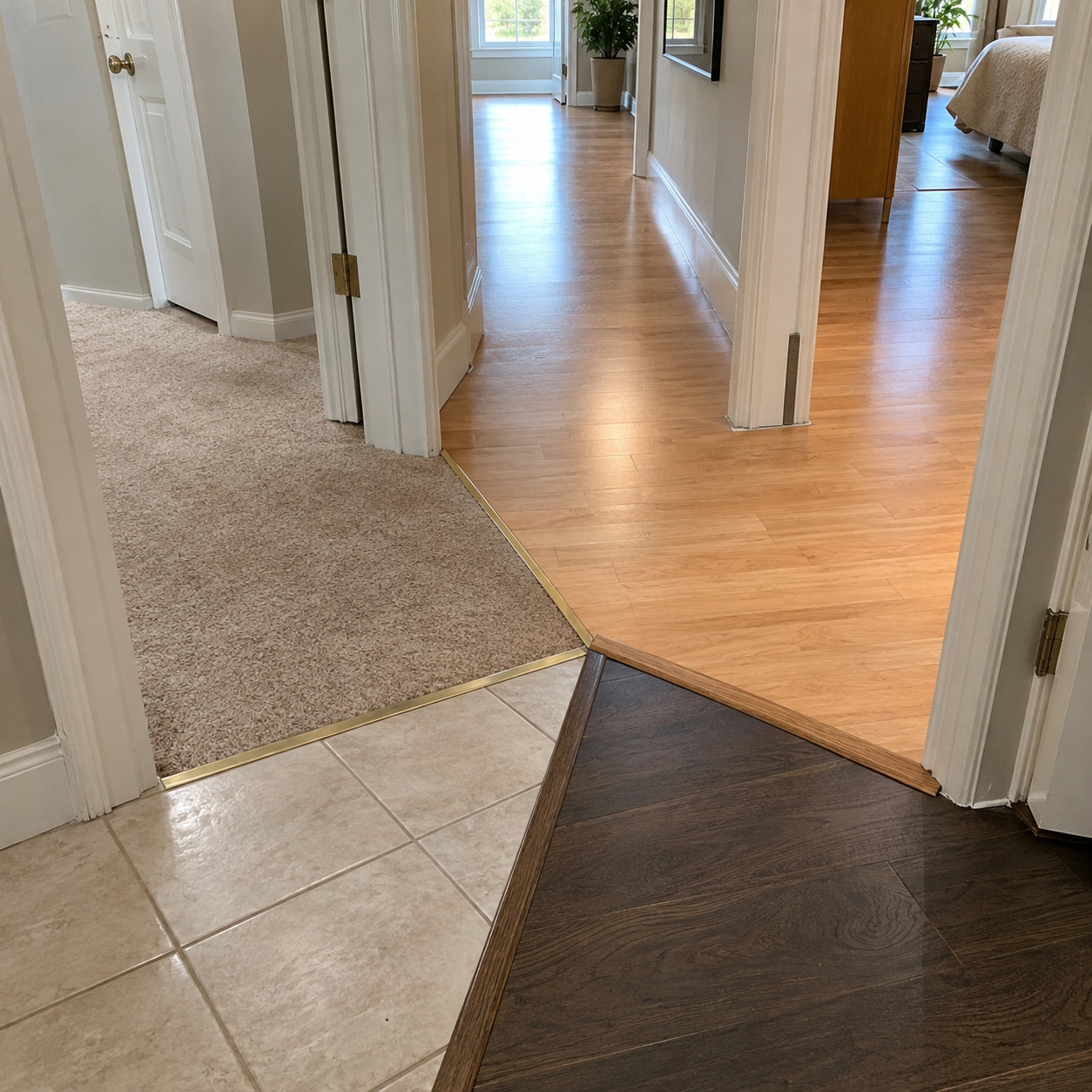
Nobody plans this. It accumulates.
Tile in the kitchen in 2011, laminate in the den in 2015, carpet in the bedrooms because it was on sale, engineered plank in the addition. Five renovations, five floors, and eleven transition strips.
Each strip is a little ridge that catches the vacuum, trips guests, and visually chops the house into small boxes. Sightlines die at every doorway.
Running one floor through the main level is the cheapest way to make a house feel twice as big. You only notice the mistake after everything’s installed and you’re standing in the hall looking at four different woods. It’s the same slow-accumulation regret behind a lot of features homeowners wish they’d chosen differently.
30. Ripping Out the Original Old-Growth Floor
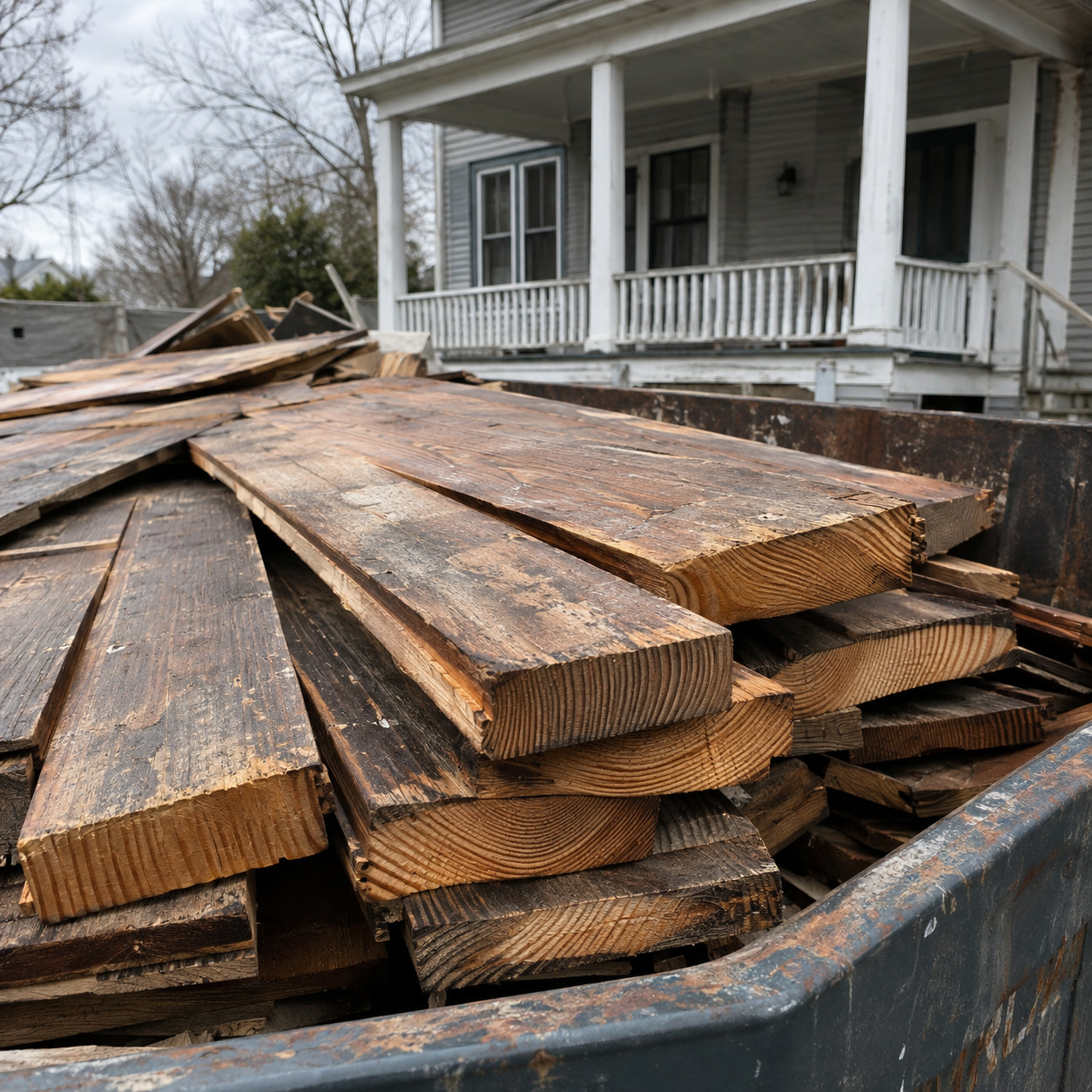
The dark, scratched, slightly gappy floor in a 1912 house is usually the most valuable thing in the room.
Quartersawn white oak, longleaf heart pine, Douglas fir with thirty growth rings to the inch — that lumber came from trees that had been standing for two or three centuries before they were cut. Nothing growing on a plantation today produces that grain density, and no amount of money buys it new.
It also has a quarter-inch or more of wood above the tongue. That’s four or five refinishes. It will outlive the next three owners.
Nine times out of ten, what looked like a ruined floor was a tired finish. Eighty grit, three coats, done.
A dumpster is forever.
31. Rolled Rubber Gym Flooring in a Spare Bedroom
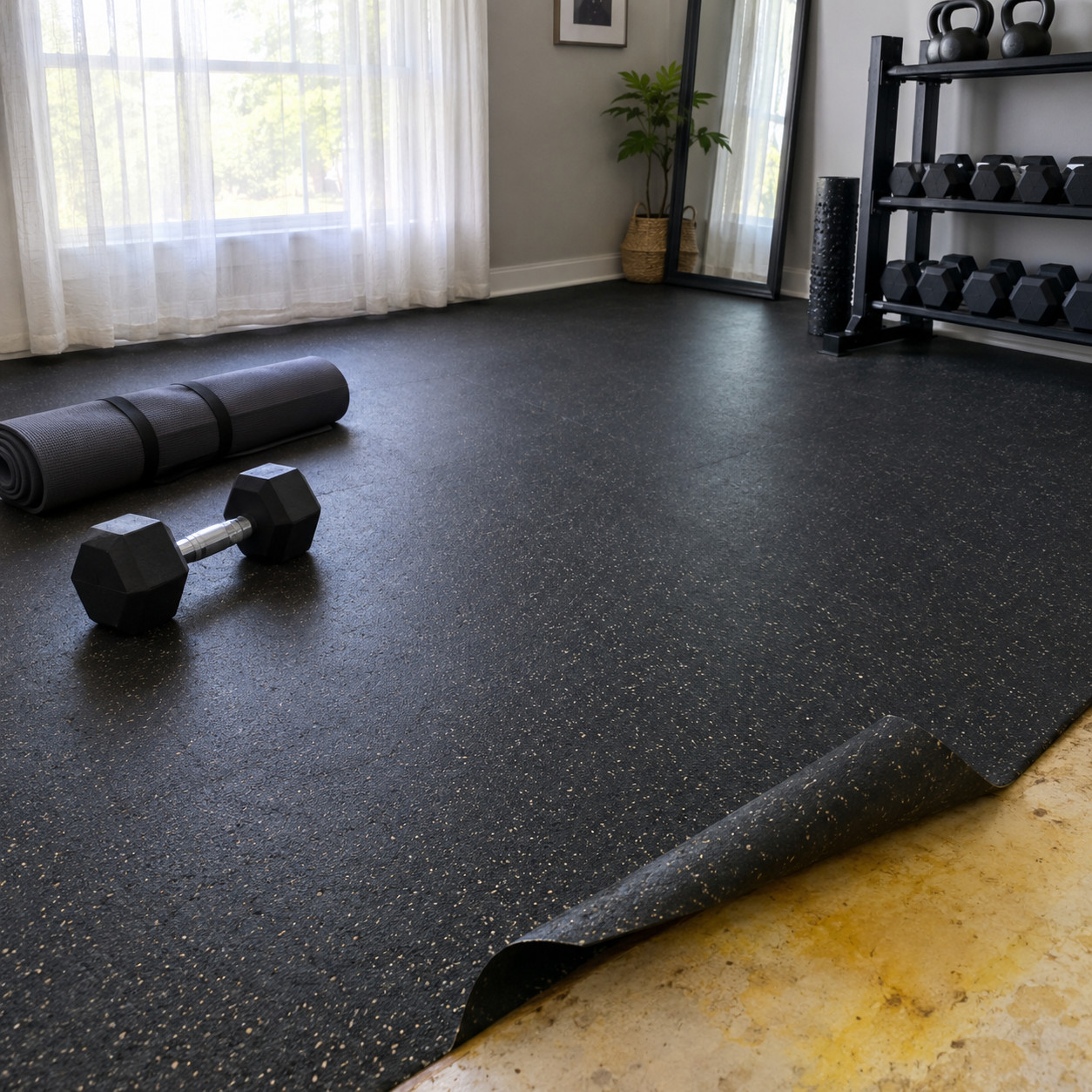
The 2020 home-gym boom filled a lot of spare bedrooms with 3/8-inch recycled rubber rolls.
The smell is the first regret. That’s off-gassing from the recycled tire crumb and it can hang around for a year or more in a room with one window.
The second regret shows up when you pull it. Plasticizers migrate out of the rubber and into whatever’s below, and they’ll permanently discolor vinyl, finished wood, and even light-colored tile.
Put a moisture barrier or a drop cloth underneath if you’re going to do it. Interlocking tiles you can lift out are a smarter bet than glued-down rolls.
32. Glossy Black Tile or Dark Stone in a Bathroom
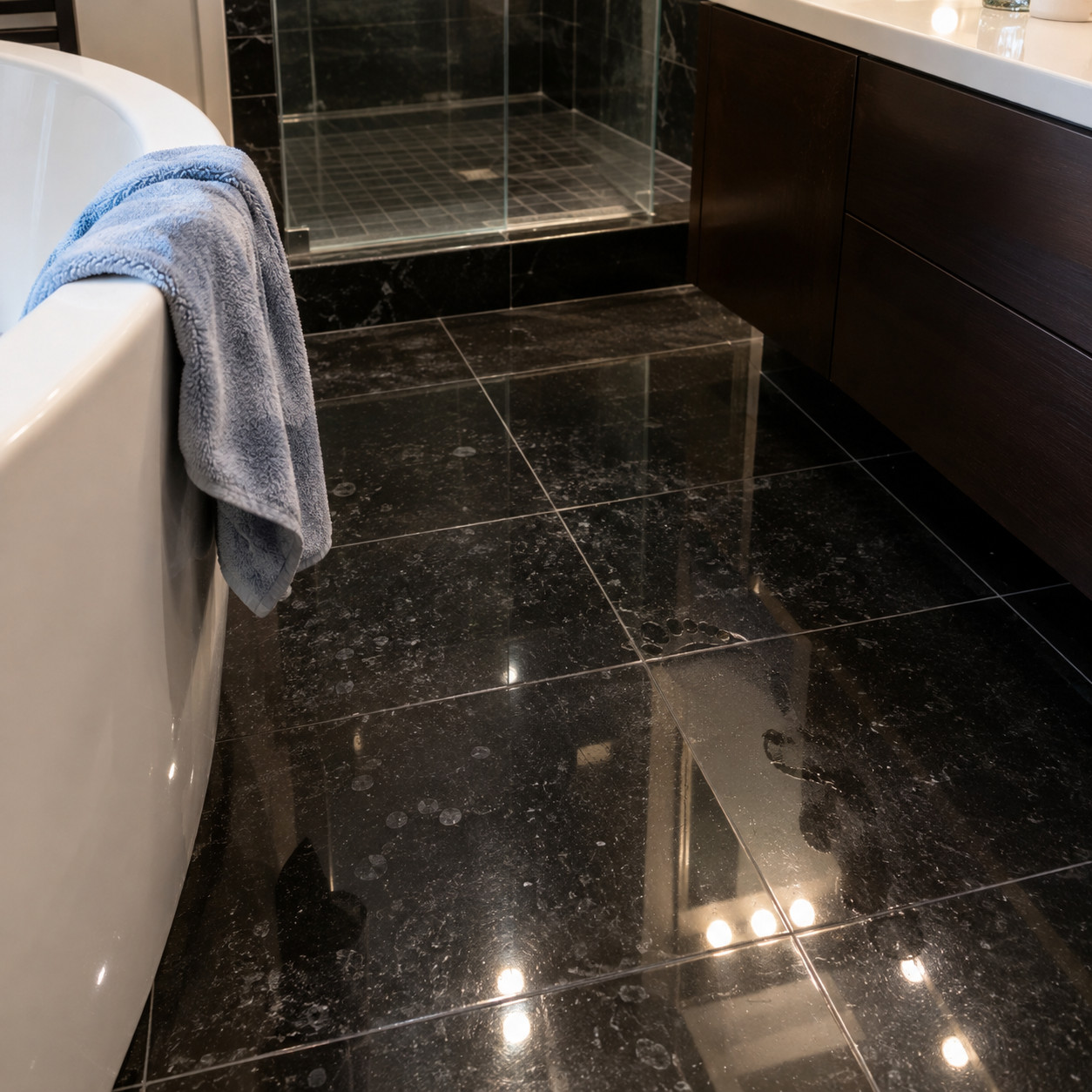
It cycles back every fifteen years or so, and it looks spectacular for the first week.
Then you shower. Hard water dries into white spots across the whole floor, dust reads like snow, and every bare footprint stays visible until you buff it off.
A dark bathroom floor demands a microfiber cloth after every use to look the way it looked in the showroom. Nobody does that.
Honed instead of polished, or mid-tone instead of black. Same drama, a fraction of the upkeep.
Almost none of these floors failed because the material was bad. They failed because the material was in the wrong room, or the spec sheet said 6 mil and nobody read it, or the subfloor was never checked with a straightedge.
Ask three questions before you buy anything: How thick is the part that wears? What happens to it when it gets wet? And is the deck underneath flat enough to hold it?
Floors are the one surface in a house you touch every single day. Buy the one you’ll still be walking on in twenty years — not the one that photographs best on install day.