


Someone in your family is minutes away from a costly mistake. That dresser is headed to Goodwill, the walnut credenza is going out with the trash, and the little oak table is about to get sanded because it “looks old.”
That worn-out look might be exactly what makes it valuable.
Estate liquidators pass on pieces constantly — not because the furniture isn’t good, but because a family already stripped it, painted over it, or swapped a part before anyone else got a look. The real clues almost never show up from across the room. They’re hiding on the back panel, underneath the piece, inside a drawer, or beneath a cushion.
No loupe required, no antiques degree needed. Just a flashlight, ten spare minutes, and the willingness to flip things over and actually look.
Below are 33 signs that the furniture sitting in your grandparents’ house might be worth serious money — plus the “helpful” fixes that quietly destroy that value.
1. Check If the Veneer Is Thick Enough to Spot at the Edge

People throw around “it’s just veneer” like it’s automatically bad news — it isn’t.
Old-style veneer was hand-sawn to roughly a sixteenth of an inch and layered over solid mahogany or oak underneath. Back then it actually cost more than solid lumber, since so much material was lost in the sawing process. Check a chipped corner or raw edge and that layer is visible to the naked eye.
Compare that to today’s rotary-cut veneer, which is thinner than a business card and tends to chip and peel rather than gracefully wear down.
Thick veneer laid over a good secondary wood tells you someone spent real money on this piece originally.
2. Spot Standout Grain Like Tiger Maple, Bird’s-Eye, or Crotch Mahogany

Nobody stumbles into dramatic wood grain — it was chosen and cut deliberately, at extra cost.
Think tiger maple rippling across a country bureau, bird’s-eye scattered through a chest front, or crotch mahogany book-matched into a butterfly pattern on a Federal case piece.
This figuring was most valued from 1780 through 1860, with another surge during the Empire era. Take two pieces of identical age and form — one plain, one figured — and the figured example can sell for multiples of the plain one.
3. Look Underneath Bentwood Chairs for a Branded Thonet Mark

Everyone assumes this café chair is a mass-market nobody.
Thonet released the No. 14 in 1859 and sold tens of millions of them — which is exactly why people write them off. Turn the chair over and check underneath the seat for a paper label or burned stamp, along with the original knockdown bolt-and-nut hardware that let manufacturers pack 36 chairs into a single crate for shipping.
Early Austrian and Czech pieces, plus unusual forms like rockers, high chairs, and settees, command far more than the hundred-plus years of copies that borrowed the silhouette.
4. Confirm the Marble Top Truly Matches the Piece

With a helper, carefully lift a corner of the marble top. Genuine original stone runs thick — three-quarters of an inch or more — and looks rough or chiseled underneath.
Next, check the outline against the case. A true original fits exactly, and its corner wear should line up with wear on the wood frame it sits in.
A thin slab, perfectly polished, with a modern rounded bullnose edge, is almost certainly a later replacement.
On Victorian and Eastlake dressers or washstands, that original marble can carry serious value on its own — those profiles simply aren’t produced anymore.
5. Watch for the Shimmer of Quartersawn White Oak

Angle the piece toward a light source and watch for shimmering ribbons and pale flecks moving through the grain — that’s medullary ray flake.
This figure only appears when a log is sawn perpendicular to its growth rings, a slow and wasteful method that most mills abandoned since plainsawn lumber stretches further per log.
The look peaked from 1895 to 1925, spanning the Arts and Crafts movement into Golden Oak furniture, and it remains the quickest way to tell genuine period oak from a flat, repetitive 1970s oak-look knockoff with zero flake.
6. Recognize an Untouched Original Finish

This entry might cost you the most if you get it wrong — “freshening up” old furniture is the single priciest mistake families make.
Shellac and early varnish darken to deep amber over a century, developing a fine crackled web and thinning out on arms and drawer fronts from decades of hands touching the same spots. Collectors call this patina, and they’ll pay for it.
Strip that surface down to bare wood and refinish with polyurethane, and you can erase 40 to 70 percent of a good period piece’s value in a single weekend — on something signed or documented, that could mean losing thousands of dollars.
In this market, water rings and light alligatoring read as proof of age, not damage. A trained restorer can clean and stabilize an original surface without stripping it away, which is an entirely different job from refinishing.
Leave the finish alone. Whether it’s a dresser, a chest, or a table, get an appraiser or conservator experienced with period pieces to examine it first and tell you what, if anything, it actually needs.
If cleaning feels necessary, start gentle: a barely damp cloth followed by paste wax. Skip anything with ammonia, and never touch it with a heat gun.
One exception stands: a 1970s dresser with peeling factory lacquer and no maker’s mark isn’t protecting any value. That one you can paint.
7. Identify Rare Woods Like Brazilian Rosewood or Cuban Mahogany

Some of this value comes down to scarcity — you simply cannot buy this material today, at any price.
Cuban mahogany was largely used up by 1900, prized for its tight grain and density that no current mahogany replicates. Brazilian rosewood, known for dark streaks and an oily shine, became CITES-restricted in 1992.
Anyone considering selling or shipping rosewood should check current regulations first, since international rules on restricted species have changed more than once.
8. Examine Original Brass Pulls and Their Hand-Filed Screws
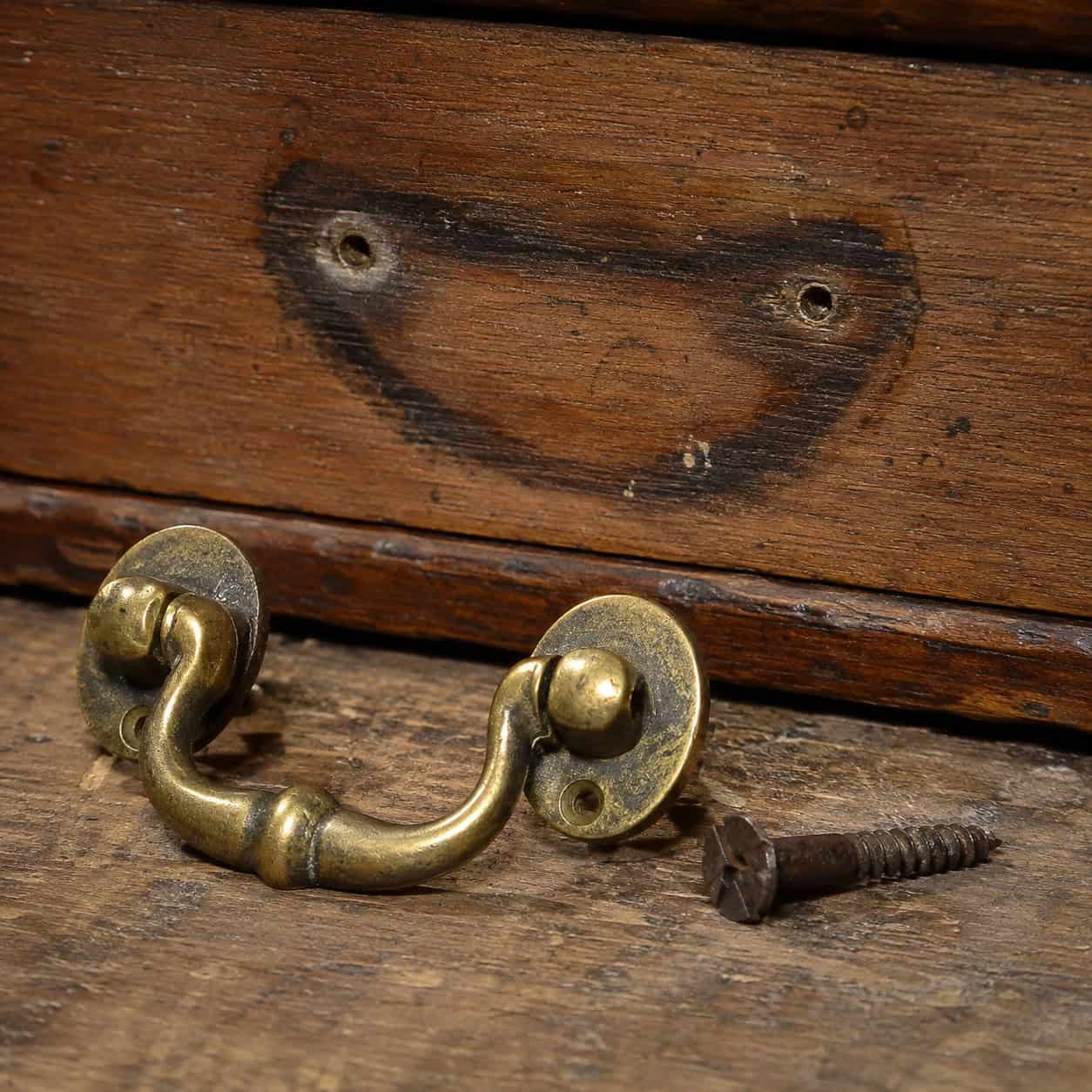
Remove a single pull and study the screw underneath — not the hardware itself.
Wandering hand-filed threads, a dull tip rather than a sharp point, and an off-center slot all point to work done before machine-cut screws existed, generally pre-1850. Sand-cast brass pulls have a grainy texture on the back and visible file marks along their edges.
Swapped-out hardware quietly destroys value more than almost anything else. Original brass leaves a shadow imprint in the finish and a wear ring in the surrounding wood, and replacement pulls almost never align with those marks. Hemswell Antique Centres lists hardware among the top giveaways for reproductions, for good reason.
If somebody in the family changed the pulls decades ago, check the basement — people tend to hang onto the originals.
9. Look for a Name and Date Penciled Inside a Drawer

Slide a drawer all the way out and flip it over to see the raw wood that was never meant to be seen.
You might find chalk numbers used to keep drawers matched to their case, a customer’s last name, a workshop stamp, or occasionally a full signature and date written in soft carpenter’s pencil, preserved because nothing ever touched that surface.
“J. Whitcomb, March 1861,” for instance.
He wrote his name somewhere he assumed no one would ever look, then slid the drawer shut. A century and a half later, that’s still his actual handwriting — and you may be the first person in generations to notice it.
Sometimes this discovery is what pushes a piece into real financial value. But for a moment, finding it stops being about money at all.
10. Check Cabinet Doors and Mirrors for Old Wavy or Cloudy Glass

Step to one side of a cabinet and watch how the room distorts through the glass. Cylinder glass — blown, then flattened — creates that ripple effect and was standard until roughly 1900.
Old mirror plate is even more distinctive. Made with mercury-amalgam silvering before about 1840, it develops a gray sparkle and fine crazing creeping inward from the edges.
Both are routinely destroyed in the name of “restoration,” with new float glass replacing old glazing and fresh silvering wiping out a mirror’s premium value entirely.
Let the cloudiness stay — it’s exactly what collectors are looking for.
11. Track Down Original Receipts, Tags, or Warranty Cards

Check behind every drawer, under tabletops, and inside the pockets of any upholstered arms — families tuck paper into furniture and forget about it for decades.
You might turn up a Marshall Field’s tag, a W. & J. Sloane delivery receipt dated 1931 with a street address, a cardboard hangtag still wired to a chair leg, or a warranty card from a 1962 Broyhill purchase.
That’s provenance, and it can shut down authenticity debates instantly — the gap between “we think this is Stickley” and an undeniable paper trail.
Photograph both sides of anything you find in good light, then store the originals in an archival sleeve or plain paper envelope (never vinyl, which off-gasses), keeping it with the piece — taped inside a drawer if that’s what it takes to avoid losing it during a move.
After that, get a formal written appraisal. A quick one-line insurance estimate won’t cut it for anything significant; look for a dated report from a credentialed appraiser that describes the item, names a value type, and explains the reasoning.
Standard homeowners insurance caps payouts on individual items well under what a quality period piece is actually worth. A scheduled personal property rider or fine arts floater covers full value, and insurers typically require a current appraisal before writing one — plan to update it roughly every five years as the market shifts.
Major institutions treat this documentation as inseparable from the object — the Winterthur Museum catalogs paperwork right alongside the furniture itself. If the piece is ever sold, that history travels with it and adds to the price.
12. Date the Piece by Its Nails
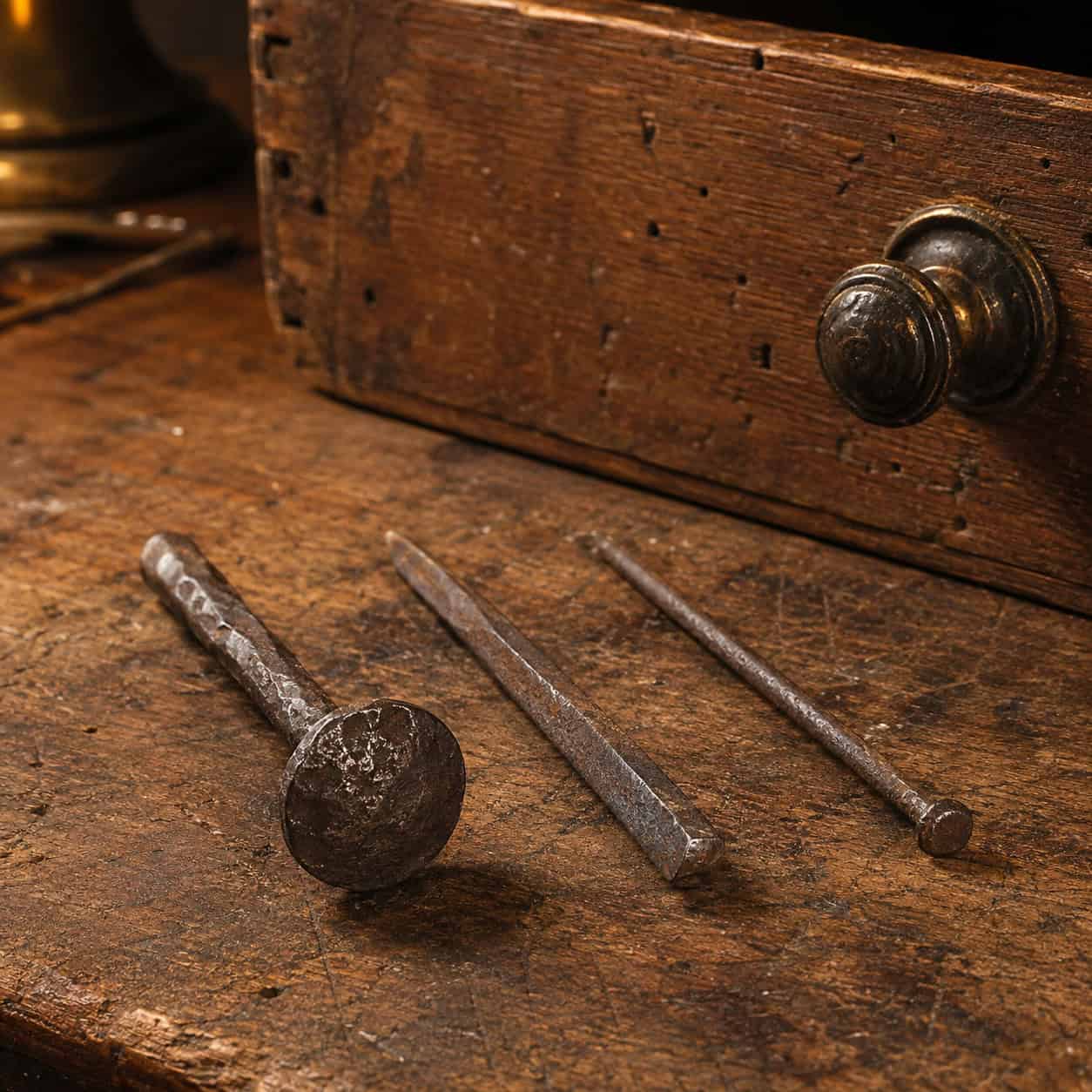
Nails might be the simplest, most reliable clock in the whole house.
Rose heads — irregular, hammered, faceted-top nails — signal the earliest construction, generally before 1800. Tapered rectangular cut nails, sheared from sheet iron, span roughly 1790 through the 1890s. Round wire nails appeared after about 1890 and have stuck around ever since.
Mismatched nail types within a single piece often mean a “marriage” — a bottom from one chest paired with a top from another, joined by a dealer decades later. Worth knowing before anyone tries to sell it as fully original.
13. Value Original Paint That Was Never Touched Up

Blue, mustard, barn red, or grain-painted swirls dragged on with a comb or rag to fake mahogany grain.
On American country cupboards, blanket chests, and benches, an original painted surface carries the single biggest premium in the whole category, since collectors are essentially buying the paint job — the wood beneath is frequently just plain pine.
Worn spots near the latch and front edge add to the value here rather than detract from it.
A single weekend with a heat gun can wipe out nearly all of that history, permanently.
14. Check Underneath for Herman Miller, Knoll, or Eames Markings

Foil labels, embossed medallions, and stamped date codes hide under seats and inside drawer bottoms. Herman Miller’s production dates back to 1946, while Eames fiberglass shell chairs were made from 1950 into the 1970s.
On a shell chair, examine the rubber shock mounts fixed to the underside — original mounts crack and separate with age, and that wear actually confirms authenticity (and it’s fixable).
The earliest shells — rope-edge construction, checkerboard labels — count as design-history artifacts rather than simple seating. Everything else with a similar shape is just a lookalike.
15. Judge the Drawers by Their Dovetails

Slide a drawer completely out and set it down where you can study the corner joint closely.
Three or four uneven, slightly wedge-shaped pins with faint scribe lines and small chisel overcuts mean a human being cut those joints by hand. Rows of tight, identical, closely spaced dovetails — a dozen or more, machine-perfect — mean a cutter head made them, dating the piece to the 1890s or later.
It takes ten seconds and it’s the fastest free value check in the house — Popular Woodworking explains how drawer construction dates furniture better than almost any other detail.
Irregularity here isn’t a flaw. It’s essentially a signature.
16. Spot Heywood-Wakefield’s Blonde Birch and Eagle Stamp

You know the set — that pale honey-toned bedroom furniture grandma always called “the blonde furniture,” with its champagne or wheat finish, rounded corners, and solid northern birch construction.
Made from roughly 1936 to 1966 under Heywood-Wakefield’s Streamline and Encore lines, these pieces carry a branded eagle logo with model numbers that make identification easy, and a complete matched suite ranks among the most sought-after American mid-century names on the market.
Worth repeating: stripping that original wheat finish tanks the value instantly. Buyers specifically want the color it left the factory with.
17. Determine Whether Ball-and-Claw Feet Were Truly Hand-Carved

Get down at floor level with a light aimed between the talons for a close look.
Genuine period Chippendale carving from the 1750s through 1790s shows undercut claws deep enough to slide a fingernail behind, knuckle detail that varies foot to foot, and leftover rasp and gouge marks tucked in the recesses where nobody bothered sanding. Colonial Revival copies made after 1890, by contrast, look machine-roughed, unnervingly symmetrical, and soft where the carving should be sharp.
Same basic shape. Wildly different price tags.
This is exactly how a family “Chippendale” piece often turns out to be a 1920s Grand Rapids reproduction — still a good chair, just not worth five figures. The North Bennet Street School teaches this exact hand-carving technique, and watching how it’s really done is the quickest education in spotting the genuine article.
18. Feel for a Hand-Carved Saddle Seat on a Windsor Chair

Run your hand across the seat surface. A genuine period Windsor seat was hand-gouged from a thick plank, so it rises and dips unevenly, with shallow tool marks visible when you catch the light at an angle.
Look for splayed legs socketed straight into that same plank, spindles shaved with a drawknife that taper at slightly inconsistent rates, and sometimes a maker’s brand stamped beneath the seat rail.
These chairs tend to surface in barns and back kitchens, often painted over two or three times.
Original paint on a Windsor chair beats a stripped, bare-wood version every single time.
19. Feel for Eight-Way Hand-Tied Springs Under the Upholstery
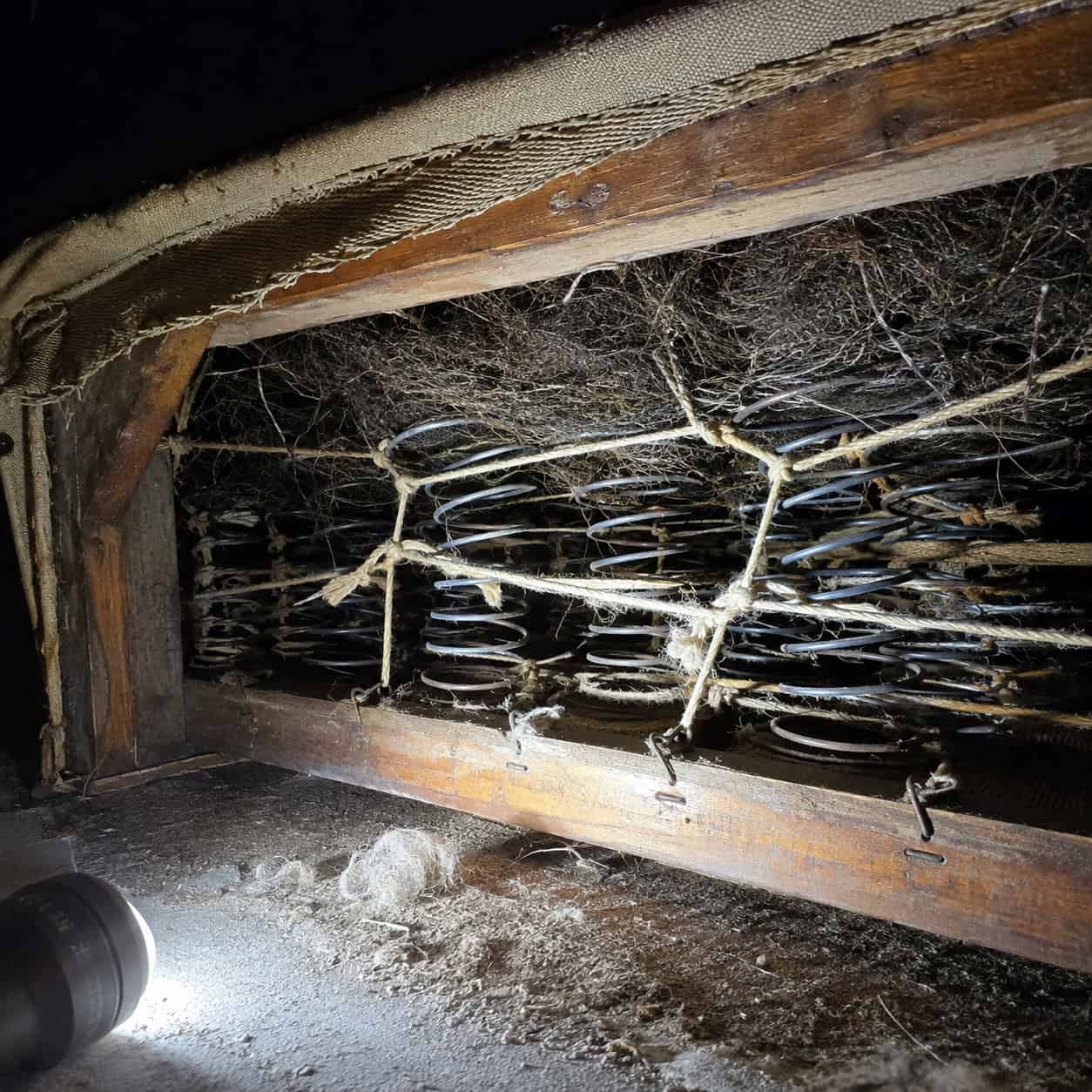
Reach underneath a sofa and feel through (or gently peel back a corner of) the dust cover.
Twine hand-knotted in eight directions around every coil is a construction method that disappeared once zigzag wire and foam took over — it takes a skilled upholsterer roughly an hour per seat to do it right.
Horsehair, Spanish moss, and cotton batting all confirm real age, and honestly, so does the smell.
The hardwood frame supporting all of that is almost always worth reupholstering, even if the fabric itself is a lost cause.
20. Tell Real Wormholes From Faked Distressing
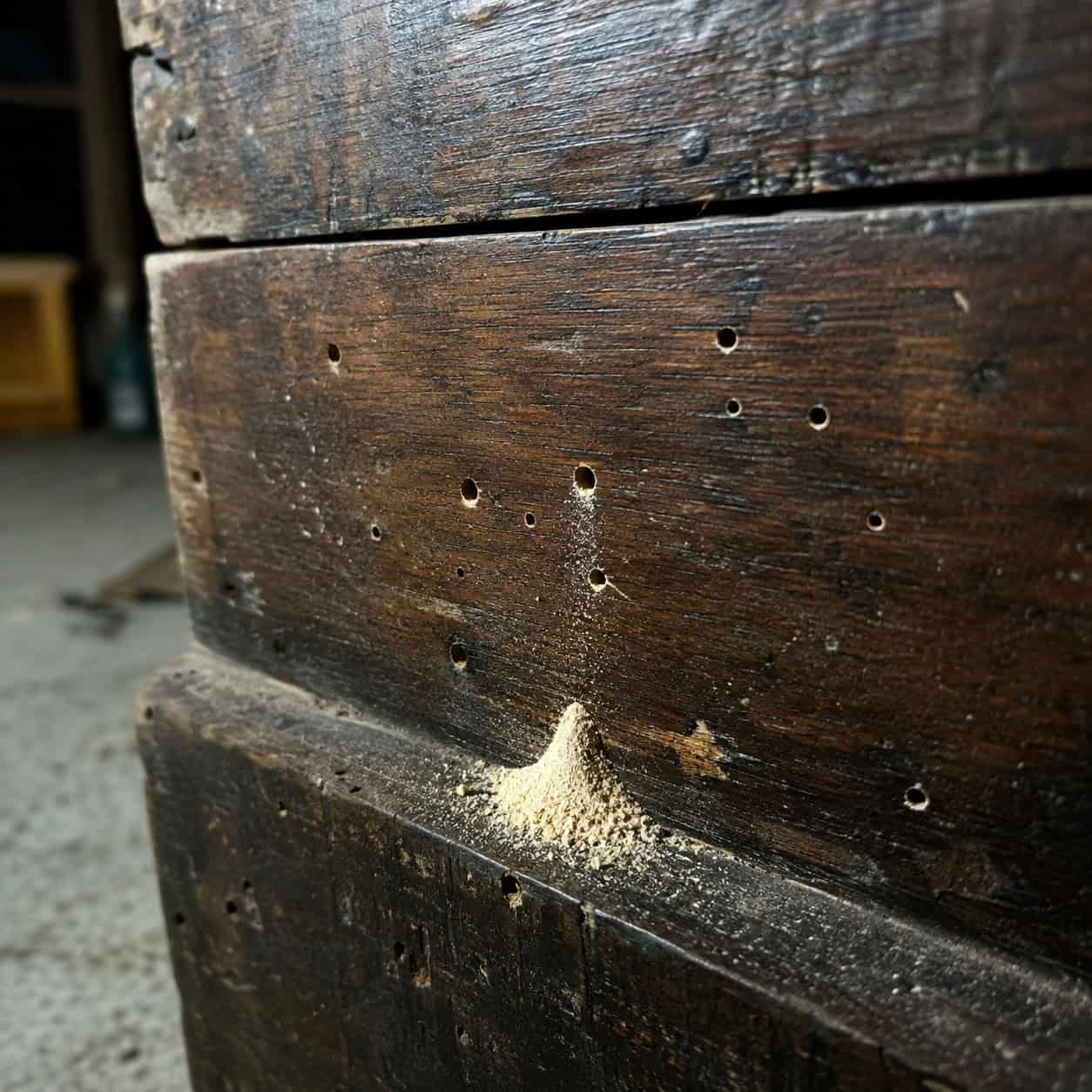
Study the holes at an angle rather than head-on.
Genuine powderpost beetle tunnels travel sideways just beneath the surface before breaking out irregularly, leaving round exit holes ranging from pin-sized to pencil-lead diameter, scattered with no pattern. Faked distressing, on the other hand, is usually drilled straight down or blasted with birdshot, leaving every hole perpendicular to the surface at a matching depth.
Gently probe a hole with a pin — if it runs straight in and just keeps going, treat that as a red flag.
More important than value: watch for fine, pale powder — the color of raw flour — collecting in a cone below a hole, or reappearing after you wipe it clean. That’s frass, meaning fresh activity, not old sawdust.
Old, inactive damage looks dark inside and stays clean once vacuumed. Active infestations keep producing new powder.
Never bring an actively infested piece straight into a home full of hardwood floors and oak trim. Isolate it in a garage or detached shed on plastic sheeting, wipe the sheeting down, and recheck in two weeks.
Depending on severity, treatments range from borate solutions on bare wood, to freezing smaller items, to professional fumigation for large case pieces. A pest control company familiar with wood-destroying insects can identify the exact species from the frass and hole size, which determines the right treatment — Wood Create goes deeper into the authenticity angle of worm damage.
Treat the problem, then keep the piece. Collectors are far more forgiving of a few old beetle holes in a 200-year-old chest than they are of a refinish job.
21. Read Saw Marks on the Underside to Date the Wood
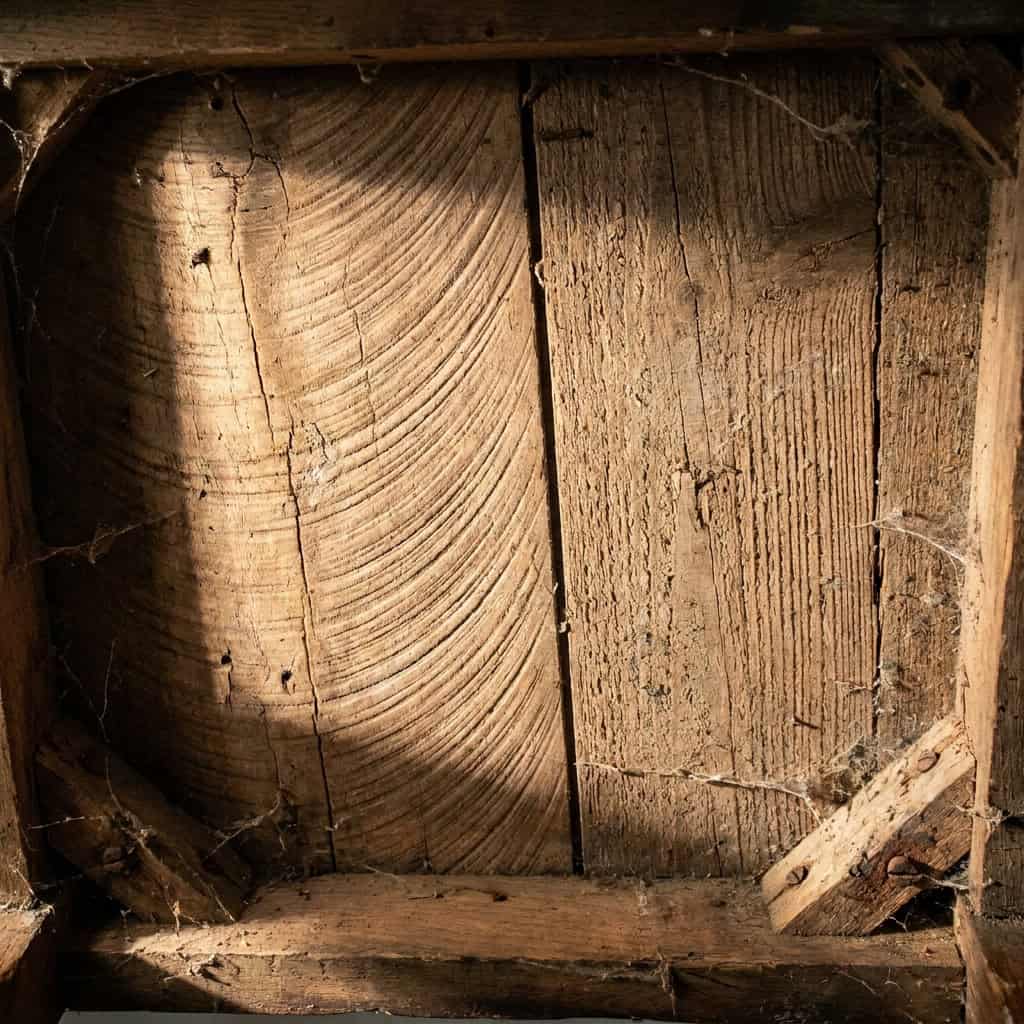
Flip the piece over and examine the unfinished surfaces — drawer bottoms, backboards, the underside of a tabletop.
Curved, sweeping arc marks come from a circular mill saw, meaning post-1830s construction at the earliest, and often later in rural regions. Straight, slightly irregular parallel marks point to a pit saw or water-powered sash saw — an older method.
It’s a dating clue forgers almost never bother faking, simply because they don’t expect anyone to check underneath.
22. Find the Original Key Still Working in Its Lock

Look for a brass or iron lock mortised into a drawer front, then check the drawer beside it for a small cloth-wrapped key that still turns it.
Keys vanish — that’s just their nature. Locked desks, sewing cabinets, and blanket chests rarely keep their original key past the second generation of ownership.
A working original lock paired with its key adds monetary value and confirms the drawer front is untouched and original.
Try the lock before assuming it’s frozen shut — a drop of oil in the keyway revives more old locks than you’d expect.
23. Weigh a Full Matched Set Against a Handful of Survivors
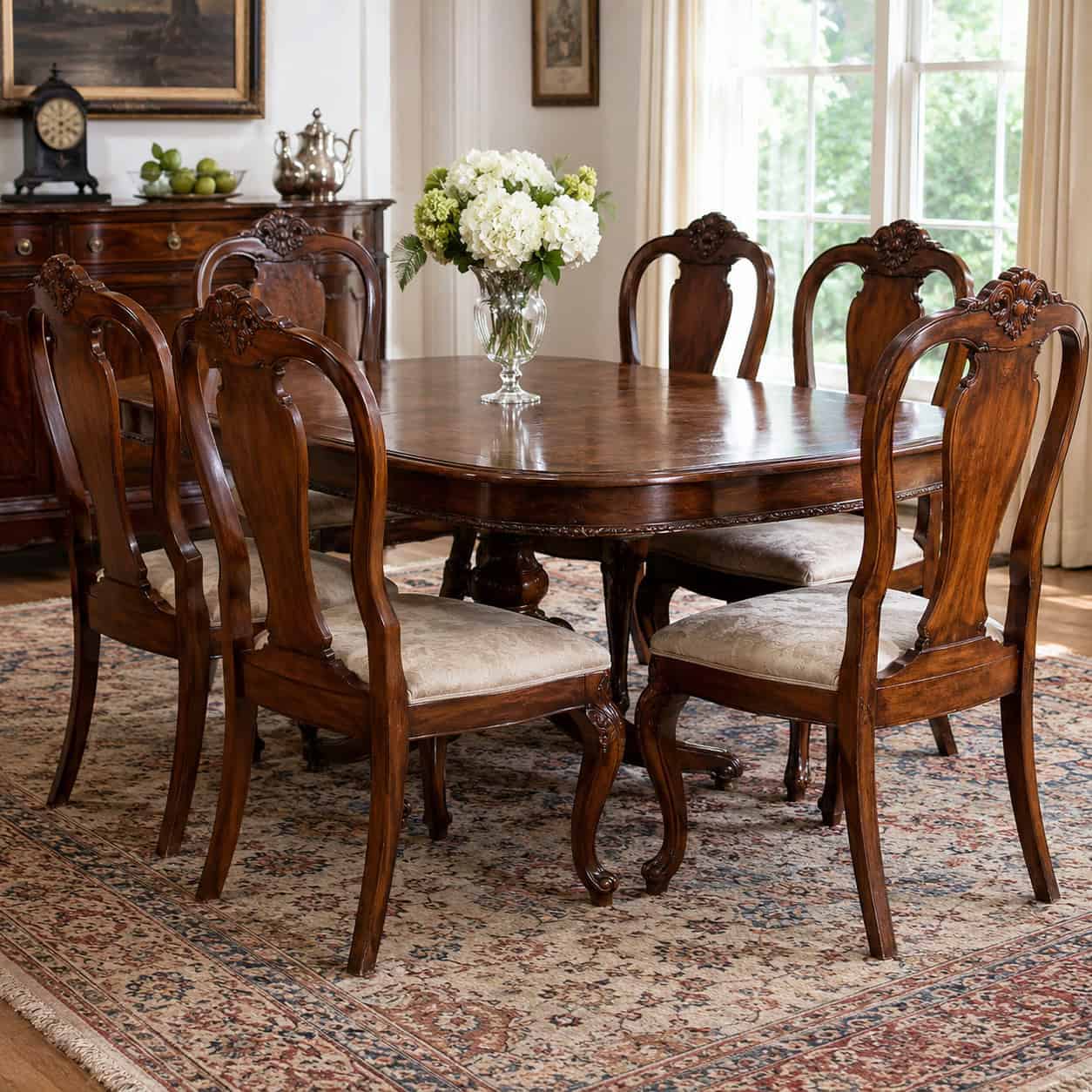
This is one area where value jumps exponentially rather than just adding up piece by piece.
Six matching period dining chairs sell for dramatically more than one-and-a-half times what four chairs bring, because six seats a table properly and four doesn’t. Eight chairs is another leap up entirely — and the same math applies to a full bedroom suite or a dining table with every original leaf still tucked in the closet.
Always sell the complete group together rather than the odd pieces alone.
| Complete Set | Broken Set | |
|---|---|---|
| Dining chairs | Six or eight matching | Four or five left |
| Buyer pool | Collectors and dealers | Casual resale only |
| Table leaves | All originals present | One missing or replaced |
| Bedroom suite | Bed, dresser, mirror, nightstands | Dresser sold separately |
| Relative value | Premium pricing | Steep discount |
Don’t sell two extra chairs at an April yard sale and the rest that September — splitting the set that way guarantees you’ll get less overall.
24. Search the Back and Underside for Maker’s Marks

Nothing multiplies value quite like confirmed attribution — “confirmed maker” versus “in the style of” can be a thousand-dollar difference in wording alone.
Check five spots: the back panel, drawer bottoms, underside of seat rails, inside top of a case, and the back edge of a mirror. Use a flashlight and read at an angle, since faded ink often shows up better in raking light.
Mid-century date stamps typically read week-then-year. Even a brittle, half-torn paper label still counts for something — photograph it immediately before it flakes away completely, as Mod City Madness advises for anything headed to market.
25. Check a Hoosier Cabinet for Its Sifter and Enamel Top

Anyone over fifty practically smells this one from the photo — white or green paint, a pull-out porcelain enamel work surface, and a tin flour bin with a hand-crank sifter built into the upper cabinet.
These date roughly from 1900 to 1930, back when kitchens had no built-in cabinetry and a single freestanding unit had to handle everything.
Values stay soft unless the accessories are still with it: the sifter, sugar bin, spice jar rack, metal bread drawer, and chip-free original enamel are what serious buyers actually chase.
A bare cabinet with a plywood top and missing bin is a nice-looking shell; the same cabinet with every original part intact is a completely different sale. It’s the same principle covered in old backyard structures worth restoring — completeness drives the price.
Someone rolled out dough on that enamel top nearly every Sunday for thirty years.
26. Spot Pegged Joinery in Aprons, Rails, and Frames

Check table aprons, chair rails, and door frames for small round or square plugs, typically a quarter-inch across or smaller.
These drawbore pegs were driven through the tenon to mechanically pull the joint tight, with glue playing only a backup role. This was standard practice before roughly 1850 and had mostly disappeared by 1900.
Here’s a nice detail: many pegs now sit slightly proud of the surrounding surface, pushed outward over 150 years as the wood expanded and contracted around them. Run a fingertip across one and you’ll feel it stick up.
27. Look for Danish Teak Stamped With Its Control Brand

Turn the chair over and check for a round burned brand reading “Danish Furniture Makers Control,” “Made in Denmark,” or a specific cabinetmaker’s stamp.
These pieces feature solid teak, sculpted edges, and an oiled finish that soaks up oil and glows for weeks — typically dating from about 1955 to 1975.
While traditional “brown furniture” prices sank for two decades, this segment moved the opposite way. A four-chair set of stamped Danish dining chairs isn’t garage-sale material by any measure.
28. Study Secondary Woods Like Poplar, Pine, or Chestnut

Cabinetmakers of the period were economical: mahogany and walnut showed up on visible surfaces, while drawer sides, backboards, and dust boards got cheaper poplar, pine, chestnut, or tulipwood.
That variety is actually the tell — a single species used throughout the piece usually signals later factory production, and any plywood or particleboard in the carcass sets a firm modern date.
Secondary wood can even hint at regional origin: chestnut and poplar suggest Mid-Atlantic or Southern origins, white pine points to New England, and Beauchamp Antiques treats this as a foundational authentication step.
29. Check for the Stickley Red Decal and “Als ik kan” Motto

Heavy, plain, square oak furniture is a classic sleeper — unassuming on the surface, valuable underneath.
Look inside a drawer, along a back rail, or under a seat for a red decal in the shape of a joiner’s compass bearing the Flemish motto “Als ik kan” (as best I can) — that’s Gustav Stickley, produced roughly 1901 to 1916. A branded mark or paper label counts just as well.
Marks from L. & J.G. Stickley, Limbert, and Roycroft all add their own premiums. A $150 side table can turn into a four-figure piece on the strength of a single decal, which is why The Hoarde‘s guide to makers’ marks beats guessing at style every time.
30. Reconsider That “Outdated” 1960s Walnut Credenza

This is the piece that most often ends up at the curb.
A low, dark, plain walnut dresser that’s sat in the basement since 1988, or an end table with a checkerboard top resembling a chessboard made of dovetails — families toss both because they just look dated.
Broyhill Brasilia debuted in 1962, identifiable by arched, sculpted pulls and a distinctive scalloped apron. Lane Acclaim launched in 1958, and its inlaid oak-and-walnut top is instantly recognizable once you know what to look for. Both names rank among the most-searched vintage furniture terms online today.
Lane stamped a backward-reading date code inside a drawer — “6 20” translates to the twentieth week of 1962.
A single Acclaim end table in decent condition has no business ending up free on the curb.
Before You Load Anything Into the Truck
Grab a flashlight and pull open one drawer. That’s really all it takes to start — most of what separates an $80 piece from an $8,000 one is hiding on surfaces nobody was ever meant to examine.
If there’s just one rule worth carrying forward, it’s this: don’t strip anything. Scratches, darkened shellac, worn-through paint — all of it is a record of everyone who used the piece before it ever reached you.
Refinishing can always happen later. Undoing a refinish never can.
Go pull open that drawer. There might be a note waiting for you.