

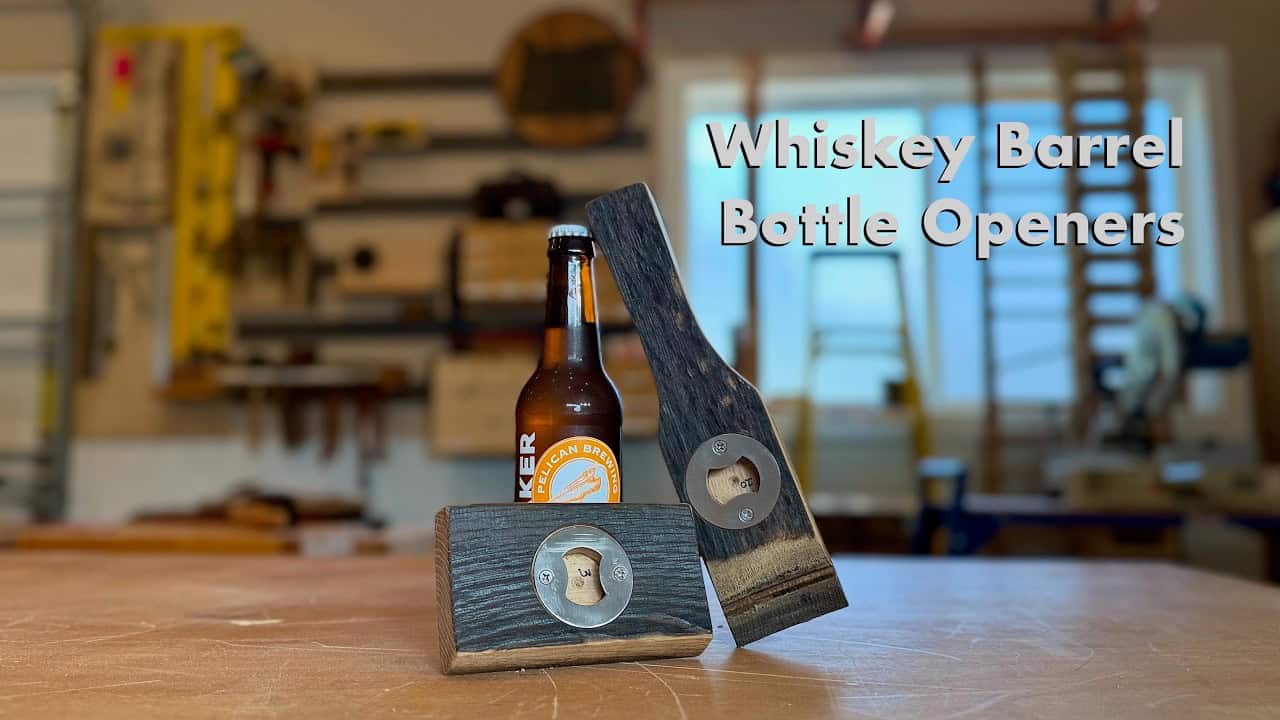
This project was built and designed by Mike from Oregon Makers.
This build takes reclaimed whiskey barrel staves and turns them into functional, one-of-a-kind bottle openers. Each piece retains the natural char, grain, and patina of the original barrel, making every opener slightly different from the next.
Watch the full video and subscribe to Oregon Makers:
Sourcing and Prepping the Staves
Mike works from a personal stockpile of whiskey barrel staves, which he had already partially cleaned by removing most of the char left over from the barrel-making process. Before shaping anything, he cleared away leftover debris and cobwebs from long-term storage.
Rather than following strict measurements, he sets his cut length based on feel, using a stop block on his saw to keep things consistent across each piece. He also repurposes offcuts from the middle sections of the staves, giving him more usable material without waste.
Designing on the Fly
Instead of working from a fixed plan, Mike develops the shape of each bottle opener as he goes. He starts with one fixed reference point, the metal bottle opener insert, since its size dictates part of the layout.
From there, he uses a center-finding ruler to strike a centerline down each stave, helping him keep the design symmetrical despite the curved, tapered nature of the wood. He pays close attention to how the handle blends into the top curve of the stave, aiming for a smooth transition so the piece feels comfortable no matter how it’s held.
Marking curves directly onto the charred wood proved tricky, since regular pencil lines are hard to see once the piece is under the bandsaw’s lighting. Even so, he works through it, cutting smooth, gentle curves that give each opener its organic, one-of-a-kind shape.
Shaping and Sanding
Once the basic shape is cut, Mike moves to shaping the curves and refining the profile at the bandsaw. All of the leftover scraps get saved in a bucket, which he later passes along to a friend who uses them for smoking food, a nice way to keep even the smallest cutoffs from going to waste.
Sanding is done entirely by hand, particularly the areas people will actually touch. He’s careful not to sand too aggressively, since the goal is to remove the roughest fibers without stripping away the natural patina the barrel wood carries. The staves are left unfinished, relying on the durability of white oak to hold up on its own.
Dealing with Imperfect Stock
According to Mike, the most challenging part of the entire project is working with the staves themselves. None of the boards are straight, flat, or square, since they were originally shaped to curve around a barrel.
Every edge is tapered rather than parallel, which complicates drilling and assembly. To manage this, he uses shims to level pieces out before drilling, easing into each hole slowly and checking for square along the way.
Drilling and Assembly
Mike drills a hole matched to the thickness of the hardware being inserted, ensuring the bottle opener mechanism sits at the right depth. A second hole is added in the center to give the top of the bottle somewhere to go once the opener is in use.
For the smaller holes, he switches to a drill press and clamps the piece for accuracy, cleaning up the edges left by the Forstner bit beforehand. Each finished piece is labeled with a marker, since Mike photographs every individual opener for his website. That way, customers ordering online receive the exact piece pictured rather than a similar but different item.
When it comes to assembly, the density of the white oak makes driving screws difficult, so wax is applied to the screws beforehand to ease the process. A Vix bit helps keep everything centered and square during final assembly.
Bringing It All Together
After a couple of days of work, the barrel stave bottle openers are ready for display. Mike even built a small rack to showcase them, since he plans to sell the finished pieces both in his shop and online.
This project is a good example of how reclaimed materials with character, like charred barrel staves, can be turned into practical, sellable items without needing perfectly uniform stock. It also shows how working through imperfections in reclaimed wood can still lead to a clean, functional final product.
Check out Mike’s Shop here: https://www.oregonmakers.com/shop/available-now.

Matt’s Take
These are my personal thoughts and tips based on my own experience in the shop. This section is not written, reviewed, or endorsed by the original creator of this project.
Working with barrel staves like this is a fun change of pace from milled lumber, but it comes with its own learning curve. Since nothing is flat or square to start, I’d suggest taking your time at the bandsaw and letting the shims do their job rather than forcing the piece through. A little patience here saves a lot of headaches on the drill press later.
White oak is a great choice for something that’s going to see repeated use and moisture, like a bottle opener. It’s naturally rot and moisture resistant, which is exactly why it’s used for whiskey barrels in the first place. Leaving it unfinished is a reasonable call too, especially with that charred patina involved, since a film finish can sometimes trap unevenness or look blotchy on wood with that much natural variation.
One thing worth keeping in mind with charred or dark wood is marking your lines. A regular pencil almost disappears on that surface. A white charcoal pencil, chalk, or even a silver/white paint marker can make a huge difference in visibility, especially once you’re under bright shop lighting at the bandsaw.
Waxing screws before driving them into dense hardwoods is a great habit to build regardless of the project. It reduces friction, lowers the risk of snapping a screw or stripping a head, and it’s cheap insurance for just a few seconds of extra work. A little bit of beeswax or even a candle stub kept in the shop works just fine for this.