

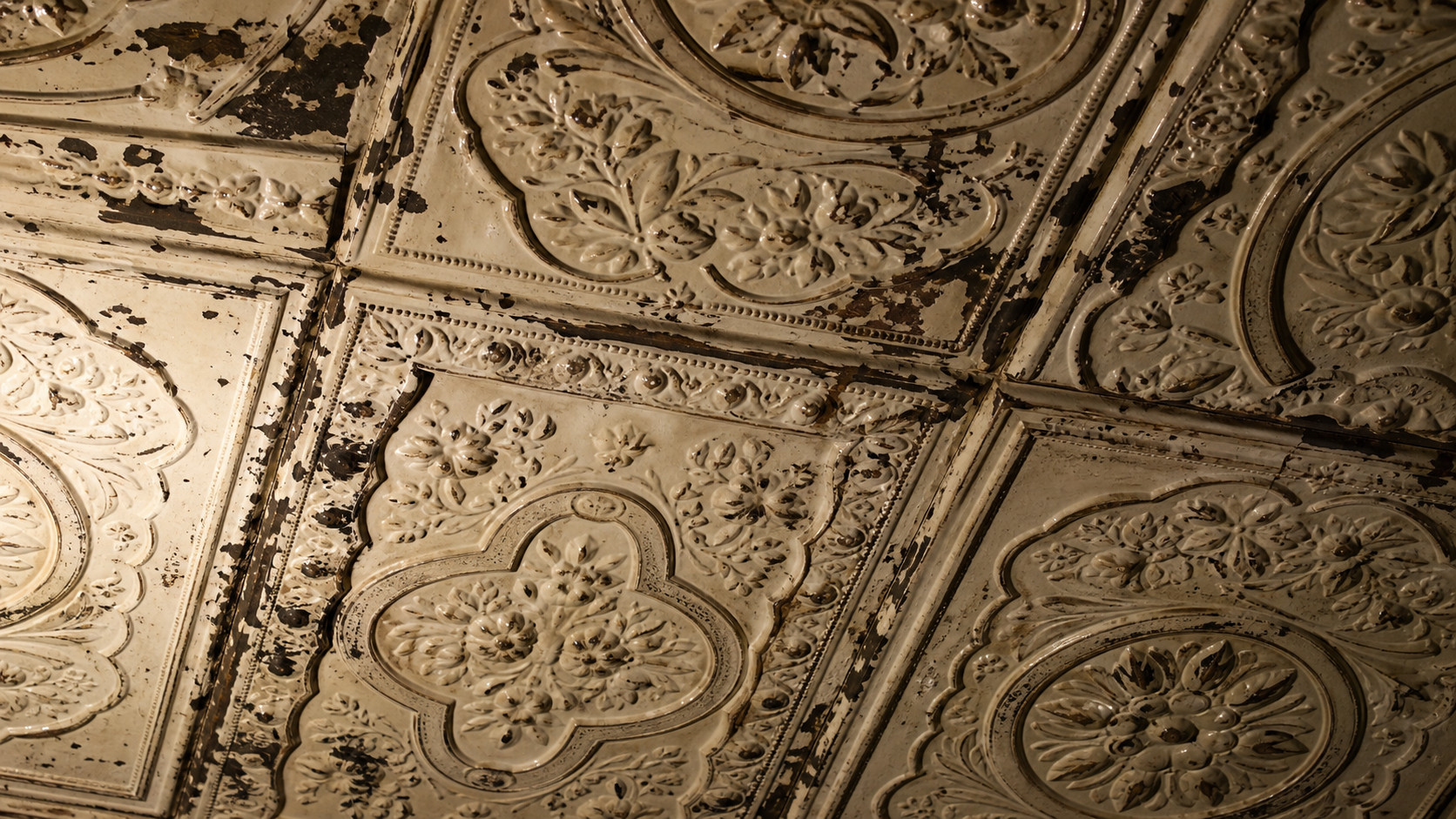
Most people never look up.
They’ll study the floors, the trim, the kitchen cabinets, the foundation cracks. But the ceiling holds some of the most honest evidence in the whole house — and it rarely gets touched once it’s built.
That’s what makes it so useful. A ceiling carries the fingerprints of whoever built it and every owner who tried to modernize it since. The lath behind the plaster, the texture sprayed over a tired surface, the medallion ringed with a century of candle soot — each one is a timestamp.
Learn to read them and you can date a house to the decade without a single deed or document.
Here are 24 ceiling details that quietly tell you exactly how old your house really is.
1. Hand-Split Riven Lath Behind the Plaster
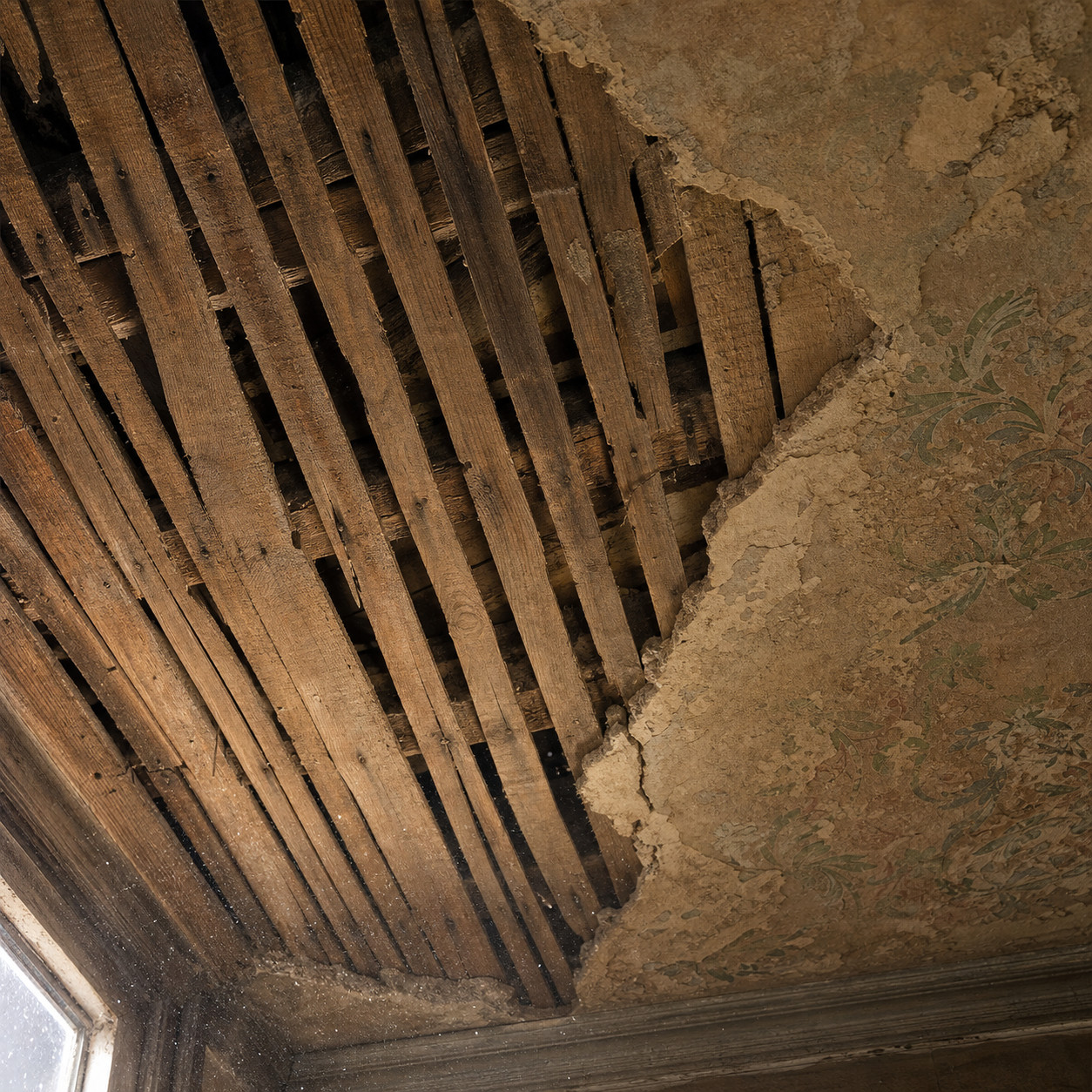
This is the single most reliable age clue hiding above your head.
Riven lath was split by hand, with the grain, from oak or chestnut. The strips come out irregular — random widths, wandering edges, no two alike.
It largely vanished after 1800. So if you pull back a damaged ceiling and find ragged, hand-torn wood instead of neat sawn strips, you’re looking at the 18th century or earlier.
Nothing else dates a house this far back this cleanly.
2. Accordion (Split-Board) Lath

Picture a wide green board nailed flat to the joists. Then a worker hits it with a hatchet in staggered cuts and stretches it open like an accordion.
The gaps it creates become the keys that hold the plaster. Clever, fast, and almost free.
This method took over around 1800 and stayed near-universal until the circular saw showed up. Find it and you’ve bracketed the house to the early 1800s with surprising precision.
3. Circular-Sawn Wood Lath

Water-powered circular saws spread around 1830, and lath changed overnight.
Suddenly the strips were uniform — about an inch wide, evenly spaced, with the curved scoring marks a circular blade leaves behind. Machine-cut and tidy.
This is the workhorse lath of Victorian and early-1900s plaster ceilings. It ran for roughly seventy years. On its own it won’t pin a decade, but it firmly rules out anything earlier than the 1830s.
4. Adamesque Plaster Medallion (Federal Era)

Before Victorians went big, Federal-era homeowners kept it restrained.
Adam-style medallions favored delicate radiating palmettes and a fluted outer ring. Light, symmetrical, almost neoclassical in their calm.
The motif is a period fingerprint. A medallion this disciplined — no fruit, no riotous scrollwork — points straight to the early 19th century.
5. The Soot Ring Above the Medallion

Look for a faint dark halo on the ceiling around the old fixture.
Candles, oil lamps, and gas jets all burned with an open flame, and that flame left soot. Many medallions were even painted a single washable light color just to survive the staining.
That ring is a calendar. It tells you the room was lit before reliable household electricity arrived — generally before the 1910s.
Electricity doesn’t smudge a ceiling. Fire does.
6. Pressed Tin Ceiling
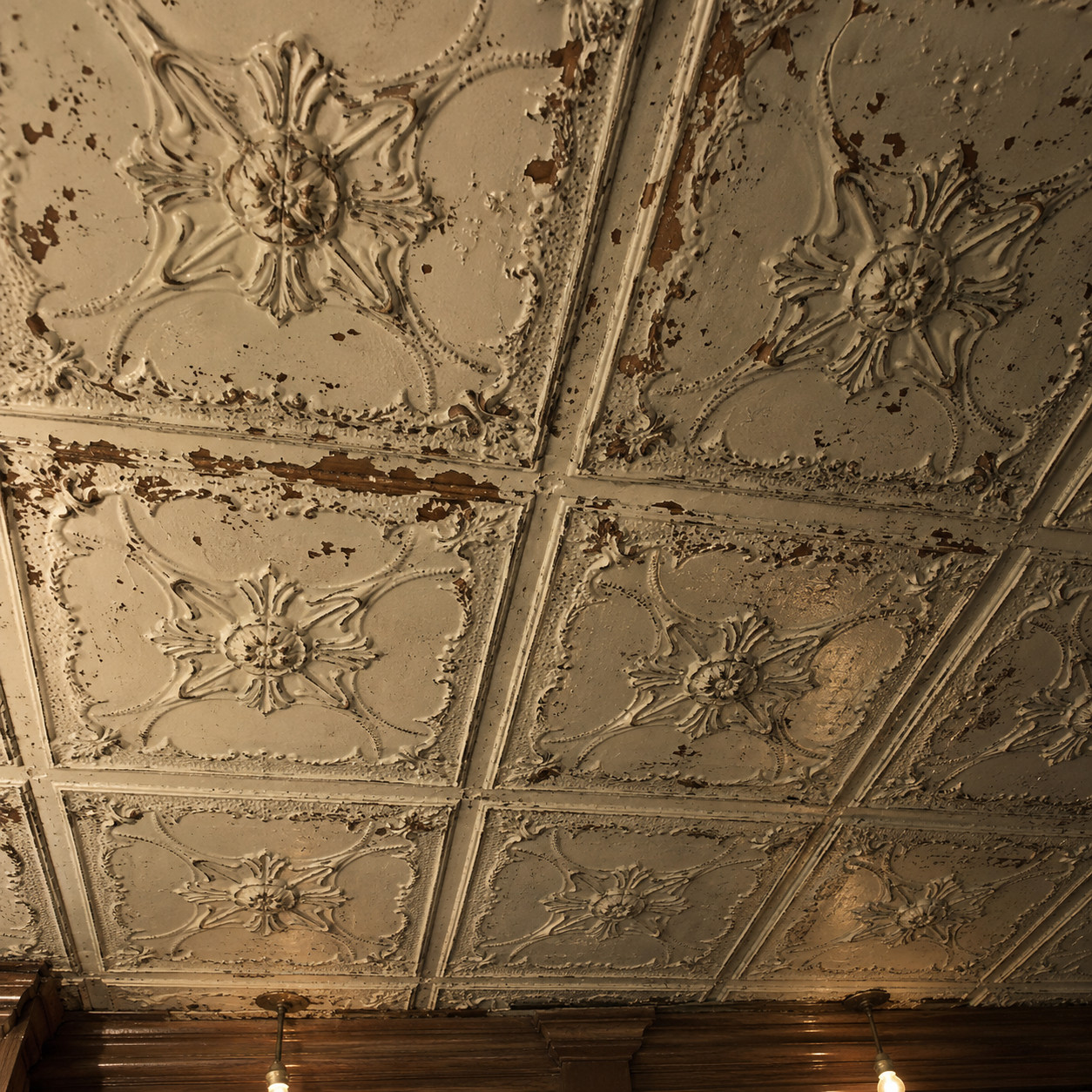
An American invention, sold as a cheap, fireproof answer to expensive European plasterwork.
Stamped tin — really painted steel — let modest homes and storefronts fake the look of carved relief for pennies. It peaked in the 1890s.
Then World War II sent metal to the war effort and the industry collapsed. An original tin ceiling almost always means pre-1940.
7. Beadboard Porch and Room Ceilings

Tongue-and-groove beadboard appears as early as the 1860s and was common by 1880.
The profile dates it. An ornate bead running down the middle of each board reads Victorian. A plain, simple V-groove leans toward the Arts and Crafts and bungalow years.
Check the porch first. That’s where it survived longest.
8. Ornate Victorian Ceiling Medallion

The bigger and busier the medallion, the more Victorian the house.
Layered acanthus leaves, carved fruit, deep scrollwork — these centers peaked from the mid to late 1800s. The style narrows the decade further.
Greek Revival leaf motifs run earlier. Angular Neo-Grec lands mid-century. A more subdued Queen Anne treatment pushes you toward the 1880s and 90s.
Read the leaves and you can almost read the date.
9. Stenciled or Hand-Painted Ceiling

Plain white ceilings are a modern habit.
Decorative ceiling painting revived in the back half of the 1800s and flourished into the 1920s. Arts and Crafts, Spanish Revival, and Beaux Arts homes wore stencils, friezes, and colored stains overhead.
Find a patterned ceiling under the white paint and you’ve found a pre-Depression room. Strip a corner and look.
10. Craftsman Box-Beam Ceiling

Those dark wooden grids in bungalow dining rooms look structural. They usually aren’t.
Most are hollow box beams — built from joined boards and hung for looks, not load. Tap one and it sounds light.
They’re a signature of Craftsman and Mission interiors from roughly 1900 to 1925. Honest materials, careful joinery, no pretending.
11. Coffered Wood Ceiling

A true coffered ceiling is a grid of recessed panels framed by real beams.
It signals one of two things. Either an early high-end Georgian, Federal, or Neoclassical home, or its early-1900s revival in a library or formal dining room.
Either way, this was a statement room. The craftsmanship marks it as the work of an era that paid for it.
12. Tudor Strapwork Plaster Ceiling

Raised, ribbon-like plaster patterns crawling across the ceiling in interlocking shapes — that’s Jacobean strapwork.
Pair it with heavy decorative plaster beams and you’ve got Tudor Revival, which boomed between the world wars.
The medieval motif is a tight timestamp. It points almost exclusively to the 1920s and 30s.
13. Cove (Curved) Ceiling

Instead of a sharp 90-degree corner, the wall curves softly up into the ceiling.
That gentle cove was popular in Art Deco and formal rooms of the 1920s and 30s, often paired with hidden indirect lighting tucked into the curve.
It’s a quiet giveaway. A pre-WWII design sensibility, expressed in a single smooth radius.
14. Popcorn (Acoustic Spray) Ceiling
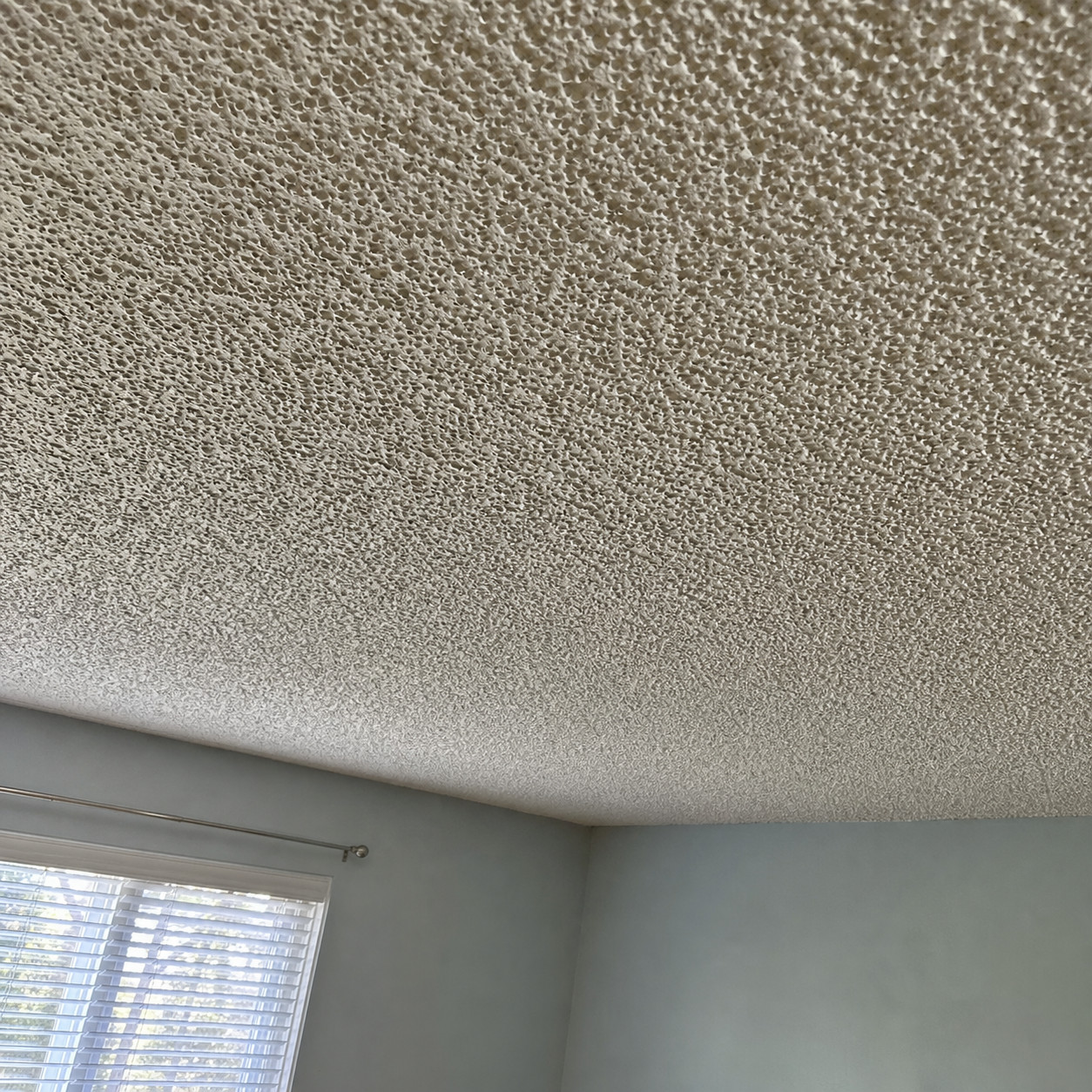
The defining ceiling of postwar America.
Sprayed-on texture hid sloppy drywall work and softened sound, and builders loved it for tract housing from roughly 1945 into the early 1990s.
One warning. Pre-1980 formulas often contained asbestos, so don’t sand or scrape an old popcorn ceiling without testing it first. Test before you touch.
15. Rock Lath (Button Board)

Half lath, half drywall — the missing link between them.
Rock lath came in 2-by-4-foot gypsum panels punched with regular holes so plaster could still key into the surface. In use as early as 1900, it became the standard plaster base by the late 1930s.
Find it and you’ve caught the house mid-handoff, right as the old craft was giving way to the board.
16. Early Drywall / Sheetrock

Gypsum pressed between two paper sheets became the default ceiling after the 1950s.
It replaced lath and plaster almost entirely, and it cracks differently. Drywall splits in straight lines along the seams. Plaster cracks wander in fine spidery webs.
So watch how the ceiling fails. Straight cracks mean postwar.
17. Glue-Up Acoustic Ceiling Tiles

Twelve-inch fiber squares, stapled to furring strips or glued straight onto a tired old ceiling.
This was the classic mid-century facelift — 1950s and 60s homeowners covering cracked pre-war plaster in kitchens and back rooms.
The tiles and their mastic can carry asbestos too. If you’re pulling them down, treat the glue with the same caution as the tile.
18. Suspended Drop Ceiling

The lay-in grid hit usable form by 1961 and became the standard way to hide ducts, pipes, and wiring.
You’ll find it most in finished basements, dropped a few inches below the joists with 2×2 or 2×4 panels resting in a metal frame.
It reads as a mid-century-or-later remodel every time. Lift a panel and you can often see the real, older ceiling waiting above it.
19. Orange Peel and Knockdown Texture

When popcorn fell out of fashion, these took over.
Sprayed orange peel gives a fine, bumpy splatter. Troweled knockdown flattens those bumps into soft mottled patches.
Orange peel peaked in the 1980s and early 90s. Knockdown still dominates new construction. Spot either and you’re standing in a late-century or modern home.
20. Lincrusta or Anaglypta Embossed Ceiling Covering

Embossed, paintable coverings that imitated tooled leather or molded plaster relief.
Lincrusta and its lighter cousin Anaglypta were a high-Victorian and Edwardian flourish, often set in panels between ceiling beams to add richness for less money.
The window is narrow — roughly the 1880s through the early 1900s. A raised, repeating relief pattern that flexes when you press it is the tell.
21. Tray Ceiling

A single recessed center stepped up above the surrounding ceiling, like an inverted tray.
Builders reached for it constantly in dining rooms and primary bedrooms to add a little drama to an otherwise flat box.
It’s a hallmark of late-20th-century construction. Spot a tray and you’re almost certainly in a home built after the late 1980s — or recently remodeled.
22. Vaulted / Cathedral Ceiling

Sloped ceilings that open all the way to the roofline.
This became one of the most popular moves in new construction from the 1970s on, prized for airy great rooms that feel twice their size.
Add skylights or exposed engineered beams and the date locks in further. These belong firmly to the late 20th century and after.
23. Barrel-Vaulted Ceiling

A half-cylinder ceiling — a smooth tunnel of a curve overhead.
This one’s a puzzle, because it shows up twice. Once in 1920s Spanish and Renaissance Revival homes, and again in high-end contemporary foyers and bathrooms.
So read the surrounding clues. Period plaster and old hardware say 1920s. Drywall, recessed cans, and engineered framing say modern luxury build.
The curve alone won’t date it. Everything around it will.
24. Hand-Run Plaster Cornice and Crown Molding

Before crown came in nailed-up wood or foam, a plasterer made it in place.
He’d drag a metal profile template along wet plaster, building the molding up pass after pass until the cornice ran crisp and seamless around the whole room.
You can spot the difference. Hand-run plaster crown has no joints and no nail holes — it flows into the wall as one continuous piece.
That’s pre-drywall craftsmanship. Victorian through the 1920s, made by hand, one room at a time.
Conclusion
No single ceiling detail tells the whole story. Riven lath under a modern tray ceiling just means someone remodeled an old house.
That’s the point. Layers contradict each other, and the contradictions are the history. The oldest clue tells you when the house was born. The newest one tells you when somebody last cared enough to change it.
Start looking up. Your ceiling has been keeping a record this whole time.